Full article about Belinho: Where the River Breathes the Atlantic
Granite cottages, salt-laced pines and a 600-year-old estuary village in Esposende
Hide article Read full article
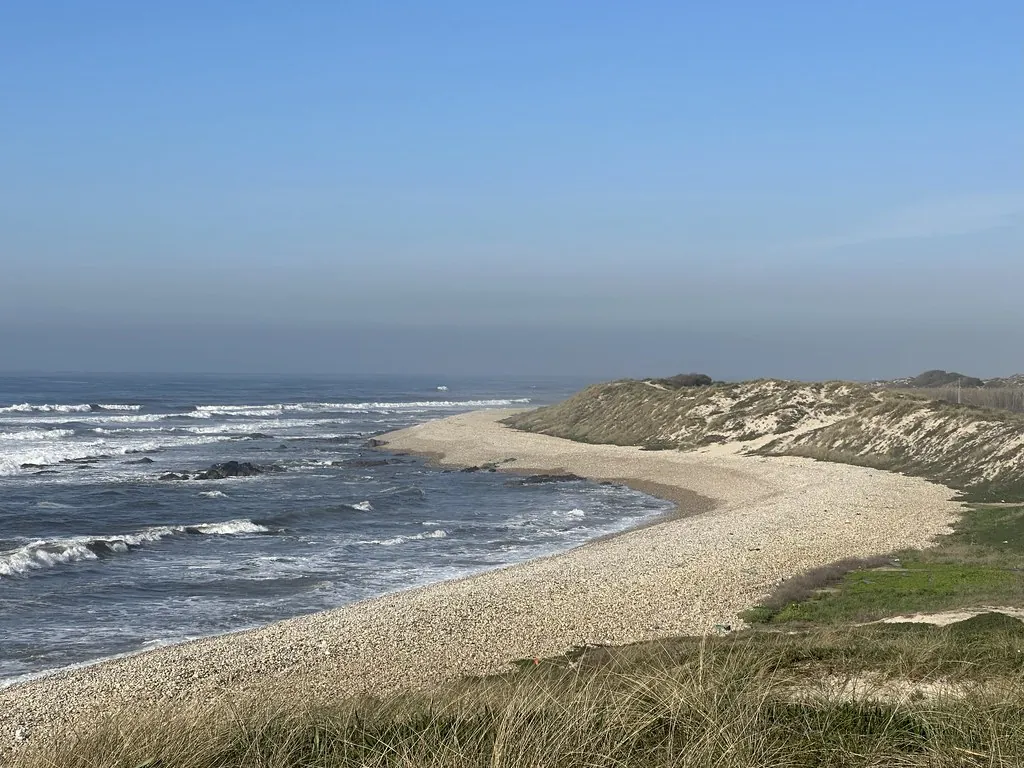
The Atlantic arrives on skin before it reaches the eye. Salt, iodine and sun-warmed pine ride the same breeze that rattles the needles of the coastal forest. Where the River Belinho bends for the last time and slips into the breakers, the village perches on a low bluff—granite, sand and dune stitched together by 600 years of wind.
Stone that remembers
Above the cottages, the parish church surveys the estuary with nineteenth-century composure. Neoclassical pilasters, stone urns and a curved pediment frame a statue of St Peter; the granite base is the colour of wet sand, the walls above it whitewashed to a glare. Inside, gilded baroque retables drink the light falling from high windows, while the revivalist high altar heaves with carved cherubs and swirling foliage. In the forecourt an eighteenth-century stone cross—arms fissured by Atlantic gales—keeps vigil over the valley that drops to the sea.
Belinho already existed in 1135, when Portugal’s first king donated these lands to the archbishop of Braga. The name is thought to echo a Roman estate owner, one Bellius, whose villa may lie beneath the present settlement. On Monte Castro, ten minutes above the lanes, the circular footprints of Iron-Age huts and rock-cut silos are still visible within the ramparts of a pre-Roman castro. From here the ocean is an uninterrupted blade of mercury, the horizon stitched white by surf.
The saint born of a mix-up
Every 1 August the village honours São Pedro Fins—an accidental saint created when medieval tradition folded two separate feast days into one. Processions, brass bands and a river-borne flotilla of painted boats converge on the beach, where a wooden barca carved by local carpenters is blessed in the shallows. The Atlantic is not scenery here; it is nave, altar and aisle.
In 2024 the same sea surrendered a pair of sixteenth-century bronze cannon, probably from a Carrack wrecked on the shoals offshore. Archaeologists have been working the site since 2014, recovering shards of Ming porcelain and peppercorns that speak of a long-buried spice route between Lisbon and the Indian Ocean.
Salt, fish and vinho verde
The day’s catch dictates lunch: line-caught sea bass, scarlet mullet simmered with potato and coriander, or a caldeirada thick enough to stand a spoon in. On summer evenings the air turns smoky with sardines, their skins blistering over cane and pine-cone fires. Locals pour vinho verde from neighbouring Amarante—sharp, lightly effervescent, the perfect blade to cut the oil of charred fish. No protected designations are stamped on the menu; proximity to the dock is credential enough.
Dunes, trails and wings
Behind the beach, the North Coast Natural Park shelters shifting dunes, fossilised cliffs and the reed-fringed estuary where herons, redshanks and yellow-legged gulls trade insults above the water. The Coastal Camino threads through the village, delivering pilgrims to the sound of surf in their boots. A small municipal campsite, shaded by maritime pines, sits two minutes from the tideline; night-time is a mix of salt on the lips, needles underfoot and the Atlantic drumming in the dark.
When the sun drops, orange light washes across the granite and the cliffs glow like embers. The bell tolls the ave-marias, its bronze note rolling down the valley until the ocean swallows it whole.