Full article about Curvos: Gold-Leaf Altars & Pine-Scented São João
Baroque splendour, frog pastries and flaming midsummer pines in Esposende's hidden hill parish.
Hide article Read full article
A baroque altarpiece and the scent of pine
Inside São João Baptista, the parish church of Curvos, 600 g of gold leaf flickers over a 1743 altarpiece carved by Porto's José de Sousa and regilded in 1952. Below it, 18th-century azulejos from the workshop of Bartolomeu Antunes freeze two moments in John the Baptist's life: his head presented on a platter on 29 August, and Christ's baptism on the banks of the Jordan. Step outside and the Atlantic breeze carries resin from maritime pines and the coconut-cust smell of blooming gorse along the compacted-earth tracks that lace together 28 tiny settlements.
Curves and rivers
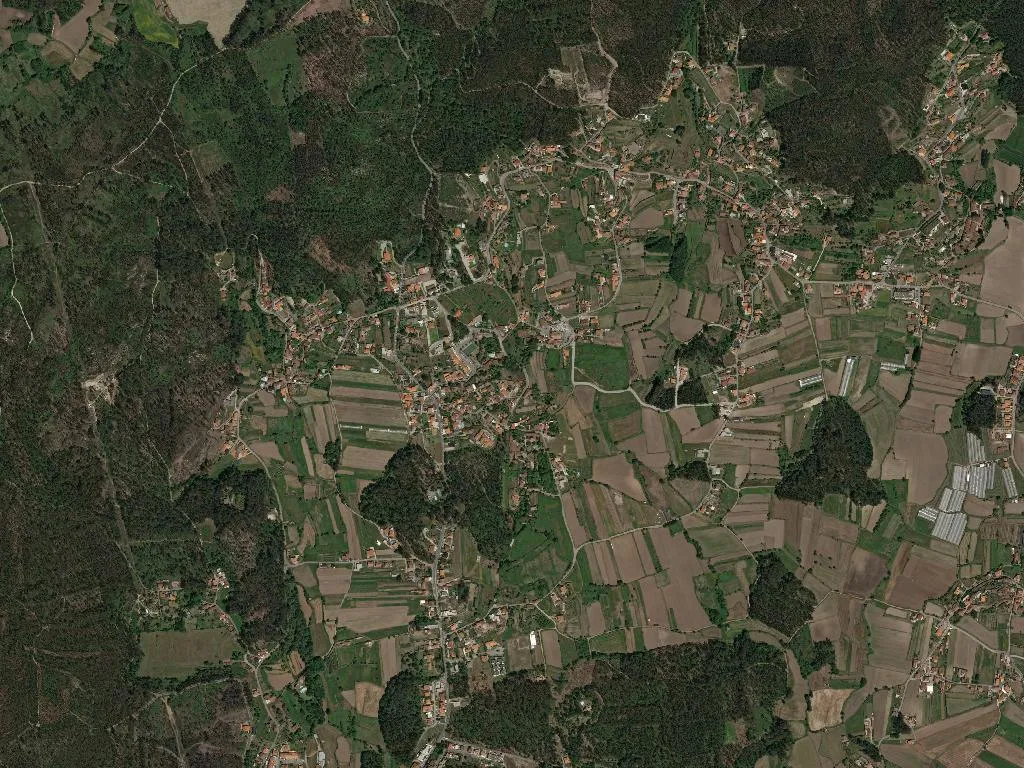
First recorded as "Curvos" in King Afonso III's 1258 royal survey, the name nods to the sinuous São Lourenço stream. The land rolls between 60 m and 160 m, gashed by five rivers – São Lourenço, Rego das Casas, Rego de Vide, Rego do Porto and Rego de Telhado – that slice steep valleys down to the Cávado. Since 2008 the parish has sat inside the North Coast Natural Park, shielding 180 ha of salt marsh and dunes at the river mouth 8 km away.
The Coastal Way of the Camino de Santiago slips into Curvos over the medieval São Lourenço bridge – a 1.2 m-wide granite slab dated 1627. From here it's 8.3 km to the Marinhas boundary, passing the 16th-century chapel of São Sebastião and Vide's watermill, last turning its wheel in 1956. Yellow-and-blue waymarks, refreshed by the Cávado municipal association in 2019, guide walkers through orchards and smallholdings.
São João, frogs and verses
The nearest Sunday to 24 June belongs to São João. A sung mass at 11 a.m. is followed by a procession squeezing through the alleyways of Lugar do Cima, then twelve bonfires consume 2.5 tonnes of pine between 9.30 p.m. and dawn. The star pastry is the "Curvos frog", invented in 1892 when baker Doroteia da Silva swapped her usual São João buns for puff-pastry amphibians stuffed with 200 g of egg-yolk jam. Three thousand are produced each festival weekend, sold at €2 apiece.
Health-restoring Nossa Senhora da Saúde is honoured on the second September Sunday. Worshippers leave the mother church at 3 p.m. and climb 2.5 km to her 1695 chapel perched at 142 m, rosaries clicking like cicadas. Winter ends with Entrudo, a home-grown Shrovetide that survived Esposende's 1834 Carnival ban; masked villagers pace the lanes two metres apart, trading improvised verses learned from their grandparents.
Smokehouses and vinho verde
Meio's communal smokehouse has perfumed the parish since 1923, hanging up to 200 chouriços for a month over sweet-chestnut embers. At table, turnip soup is made with the local "Curvos" variety grown on 100 m terraces; sarrabulho rice uses January pig's blood whisked with Loureiro white; the signature "Curvos roast" layers 48-hour-soaked salt-cod with floury "bola" potatoes, baked three hours in a wood oven. The accompanying vinho verde is the 2023 Loureiro from Quinta da Lagoa in Ponte de Lima, bottled at 11 %.
Flax, corn and communal ovens
On the second Saturday of every month the wood-fired oven at Sítio da Padaria is lit at 6 a.m. The last bakery closed in 1987, yet D. Lurdes still bakes 12 kg of "yellow giant" cornmeal ground at Marinhas mill. Seven farmers keep the Flax Route alive, sowing 2.8 ha in March and pulling 1.2 m stalks by hand in July. Threshing is done with a 30 cm cork mallet, a tool unchanged since 1920. Five stone granaries remain in Lugar do Cima; the oldest, dated 1894, still bears the Gomes family mark. With 36 inhabitants per km², Curvos is Esposende's second-sparsest parish – silence enough to hear the flax dry.