Full article about Salt-wind hymns of Marinhas, Esposende
Where Atlantic gales, salt-pans and whitewashed chapels shape daily life
Hide article Read full article
The Atlantic Has the Final Word
The wind arrives without introduction, flinging salt so fine it settles on pine needles like frost. In Marinhas the horizon is not a line but a chord: the Atlantic drums one note, the dunes whistle another, and the space between vibrates in your ribcage. Mid-day light is rinsed in sea-spray, bleaching the sky until it matches the white glare on the breakers and turns the inland lettuce plots an almost violent green.
Salt on the Tongue
The parish name is documentary evidence, not poetry. Marinhas comes straight from the Latin marina, a receipt for the shallow salt-pans that once covered these thirteen metres of altitude. In the seventeenth century evaporating seawater was the local currency; today the parish crest still balances a white salt-mound against a blue waterwheel and a green pair of scales — agriculture, milling, saliculture locked in heraldic negotiation. Walk the Abelheira lane and you meet the abandoned mills themselves: stone collars choked with briar, the wheelshafts seized mid-rotation as if an invisible hand had yanked the river away.
Chapel-to-Chapel Sociology
Territory here is measured in saints. Every hamlet keeps its own: Our Lady of Health, Our Lady of the Snows, St John, St Roch, St Sebastian, St Benedict. Tiny whitewashed rectangles with granite porches, they operate like rural social clubs. Inside, dark wood, ex-voto hearts and the cold wax smell of last week’s candles tell you who prayed for what; outside, the Atlantic glare slams the door behind you. The mother church of St Michael has the spire, but the chapels have the gossip.
Between River Mouth and Ocean
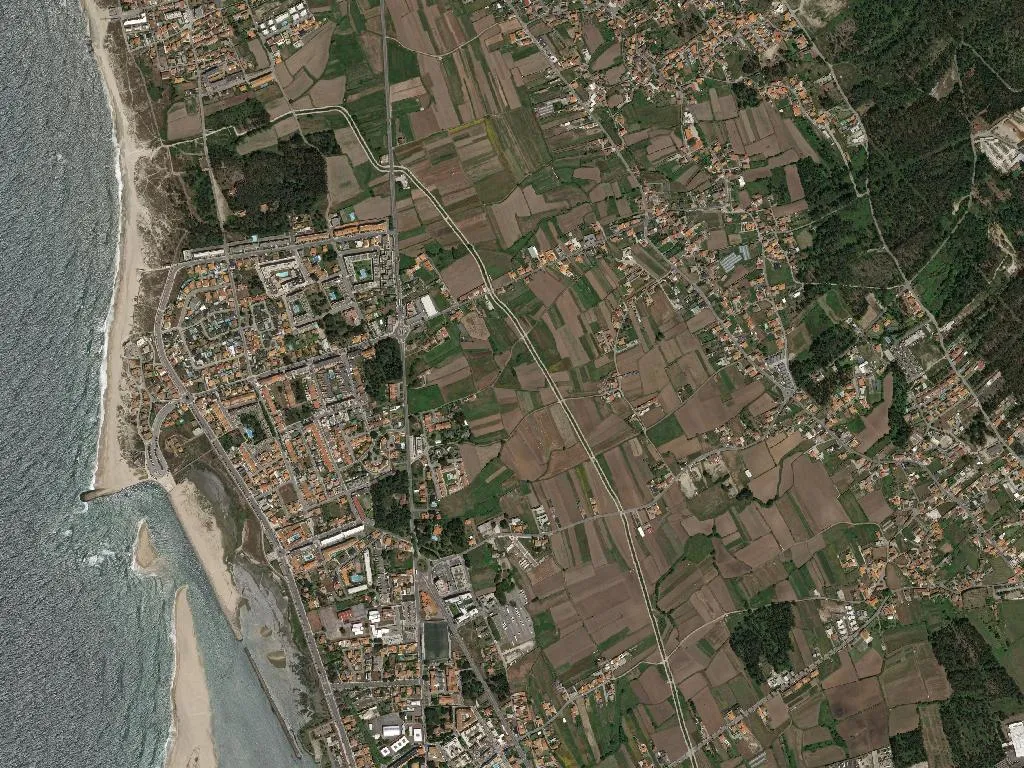
The river Cávado slips into the sea under the watch of the Forte de São João Baptista, a coastal bulwark built in 1699 to keep out whoever the Atlantic was delivering that century. These days its battlements oversee first cigarettes and first break-ups rather than privateers. Up-coast, the Peralto stream trickles into Rio de Moinhos beach, a scallop of sand and rolled pebbles where north-westerlies groom dependable surf and locals still park for free. Southwards, Marinhas beach lies inside the North Littoral Natural Park and the Natura 2000 grid; the agricultural plain simply falls into dunes, no preamble, and the dunes fall into ocean the colour of wet steel.
Pilgrims, Folk Dancers and Lettuce Farmers
The Coastal Camino cuts straight through parish fields, waymarkers guiding backpacks towards Santiago 190 km north. Walkers share the tarmac with tractors heading for the packing plant; both parties smell ocean even when they can’t see it. Meanwhile the village folk groups, As Moleirinhas and Danças e Cantares, rehearse the dances your Portuguese grandmother would recognise: drum, triangle, voices that sound as if they’ve gargled with the same iodine as the wind. June brings São João bonfires and sardine smoke; September’s São Miguel procession sets rockets ricocheting off whitewash while the village joker — inevitably nicknamed “Noise Joe” — repeats the joke everyone already knows.
Passing Through, Staying Put
With 146 registered lodgings (everything from a surfer hostel to aluminium-clad villas rented by Dutch families), Marinhas has learnt the choreography of seasonal tides: winter population 4,087; August population anything the sewage system can take. Yet density never feels claustrophobic: farm strips act as green lungs between houses, and at dawn you can still meet neighbours cutting lettuce before the factory shift. Evening is the moment the parish proves its bargain with the Atlantic: light tilts, wind drops a notch, and the wave-roar sharpens into individual cymbal crashes. The mills, the chapels, the lettuce, the saints — everything stands in that acoustic and answers back with salt, wind and memory.