Full article about Agrela e Serafão: Fafe’s smoke-scented uplands
Oak-smoked ham, chestnut honey and stone hamlets above Fafe
Hide article Read full article
A Slow Smoke of Chimneys
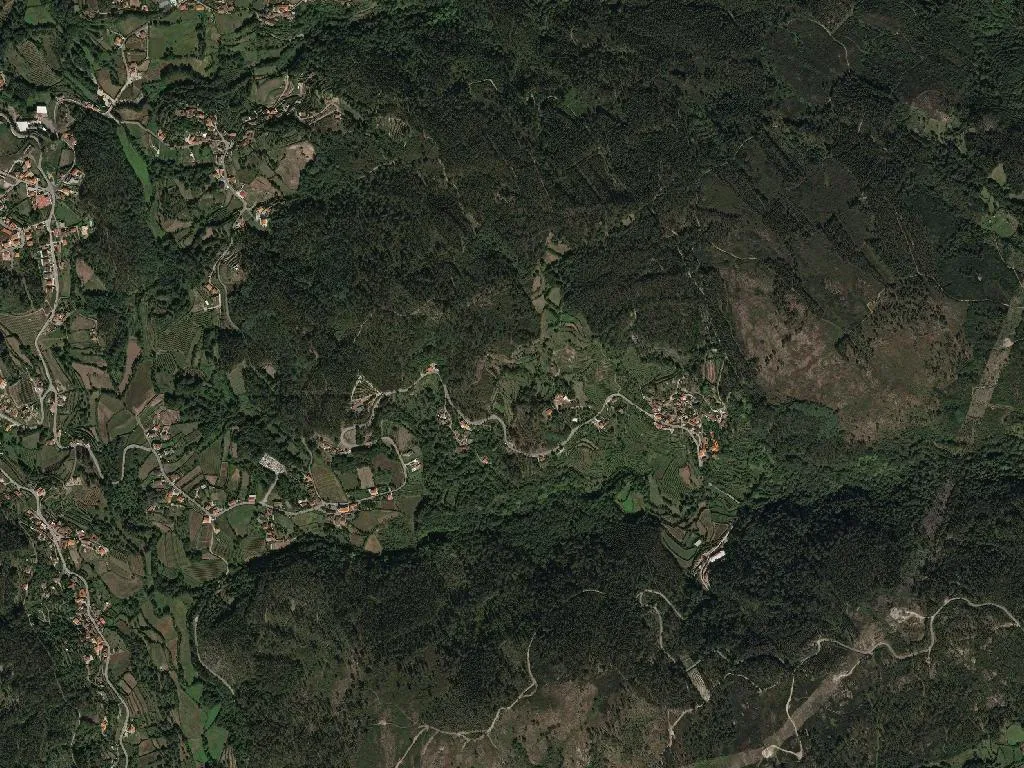
The smoke rises slowly from the chimneys, dispersing among the oaks that still hold the last leaves of autumn. Here, in the civil parish of Agrela e Serafão, 345 metres above sea-level, the air smells of split oak and wet loam—the exact fragrance that exists only where forest presses against vegetable plots and rush meadows. A cow lows somewhere out of sight; a dog barks once, the sound ricocheting off schist walls. You are standing in the agricultural core of Fafe, 919 hectares of pine ridges and tiny, geometric fields stitched together by dry-stone walls.
Roots that reach the tenth century
Agrela is one of the oldest parishes in the municipality. A charter from the county’s monastery of Rendufe, dated 961, lists ‘Agrella’ among its dues in rye and pigs, proof that this upland pocket was already cultivated a millennium ago. The name itself derives from the Latin ager, land that is worked; the local patrimony is the cult of Santa Cristina, whose small stone church, rebuilt in 1697, still anchors the village. Serafão, absorbed during the 2013 administrative merger, was historically a scattering of lugares—hamlets whose populations rarely exceeded fifty. Each keeps its own bread oven and smoke-house, so identity is hyper-local: you belong to Carvalhal, Carvalhas or Outeiro long before you belong to a council.
Where meat and honey taste of altitude
Industry never arrived. The economy is pasture-based: slow-growing Barrosã cattle, identifiable by their lyre-shaped horns, graze the common land; their DOP-labelled beef appears on the block at the weekly market in Fafe every Saturday. Between April and July, hives are carried up to the chestnut canopy; the resulting Mel das Terras Altas do Minho DOP is dark amber, tasting faintly of heather and chestnut blossom. Small south-facing terraces, too cramped for tractors, still support vines trained on granite posts—perfect for the bright, low-alcohol Vinho Verde that cuts through the richness of local chouriço.
Daily rituals that outnumber the people
There are 1,208 residents on the books, but only 128 are under fifteen. Walk the lane that links Agrela to Serafão and you will meet a beret-capped man wheeling a barrow of birch logs; he will nod but not stop—conversation is for after dark, when the day’s labour is done. Women peg washing in vegetable gardens where chickens scratch between kale plants. Shutters are painted the regulation Minho green, but paint fades quickly in Atlantic rain; time is measured by the clang of the church bell at dawn, noon and vespers, and by the weekly thud of bread dough being kneaded in the communal forno.
Festas that stitch the parish together
During the municipality’s main festa, held in the first week of September, Agrela and Serafão empty into Fafe’s main square. There are no processional giants or fireworks over the river; instead, trestle tables appear outside the social club, grilled sardine smoke drifts down Rua do Comércio, and a pimba band plays hits from the 1990s. Emigrants—mostly builders who spent decades in France—fly home, their suitcases crammed with calissons and stories. For three nights the population density feels almost urban, and every granite step hosts a cousin you did not know you had.
What remains when you leave
Evening light slants across whitewashed façades, turning them the colour of pale honey. There are no classified monuments, no castle keeps or Romanesque portals within the parish boundary; those lie further east, towards Guimarães. What remains is more intimate: the hiss of honey leaving the comb, the elastic crumb of rye bread pulled from the wood oven at six in the morning, the echo of your own footsteps on a dirt lane where the only other sound is the wind moving through maritime pines. When the six o’clock bell stops vibrating, you notice how absolute the quiet is—and how slowly the smoke still rises from the chimneys you have already forgotten.