Full article about Airão São João
Waist-high Vinhos Verdes pergolas, 1892 bell & 1515 charter stones in 278-ha parish
Hide article Read full article
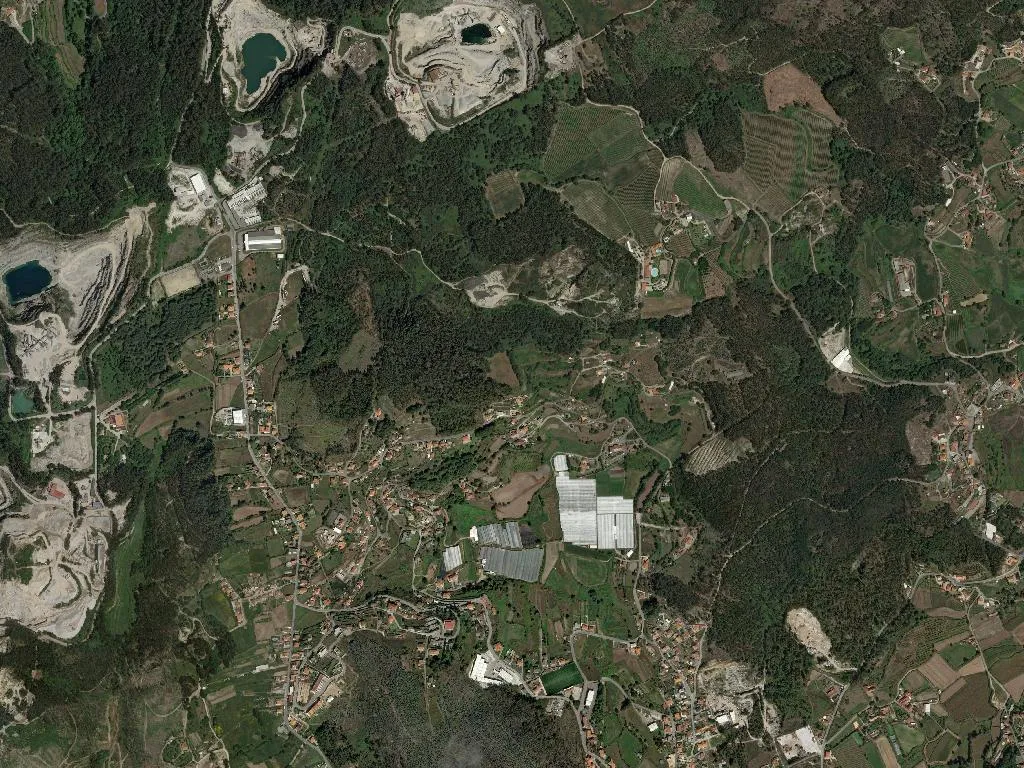
The bronze bell, cast in 1892, is the first thing you hear. Its pulse rolls down the valley of the River Ave and collides with the Ribeira de Airão, a stream that slips off the 430-metre ridge of Santa Luzia and threads past Airão São João at 344 metres above sea level. Granite extracted from the Candoso quarries defines the place: loose-stone walls parcel the hillsides into 200–500 m² plots, subdivided since the 1515 royal charter. The parish covers only 278 hectares, yet the parish archive—housed in the village social centre and running from 1643 to 1930—still hasn’t caught up with the stories embedded in every stone.
The geography of those who stay
1,607 people (2021 census) share a density of 578 inhabitants per km²—double the municipal average—yet the lane never feels crowded. It feels continuous: houses strung along the EN309, back gardens still planted with the same Galician cabbage Dona Albertina’s grandmother sowed in 1950, cornlofts where white maize from nearby Santo Tirso dries in twelve-row grids. Ageing is tangible: 359 residents are over 65 (22.3 %), only 152 under 15 (9.5 %). You notice it at 08:30 in the queue outside Padaria São João (trading since 1978) and in the deliberate snip of Joaquim Cerqueira’s secateurs as the 82-year-old prunes 350 vines on his 0.7-hectare patch.
Seven and a half kilometres from UNESCO-listed Guimaráes, Airão São João is no dormitory suburb; it is a buffer. When the world heritage inscription landed in 2001, land prices here jumped from €8 to €45 per square metre. Locals clock in at São Paio industrial estate, children attend the combined primary-secondary school in neighbouring Airão Santa Maria, but evenings are spent where postcode 4805-126 still lists 64 % of voters with surnames that appear in the 1900 parish seat.
Wine, beef and memory
Forty-two hectares are registered under the Vinhos Verdes DOP. The pergolas are kept waist-high—1.2 metres—so pickers still spend the third week of September on their knees. Schist-granite soils veined with quartzodiorite, 1,400 mm of annual rain and a 15 °C diurnal swing give a light 11.5 % wine with a bright 7.5 g/dm³ acidity. In the 1962 communal winery—143 members at opening—fourteen 1,500-litre chestnut barrels age the parish’s singular “Airão de São João” for six months before bottling.
Barrosã beef arrives from the municipal abattoir at Vila Nova de Famalicão, yet the 23 restaurants in Guimarães know that locals can spot a purebred from a cross-breed by the colour of the fat. On 14 January (São Torcato) and 3 May (Festa das Cruzes) eight 18- to 24-month-old steers feed 2,000 people; oak smoke rises from six in the morning beside the chapel of Nossa Senhora da Conceição.
Between devotion and the everyday
The São Torcato pilgrimage begins the Sunday before the saint’s day, when 150 men shoulder an 1780 carved wooden statue—1.8 m, 45 kg—shoulder-high from the mother church to the sanctuary 3.2 km away, a slow 2 h 30 min procession. At the Festa das Cruzes, brotherhoods from Airão São João and Airão Santa Maria still square off in extemporaneous chant, a rivalry documented in the 1856 minute book of the Confraternity of the Blessed Sacrament.
Ordinary time is measured differently: the TUG 131 bus at 07:15, 12:30 and 18:10; Wednesday-and-Saturday queues for mixed-loaf bread; four-page parish newsletters hot off the photocopier since 1998 and debated in Café O São João. The smell of burning logs is not ambience but necessity—42 % of the 645 households rely on a salamander as primary heat (INE, 2021).
When the 18:30 light gilds the 1878 fountain in the church square, Airão São João shows what hasn’t changed. The 1890 subscription list for the bell tower carries twelve surnames still on today’s electoral roll. Zé Manel—grandson of the first—leases his plot to the son of António who bought it from Zé Manel’s father in 1953. Time is counted in harvests, WhatsApp coordinates pruning help, and the last public phone—disconnected in 2012—still rings in collective memory: 253 491 012.