Full article about Where granite hushes time in Candoso São Tiago
Sip Vinho Verde beneath 11th-century stone where Portugal’s birth-echo lingers
Hide article Read full article
Stone That Listens
The walls of São Martinho de Candoso are almost a metre thick. Cross the threshold and the morning noise of the Minho simply drains away, as though the granite swallows decibels and deadlines alike. Two doorways still function: the right for men, the left for women, an eleventh-century gender protocol set in stone. Slender slits of glass razor the gloom, throwing stripes of light onto a Visigothic baptismal font that has wet the heads of new-born Christians for nine centuries. Beyond the nave, a carved arch of paleo-Christian geometry divides congregation from high altar, a reminder that this building was already old when Portugal was declared in 1139 and has been a National Monument since 1910.
Candor and Candlelight
The civil parish of Candoso São Tiago e Mascotelos was stitched together in 2013, yet Candoso itself appears in a 1043 charter. The name is thought to echo the Latin candor—whiteness—either a nod to the pale granite or to the quality of light that lingers at 238 m above sea-level. São Martinho remains the reference point: Romanesque bones overlaid with seventeenth-century gilt, grotesques peering from capitals, a ceiling painted with the cardinal virtues—Justice, Prudence, Temperance—intended as moral flash-cards for a largely illiterate flock. Services still follow the liturgical year; visitors arrive to find the heavy door ajar and the sacristan willing to unlock the Baroque side chapels for the price of a polite greeting.
Green Wine and Sun-Cured Beef
Terraces of Loureiro and Trajadura vines stair-step the small valleys cut by the Selho river. This is the southern lip of the Vinho Verde demarcation, and the wine is poured at cellar temperature into squat glasses that emphasise its citrus snap. Local Barrosã beef—animals grazed within sight of the church tower—ends up as arroz de sarrabulho, a mahogany risotto thickened with pork blood and spiced with regional paprika. On Fridays the parish social centre serves caldo verde sharpened with broa straight from the wood-fired oven; the crust cracks like thin ice.
Processions and Bonfires
May brings the Festa das Cruzes in neighbouring Serzedelo: torches of coloured paper paraded through the lanes to a soundtrack of snare drums and concertinas. Mid-July belongs to the Romaria de São Torcato, whose statue is shouldered from the neighbouring basilica to Candoso and back again, a 10-kilometre oscillation of candles and brass bands. Both events are financed by a whip-round among householders; no tickets, no wristbands, just long tables in the street and a tacit understanding that anyone who left for Lyon or Newark in the 1970s will be home for the weekend.
Between Smallholding and Stadium
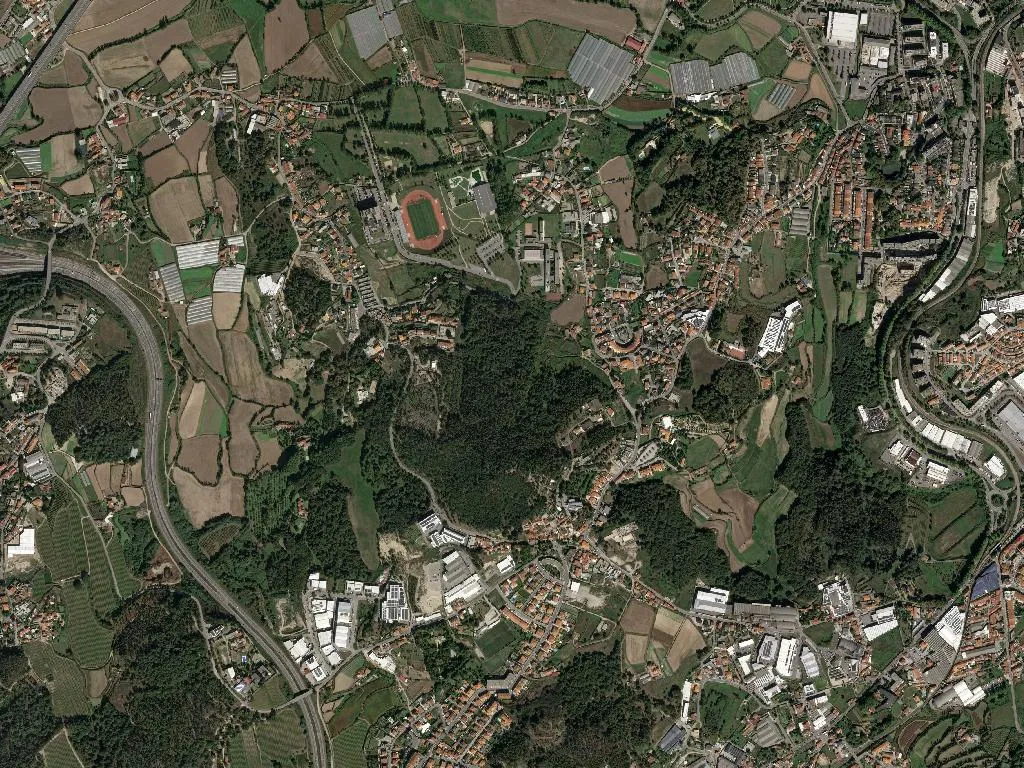
A five-minute drive south and you are in the Cidade Desportiva de Guimarães—flood-lit artificial turf, indoor arenas, the academy of top-flight football club Vitória SC. Yet immediately behind the complex smallholders still hoe vegetables between granite outcrops. There are no signed footpaths, but secondary lanes lead past oak-shaded threshing floors, improvised chicken coops and the occasional modernist villa financed by remittances. At dusk the air is seasoned with wood smoke; when the church bell tolls the note rolls across the roofs like a slow-moving weather front, reminding 3,808 residents—and whoever is simply passing through—that every stone here is a page someone has already turned.