Full article about Pencelo’s Granite Hush Above Guimarães
Whitewashed cottages, Vinho Verde terraces & 17C manor in Braga’s ridge parish
Hide article Read full article
The Weight of Stone and Lime
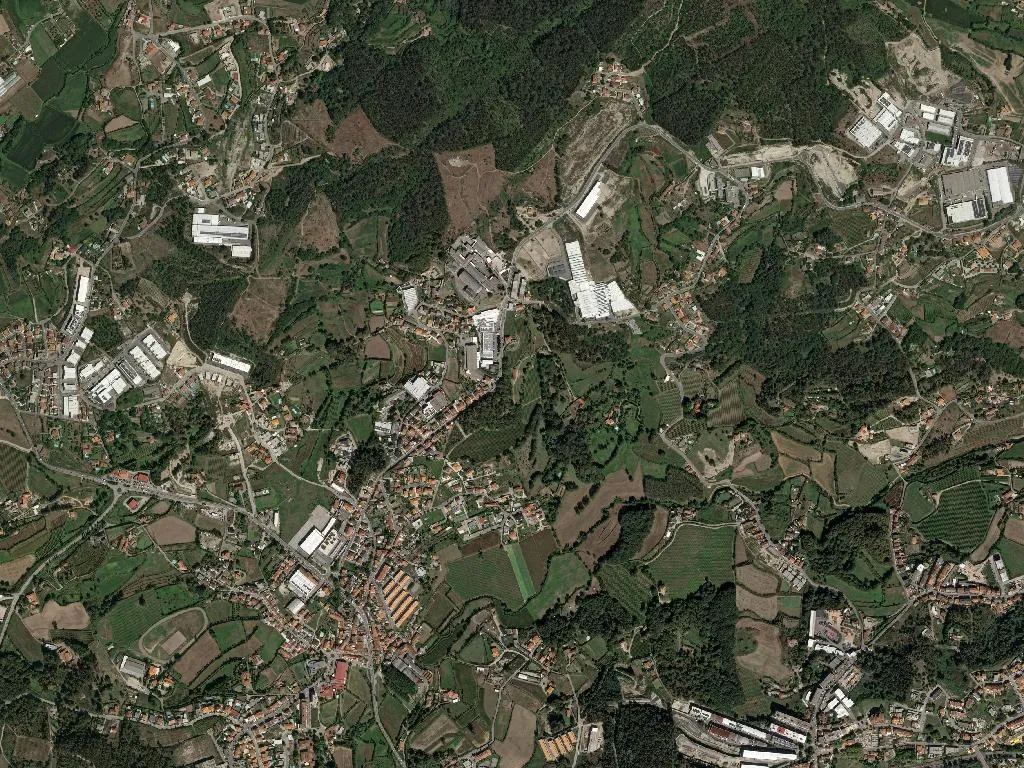
Morning light strikes the whitewash of Pencelo so sharply it almost hurts. At 220 m above sea-level, on the brow of a ridge that rolls toward Guimarães, granite cottage walls throw back the glare in silvery flakes, every course tight as a mason’s ruler. Nothing moves except a single iron gate complaining on its hinges, a dog two valleys away, and a tractor grinding uphill in low gear. Density here is 500 neighbours per km², yet the parish keeps its own hush: homes are threaded through smallholdings rather than stacked along streets, so voices stay inside kitchens and boots stay on doormats.
A granite archive
The only building with listed status is the 17th-century manor Quinta da Penha, its coat of arms still legible above the doorway. Official protection is rare for a place this size, but the citation matters: it confirms Pencelo has always sat on the north–south arteries that carried pilgrims, merchants and wine between Braga and the coast. The same granite sobriety you see in Guimarães’ UNESCO core – slate roofs, chamfered corners, doorways trimmed like altarpieces – repeats here, only without the audio guide. History is worked into the terraces that prop the vineyards, into the stone crosses where footpaths fork, into threshing circles now used for Sunday football.
Green wine, Barrosã beef
Pencelo lies inside the Vinho Verde demarcation, and the trellises prove it: rows of Loureiro and Arinto propped on wooden stakes or braided wire, the foliage trimmed to let Atlantic breezes race underneath. The resulting wine is the colour of pale cider, sharp enough to cut through grilled sardines or, in winter, the smoke of a wood-fired grill laden with Barrosã-PDO beef. The cattle themselves graze further east, yet the name appears on butchers’ awnings because nineteenth-century cattle fairs drew mountain herds down to Guimarães; the tradition lingers in sausages that cure under eaves – dark chouriço, paprika-stained alheira, ham that loses a third of its weight to mountain air.
Festivals that spill over borders
Two pilgrimages pull the parish beyond its edges. The Festa das Cruzes de Serzedelo, every 14 September, turns a hillside chapel into a lantern-lit picnic ground. The bigger surge arrives in May for the Romaria Grande de São Torcato, when 30 000 pilgrims walk from Guimarães behind a statue of the 8th-century hermit Torcato, sandals slapping the tarmac, rosaries clicking like abacus beads. For three days Pencelo becomes an open-air refectory: roast chestnuts, sardines crackling over hawthorn embers, plastic cups of rough red that stain fingers violet.
Between cohorts
The 2021 census counted 1 220 residents; 125 were under fifteen, 289 over sixty-five. The arithmetic is not yet alarming, but the trend is clear. Children still kick balls in the square beside the 18th-century chapel, yet an increasing number of granite houses have become weekend retreats for Porto families who arrive with flat-pack furniture and a Wi-Fi repeater. Weekday life is calibrated between vegetable plots, the 20-minute commute to a Guimarães office and the 4 pm school bus. Tourism hasn’t arrived, abandonment hasn’t either; the parish simply negotiates each season, renewing its limewash after the first autumn rain and stacking firewood until the scent of burning eucalyptus announces winter.