Full article about Urgezes
Walk Urgezes, Guimarães, for sun-split balconies, vanished farmsteads and Barrosã cows grazing above the Ave valley traffic.
Hide article Read full article
Urgezes: Minho’s Rough-Cut Edge Where Granite Meets the City
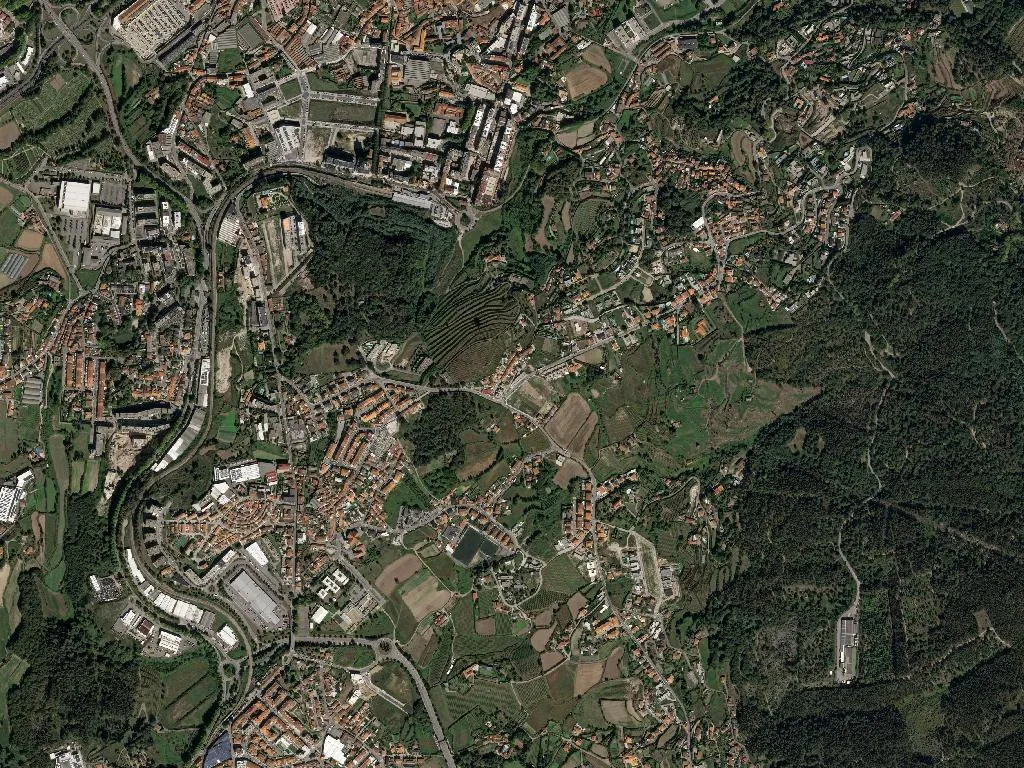
The scent hits first: warm, iron-rich soil exhaling after the night’s dew. Only afterwards do the red-tiled roofs, the lichen-flecked walls and the rectilinear vegetable plots swim into view. At 270 m above sea-level, Urgezes wakes on a shelf between Guimarães’s historic plateau and the Ave valley, a place where the urban and the rural collide without ceremony. One minute you’re passing a 1990s apartment block, the next your shoe sole is on compacted earth, edging a pasture where Barrosã cattle graze within earshot of commuter traffic.
A name that once meant “his land”
The parish covers barely 330 hectares yet squeezes in 5,517 residents – a density higher than central Porto. Its name is a medieval fingerprint: “Urgezes” almost certainly mutated from “Urges”, a landowner who stamped his surname on the landscape with the possessive suffix –es. Officially demarcated in 1836, the settlement long served as Guimarães’s agrarian lung, supplying rye, maize and beef to the mother town. Only after 1980 did tarmac and roundabouts muscle in, turning the old grazing circuits into dormitory streets for office workers who clock off in the UNESCO-listed centre five kilometres away.
The architecture no guidebook lists
There are no national monuments here, which is precisely why the place still feels legible. The parish church, inaugurated on 28 April 1963, replaces a hillside chapel and declines the gilded theatrics of Minho baroque for clean, almost Calvinist lines. The real archive is scatter-gunned through the back lanes: granite cottages with sun-split chestnut balconies, threshing floors swallowed by moss, external staircases that end in mid-air where the upper storey was demolished for tax reasons. Walk Rua da Eira or Travessa do Padrão and you’re reading a palimpsest of smallholdings abandoned when the children emigrated to Lyon or Newark.
Borrowed saints and thunderous drums
Urgezes has no procession of its own, yet it borrows intensity from next door. Each July the Romaria de São Torcato draws 50,000 pilgrims to the neighbouring monastery; locals simply walk uphill, candle in hand, and claim it as theirs. Equally contagious is Serzedelo’s Festa das Cruzes every May: drums pound through the night, smoke from roast-suckling stalls drifts over the parish boundary, and on Ascension morning you’ll find Urgezes residents pinning basil and marigold to their gates, improvising a floral border that wasn’t in the script.
What lunch weighs
Minho cooking makes no concession to calorie counting. The signature sarrabulho arrives the colour of burnished mahogany – pork’s blood simmered with cumin, clove and bay until it coats rice like velvet. Its thicker cousin, papas de sarrabulho, is spooned beside rojões: pork shoulder fried in lard stained red with paprika. Caldo verde slips down as a palate cleanser, the kale sliced filament-thin so it tangles round slices of chouriço. On feast days the meat is Barrosã-PDO, the mountain-bred beast whose muscle tastes faintly of gorse and granite. Pudding is toucinho-do-céu, literally “bacon from heaven” – a chestnut-yellow slab of egg yolk, almond and sugar that sits like ballast in the stomach. All of it is chased by vinho verde poured from unlabelled bottles whose hiss of carbon dioxide is the only fizz you’ll ever need.
Pedal west, walk back in time
The Ecovia do Ave skirts the parish boundary, a flat 12-kilometre cycle track that swaps granite kerbs for willow-shaded banks and the mechanical click of herons’ bills. Turn east instead and you’re on the medieval laneway that once hauled chestnuts to Guimarães castle; in forty-five minutes you’re under the UNESCO parapets, cappuccino in hand, wondering how the centuries shrank.
April’s quiet conspiracy
On the night of 30 April almost nobody explains what they’re doing. Laurel branches appear as if blown by the wind, wedged above doorframes before the household sleeps. Locals call it “as Maias”, a pre-Christian insurance policy against May-time malice. Dawn reveals the dark leaves beaded with dew, their bitter resin staining fingertips. By midday the streets smell like a butcher’s block rinsed with gin – an earthy, medicinal perfume that lingers longer than any souvenir. It is the moment Urgezes stops being a dot on the map and becomes a place you momentarily inhabit.