Full article about Calvos’ Oak & 14 Mills: A Living Timeline
Trace the Ave valley’s micro-hydro chain, 500-year oak and shared water rota in Calvos e Frades.
Hide article Read full article
The Pontido Brook and Its Fourteen Mills
The Pontido Brook slinks between granite walls, its voice doubling at every drop—first at the Pinto mill, then at the Cunha, finally at Sr Armindo’s, all still turning wooden water-wheels that an engineering survey in 1978 called “a rare surviving sequence of micro-hydro engineering”. In 850 m I counted fourteen mills once sharing the same thread of water, each waiting its turn in the cascade of leats that monks from Braga and smallholders laid out between 1723 and 1756. Today only three wheels still spin—Pinto’s, Cunha’s and the one Sr Armindo greases every Saturday with used chip oil.
An Oak That Has Counted Five Hundred Winters
In the square beside the stone cross stands a Quercus robur planted in 1506 by the parish priest—7.2 m round the trunk, 32 m high, a canopy 15 m across. The Calvos Oak outlasted the 1816 storm that toppled the bell tower, Soult’s cavalry who stabled horses in the nave in 1809, and the 1945 drought that dried the brook for six months. Listed in 1988 as a Tree of Public Interest, it is still the compass point for António’s vineyards: “three terraces south of the oak, two to the north”. Beneath its branches the parish council installed an interpretive centre in 2003; panels written by local biologist Dr Fernanda explain why chiffchaffs linger until March and why pied wagtails appear whenever the wind swings south.
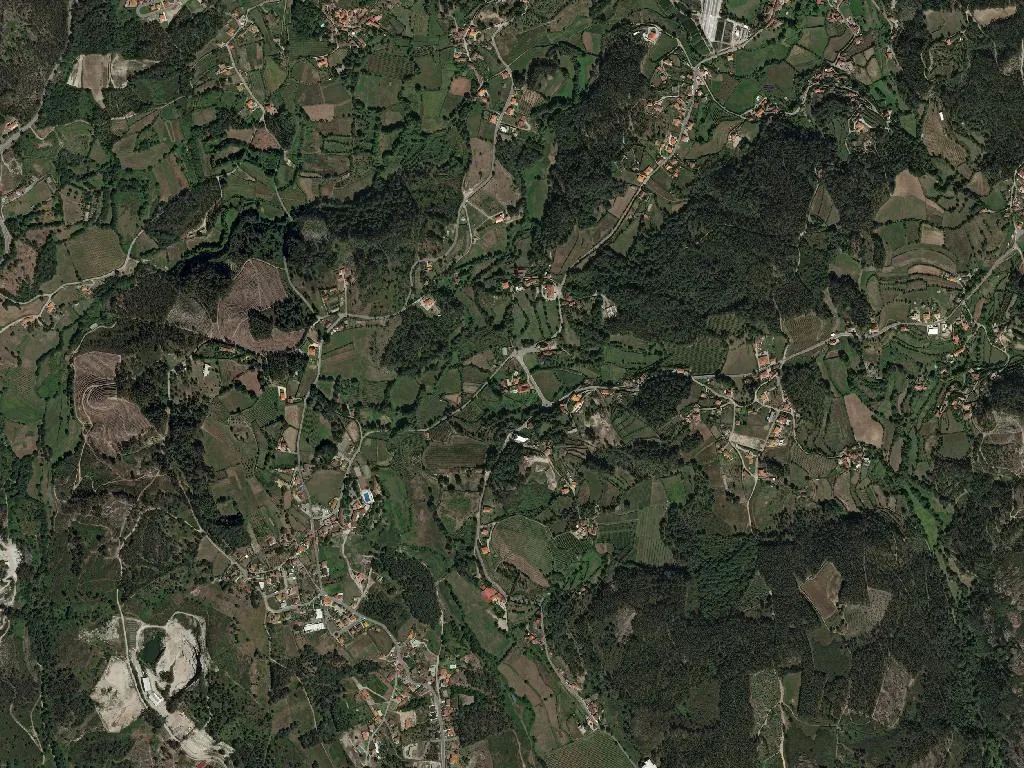
Human settlement in this fold of the Ave valley begins with the dolmen at Outeiro do Rato, excavated in 1876, but the key date is 1734, when the priest Jerónimo ordered the main irrigation channel—the “acequia de Calvos”—opened. The 1852 register still governs today’s water rota: Monday 06:00-10:00 to Sr Albano’s farm, Tuesday 14:00-18:00 to D. Amélia’s quinta, and so on. The name Calvos comes from the Latin calvus, “bald”, a reference to the schist slabs that glare through the turf when the sun scorches the meadows.
Vinho Verde, Honey and Meat That Knows the Cold
The parish lies inside the Basto sub-region of Vinho Verde; on the Costa family holdings the loureiro and trajadura grapes ripen at 290 m, the altitude that agronomist Oliveira pegged precisely at the stone cross. Tastings take place on Sr Albano’s threshing floor, accompanied by salpicão smoked by D. Idalina in the kitchenette chimney every January, and by her son’s carne-chouriço, made from pork legs bought at Vieira do Minho’s Thursday fair. Sr Armindo bottled the 2023 batch of Terras Altas do Minho DOP honey last August—dark amber, almost thick enough to stand a spoon in—used in the sponge cake D. Amélia takes to Póvoa market every Saturday morning.
Barrosã beef arrives at O Minhoto restaurant as chanfana, slow-simmered in quinta Costa’s red wine and Trás-os-Montes garlic, or as rojões the way Zé’s grandmother did it—laced with smoked belly pork and chestnuts from the grove he planted in 1967. Kid goat is roasted in Sr António’s wood oven held at a steady 280 °C; papas de sarrabulho, a blood-and-bread stew, appear only on market days—Tuesdays and Fridays—coloured with Ferreira family paprika and cumin D. Idalina grinds on her stone. In October Sr Armindo’s magusto draws fifty neighbours to the square, fortified by jeropiga from the Fafe co-op and cantares ao desafio learned from Domingos’ father.
Trails, Water and Silence
Jorge way-marked the Pontido Mills Trail with yellow paint in 2019—1.2 km, 185 m at the Pinto mill to 343 m at the Cunha. It crosses the slab bridge built by Sr Armindo’s grandfather in 1923, skirts the leat that once fed the Ribeiro mill—now a weekend cottage—and ends in the water-meadow where the council has set two concrete tables and a barbecue Zé scours every Monday. The sound of water changes three times: the murmur of the leat, the clack of Pinto’s wheel, the final whistle of Cunha’s spillway.
There is no through road—the N205 lies 3.5 km away at Bouça—so granite window frames with stone sills survive; Sr Albano refuses aluminium “however cold the bedroom gets”. The parish church, rebuilt in 1867 after the tower collapsed, keeps the 1899 altarpiece carved by José Carvalho and the St Joseph statue restored in 1934. On 19 March the procession leaves at 15:30 sharp, pausing for the blessing of loaves baked at dawn by D. Idalina, followed by a dance that begins when Sr Armindo switches on the speakers at 17:00. In July the Romaria of Nossa Senhora do Pilar mobilises thirty pilgrims who set off at 06:00 for the sanctuary; last year Sr António’s auctioned kid goat fetched €180.
From the Calvos hilltop viewpoint the late-afternoon light unrolls the Ave valley as far as the Gerês ridge 28 km away on a line of sight. At 18:00 the sun ignites the granite houses the colour of honey—honey that Sr Armindo leaves in the vats three days longer than anyone else. Down below, the Pontido Brook keeps its three surviving mills turning, indifferent to calendars and to the hush that falls when Sr Cunha switches off his pump at 20:00 on the dot.