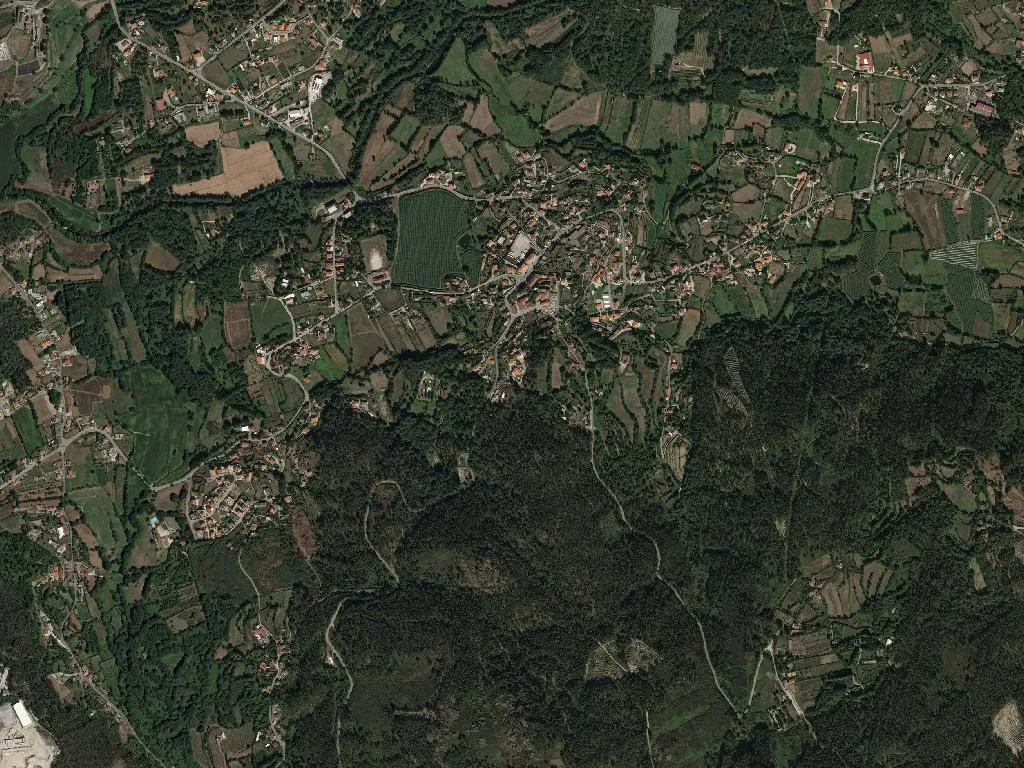
Full article about Garfe: Where a Stream Splits Stone & Stories
Follow the granite-clad mill road and taste warm broa beneath heron-haunted Lagoa de Garfe
Hide article Read full article
The Village That Saws Itself in Half
Sunlight slips between the warped planks of the mill door and lands on a gear that still smells of scorched crust and carbolic soap. Outside, Lagoa de Garfe — everyone here calls it “the dam” even though the reservoir turned sixty-six last year — sends a heron skyward. Its wings beat slow circles into the water, the ripples spreading like cigarette smoke rings across the 5.44 km² that shelter 983 souls, twenty-eight watermills and more stories than Google Maps will ever index.
Garfe takes its name from the Galician verb “to cut”, and that is exactly what the stream does: it bisects the parish the way a blunt knife halves stale bread. The granite bridge thrown across it in 1903 still shoulders tractors, yet wobbles when Zé Manel’s lowered Toyota growls past, sub-woofer pumping pimba at field-shaking volume. Up the hill, the twin-doctor saints Cosmas and Damian — patron healers who never sent anyone a bill — guard a gilded altarpiece that English grand tourists once paid to sketch. We saw it free at eight o’clock mass, fighting yawns and the chill of stone.
The Mill Trail is what glossy brochures label a “rural walk”; locals simply call it “the road”. Four kilometres that start beside the church, skirt the lake where Vasco once jumped in fully clothed during the 1997 São João night, and finish at Penedo mill, where Zeca’s grandfather ground corn until the village christened him “the mill-lord”, said with the same nod once reserved for the biscuit man.
Bread, Lamb and the Alibi for Another Glass
The Bread Interpretation Centre is municipally branded a museum; everyone else knows it as the shed where Dona Amélia schools tourists in the art of broa. On Fridays the millstone turns and flour snows onto the trough — only this snow is warm and clings like blu-tack. The loaf that emerges needs the black-handled knife, kills a wolf-sized hunger and practically begs for a glass of red “to help it down the road”.
Across the lane, António has converted Ti’ Rosa’s old grocery into O Molinho, where lamb stew is set to simmer on Friday and served from Saturday noon. The meat collapses faster than a cheating husband’s excuse; the sauce demands successive bread sorties until the plate is cleaner than a priest’s conscience on Easter morning.
Dances, Logs and the Soup Men Make
The Festa de São José gives the parish licence to haul rosemary trunks and knock back imperial pints. Tradition says the logs are ceremonial, but they weigh a tonne and the lager is ice-cold — you do the maths. On 19 March the air turns to wood-smoke and “stone soup” — minus stones, plus endless rotating chouriço.
Easter Sunday brings the Danças dos Homens: men in white shirts half-singing like they’re at the café counter, only they carry flaming rosemary torches that make the local GNR twitch. Maria da Conceição was the last to weave blankets on her grandfather’s loom. “Wool’s like life,” she’d say, “pull it too hard and it just keeps stretching.” She died in 2015, taking with her the secret of a weave that survived forty years, three generations and an indestructible supply of cat pee.
When the mill shutters close for the night, water keeps gnawing the stone the way memory gnaws at saudade. Casa da Ribeira — once Sr Albano’s granary — now has fibre-optic and a Nespresso machine, yet its windows still frame the oak copse where Zé Manel lost his virginity in 1983. The church bell tolls the hour, less a reminder that it is eleven than a hint that Zé should have been back from the pub an hour ago. And the mill-wheel? It never really stopped turning; it simply grinds a different grain now — tourists instead of rye.