Full article about Sobradelo da Goma: smoke, stone & legends
Oak-wood ovens, 14th-century bridge & hilltop chapel in Minho’s hidden hamlet
Hide article Read full article
Smoke Signals from the Communal Oven
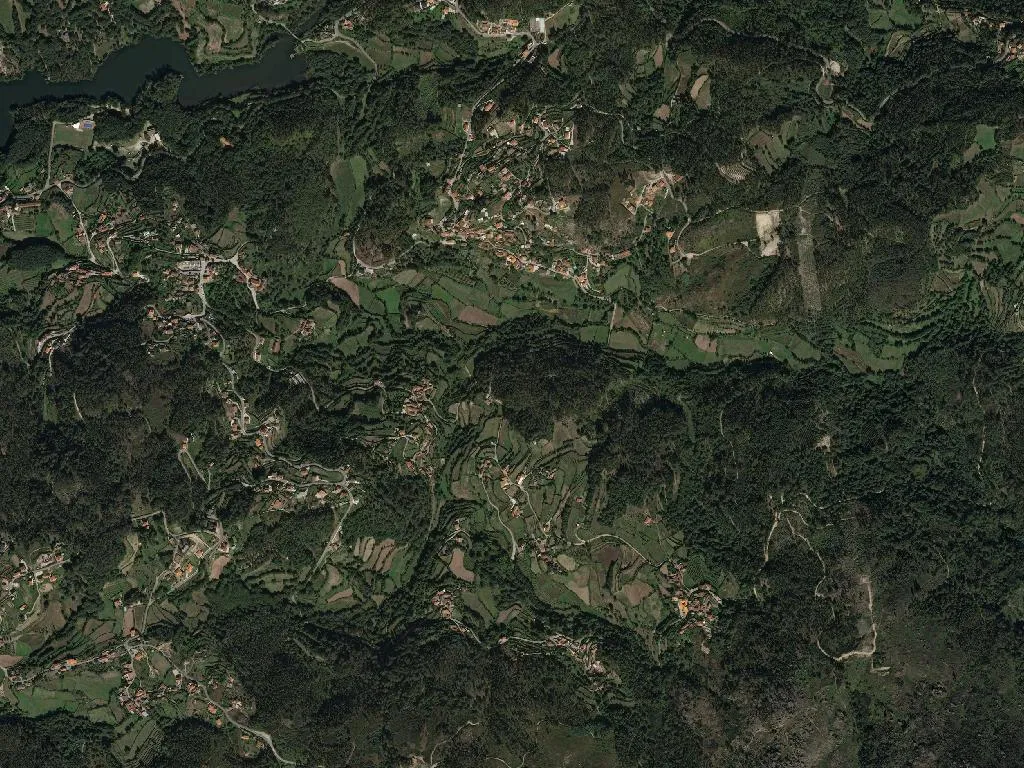
Thursday morning drifts upwards in slow skeins of oak-scented smoke. Inside Sobradelo da Goma’s shared bake-house the weekly rhythm is immutable: dough kneaded to the same cadence heard by grandmothers’ grandmothers, heat blooming from a granite mouth fierce enough to pink your cheeks in seconds. Beyond the low door the Goma stream whispers between shale banks, stitching a valley of Loureiro vines and arthritic olives. At only 271 m above sea level this scatter of stone houses—population 695—keeps time with the harvest clock rather than anything digital.
Where the Stone Gives Evidence
The parish church of São José anchors the square, its whitewash flaring against basalt doorframes quarried from the same seam that built Braga’s cathedral. Finished in 1896, it replaced a 1700s hermitage that burst at the seams once the railway from Porto brought day-trippers. Filtered light falls through tall lancets, printing long shadows on deal pews polished by 128 years of wool and worsted.
A few strides away the single-nave chapel of São Sebastião keeps its tally of answered prayers—hand-painted legs and arms on iron plates, offerings from soldiers who came home from Mozambique in ’74 or from teenagers who walked away from a Mini-Metro crash. Higher up, at 450 m, the hilltop hermitage of Nossa Senhora da Saúde still hauls in pilgrims on the second September Sunday, following the same hoof-worn track used in 1756 when the bishop of Braga ordered a sanctuary to beg the end of a murrain that was picking off livestock like flies.
Yet the village’s CV is best summarised by the low medieval bridge across the Goma. Listed in King Afonso IV’s 1325 royal survey as “ponti de Sobradelo”, its central arch carries the moss of seven centuries and the weight of 21st-century John Deeres since the town hall asphalted the lane in 1963. Beside it the Costa family’s water-mill, built 1878, still grinds organic maize for the county’s free-range poultry. Joaquim Costa, 78, grandson of the last professional miller, recites the mantra: “Twelve paddle teeth under water—no more, no less. That’s the miller’s law.”
Tastes of Wood-smoke and Farmyard
Roast kid is not up for negotiation here. The recipe was fixed in 1920 when Maria da Conceição, village feast-day cook, seasoned the meat with Trás-os-Montes garlic and sweet-smoked paprika from Vermil. Four hours at 300 °C inside the oak-fired oven, then carried to the table with Desiree potatoes grown on the Goma’s alluvial strip and a clay-pot rice baked in the same vessel that once ferried the statue of Nossa Senhora da Saúde up the mountain.
Sarrabulho—pork-blood porridge—has opened the São José banquet since 1946, when Father António Miranda commissioned 50 litres to feed pilgrims hiking in from Vieira do Minho. The blood is whisked with maize meal from the old Caldas das Taipas mills, served volcanic-hot in bowls thrown in the local pottery whose kiln has been alight since 1832.
Sweet-tooths get “cigarette rolls”, crisp wafers rolled while still pliable around a filling of egg-yolk and almond. The name dates from 1918, when soldiers returning from the Western Front brought packets of Tricana cigarettes; village women discovered the papers were ideal moulds. Every table is washed down with the parish’s own DOC Vinho Verde—Loureiro fermented in 200-year-old granite lagares that once belonged to a Benedictine monastery outside Braga.
Between Vines and Reservoir
Rural lanes corkscrew through vineyard plots first mapped for the Marquis of Pombal’s 1758 land register. Schist soils release a burst of wild-mint when crushed—the same herb shepherds twisted through sheep collars to deter blow-flies on the transhumant route that ran here until 1974.
The Andorinhas dam, completed in 1961, throws a 42-m wall across the valley, its mirror doubling the sky where 23 pairs of grey herons now breed annually. Anglers park folding chairs on the concrete lip in search of small-mouthed barbel, introduced 1983 and now nudging 40 cm. Holm and cork oaks quilt the surrounding hills, sheltering blackbirds and song thrushes; at dusk the guttural croak of white-bellied fire-bellied toads rises from the reeds—an amphibian comeback since the 1998 riparian clean-up.
March in Full Voice
São José’s feast on 19 March turns the village inside out. The tradition was formalised in 1897 when Father João Baptista commissioned the first palanquin; today’s 180-kg silver-plated litter is shouldered by 24 men in 100-m relays, a system born in 1932 after the previous wooden frame snapped halfway up Calvary hill. Procession steps off at 3.30 p.m. sharp, announced by a dozen rocketing firecrackers that scatter swifts from the belfry.
Night-time brings the street fair to Dr. José Pires de Lima Avenue—opened 1958, replacing a donkey track. Fourteen stalls grill 600 sardines trucked in predawn from Matosinhos auction. At 10.30 p.m. José Carlos, fifth generation of a concertina dynasty, strikes up “Verdes São os Campos”; the microphone is then surrendered to extempore Minho verse-duels that run until 1 a.m., every improvised rhyme logged by the county librarian for an ever-growing sound archive.
When the last sun-ray warms the bridge granite and the mill wheel stalls for lack of water, only the stream keeps talking—steady, understated, the village’s own breathing. Leave, and that low murmur travels with you; return, and it is the first voice you hear again.