Full article about Taíde: where oak smoke curls above granite time
Walk moss-quilted lanes between 1594 church and 1783 bridge in Póvoa de Lanhoso’s mountain parish
Hide article Read full article
Where the smoke writes the day
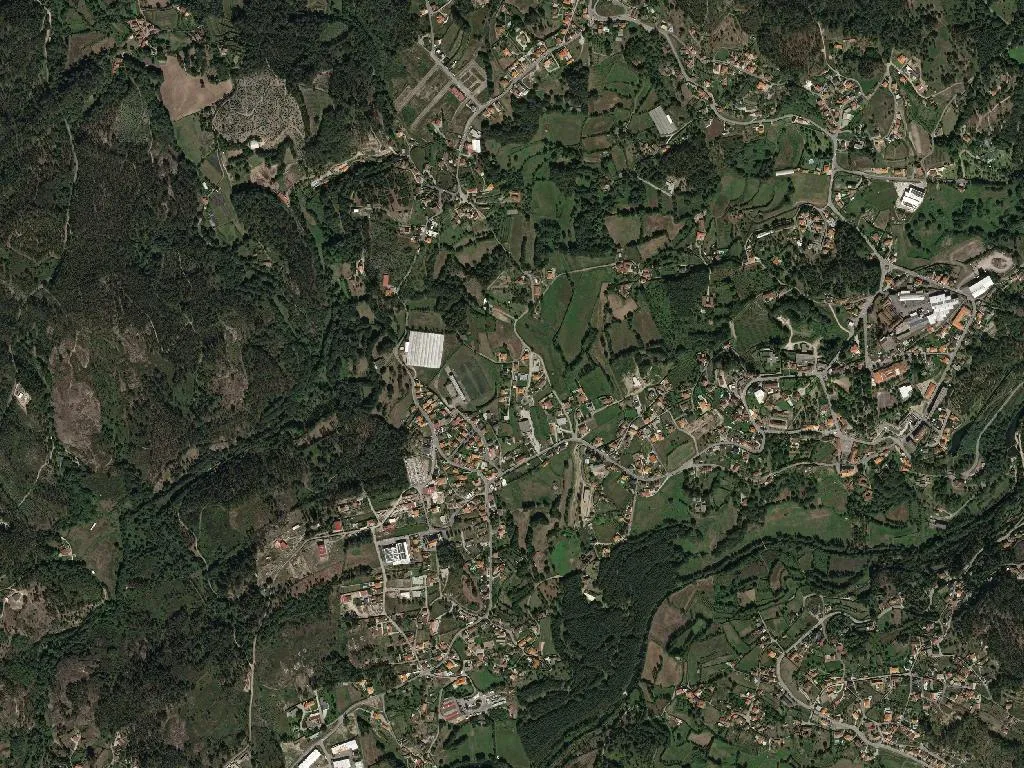
Oak smoke drifts horizontally from the eaves on a January morning, mixing with the sharper note of chouriço curing in tiny fumeiros. Each footstep down Taíde’s granite lanes ricochets between walls quilted with moss the colour of oxidised copper. At 175 m above sea-level the parish sits precisely where the River Ave’s plain buckles into the first folds of the Serra da Cabreira; the horizon is close enough to read the weather in the folds of the land.
Stone that remembers
Parish records open in 1594 with a bishop’s seal: Dom Frei Agostiano de Jesus authorises a new mother church. The building still anchors the village square, its Baroque high altar—commissioned in 1723 from Braga wood-carver José Fernandes de Lima—glimmering in winter darkness like a reliquary. On 19 March, St Joseph’s Day, the oak doors—ironwork forged in Póvoa de Lanhoso’s last charcoal furnace—swing outwards and the procession shuffles towards an 18th-century granite cross, boots scuffing the same slabs listed in 1758’s Memórias Paroquiais.
Fifty metres away, a chapel barely wider than a tractor is wedged between schist cottages. The plaque reads 1756: João Gomes da Silva raised the chapel to São Sebastião after typhoid claimed forty-seven neighbours. His coat-of-arms—crossed keys and a paschal lamb—remains chiselled into the lintel, the stone softer now than the memory.
Across the Ave, a single-arch bridge rebuilt in 1783 keeps its original line. On the downstream face the inscription “1783 / ANNO / D. JOSÉ I” is still legible, though the river has licked the edges round. Willows lean over the parapet, descendants of those measured by a local priest in 1897: “trees of noble stature whose shade invites the labourer to rest”.
Vine terraces and yellow fat
Forty-two hectares of vines stair-step the south flank of Monte do Crasto. Loureiro and Trajadura root through thin schist, giving the white wine its citrus nose and flinty finish. Picking begins unfailingly on 8 September, Nossa Senhora das Dores; the custom dates from 1856, when Canon Abreu ordered a pre-harvest mass to “bless both grapes and hands”.
Higher up, 120 Barrosã cattle graze among oaks. The beasts carry the DOP seal; their fat is butter-yellow from beta-carotene. In the one-room tavern “O Celeiro”, D. Rosa marinates loin for twenty-four hours, then casseroles it with colourau chilli her son mails from France. The sarrabulho porridge follows a 1903 manuscript: pig’s blood stirred into maize meal ground at Pinheiro water-mill, finished with oak-smoked belly that hung above the hearth during the January matança.
On the fourth Saturday of every month Domingos Pereira unloads saucisson-sized salpicão smoked for sixty days in the stone lagar at Quinta da Veiga. “Three days of blazing oak, then oak and arbutus embers barely breathing,” he explains, brushing ash from a wooden ring branded “2024-I-20”.
Hills that once burned
Until 1963 the night of 19 March turned Taíde into a constellation. António da Cunha, born 1934, recalls: “We lit the first stack on Monte do Crasto at nine; you could see the chain of fires all the way to Gerês.” Civil-protection laws extinguished the custom, but the spot is still marked—Lugar do Fogo—300 m above the church, where black ash mingles with gorse.
The Agricultural Association, founded 15 October 1923 in Arnaldo Soares’s front room, meets every Monday in the old primary school. Since 2018 the chair is Maria José Costa, the first woman to hold the post. She keeps August’s cattle-dog trials and St Joseph’s basket-weaving contest, where 82-year-old Alice Rodrigues has won three times with a 48 cm-mouth entry so tight it holds water.
Between river and ridge
The riverside trail—way-marked in 1998 by the “Rios do Minho” project—takes 1 h 45 min from the bridge to Pinheiro mill, abandoned in 1957 after the 1956 flood ripped out the leat. Halfway, a century-old alder beside the 1872 calvary measures 3.4 m around; forestry engineer Rui Pinto recorded it in 2019.
Climb to the 380 m geodetic marker on Monte do Outeiro and, on a clear day, seventeen villages slide into view from Rendufe to Gerês. The only sound is the blackbird that ornithologist Carlos Pacheco lists as a year-round Turdus merula resident.
At 18:27 on 15 October local photographer Manuel Silva caught the sun slotting beneath the bridge’s arch, shadows stretching due east, following the curve of the stonework. It is the moment Taíde keeps for itself: no audience, just the weight of granite, the drift of wood-smoke from D. Rosa’s chimney, and a glass of the 2023 Loureiro-Trajadura blend bottled by the Póvoa de Lanhoso co-op—11.5% vol., tasting of schist and citrus blossom, the terroir reduced to a postcode and a memory.