Full article about Rio Caldo: dawn pilgrims & open-doored sanctuary
São Bento never locks; mist lifts off Caniçada as valley bells echo.
Hide article Read full article
The granite still holds last night’s chill when the first shoes scuff across the sanctuary flagstones. Dawn is a rumour, yet a thin chain of pilgrims is already climbing from the reservoir’s edge, following the narrow track that corkscrews between oaks and maritime pines. The air smells of wet loam and resin; downstream, the River Cávado keeps up a low, throat-clearing growl against the rocks. Rio Caldo wakes like this: half devotion, half mist suspended above the lake.
A door that never locks
São Bento da Porta Aberta is one of the very few places in Europe where prayer has no closing time. Twenty-four hours a day, 365 days a year, the doors stand open—not metaphorically, literally. Pilgrims arrive at three in the morning, at noon, at midnight. Some have walked from Esposende, 70 km away, following the recently way-marked Caminhos de São Bento da Porta Aberta that thread along the Cávado valley into the heart of Peneda-Gerês National Park.
July and August bring the big romaria—torches, brass bands, fireworks over the water—but the shrine is never empty. There is always a candle twitching in a red glass, always marble polished by knees. Come off-season and you’ll catch the kind of silence that makes your own pulse audible: just the caretaker snoring in a cane chair and rain fretting the copper roof.
Smaller, but just as rooted in the slopes, are the parish chapels: São Cristóvão in São Pedro, Santa Luzia in Matavacas, São Bento da Seara. Single-cell stone buildings, whitewashed once a year before their saints’ days—Anthony in June, Christopher in July, Lucy in December. Processions are short, the village band turns up in blazers, lunch is whatever the garden yielded that morning. No theatre, just competence: a coffee that doesn’t need an Italian machine to taste like coffee.
Between the mountain and its mirror
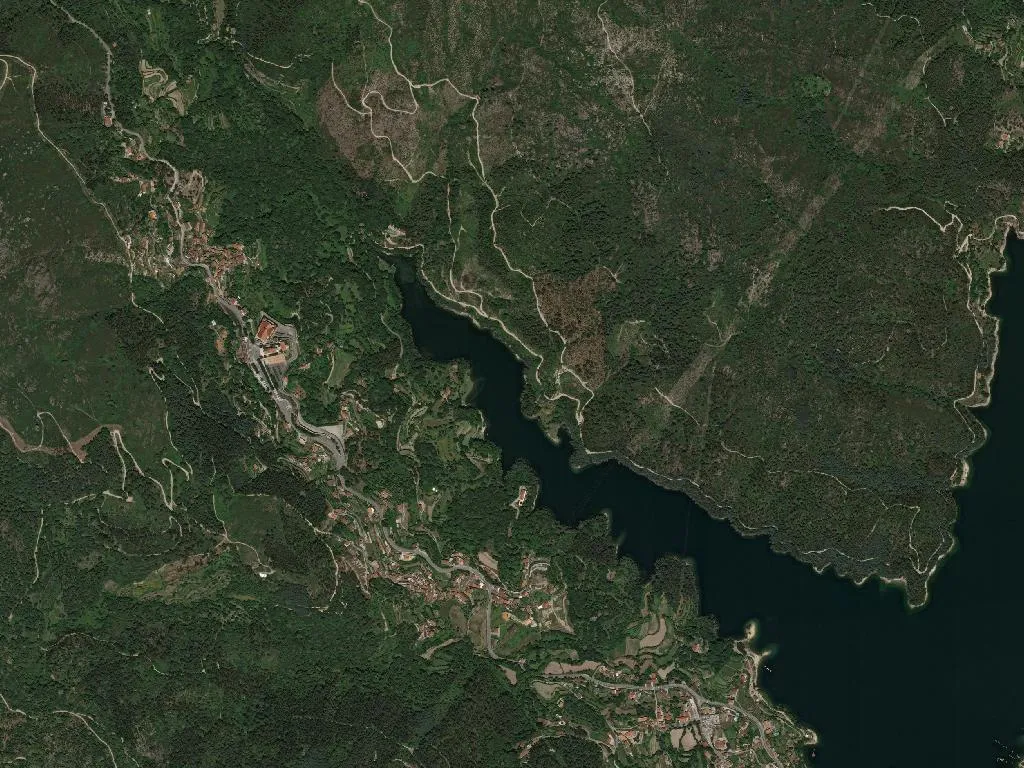
The Caniçada reservoir draws a liquid boundary that changes colour with the clock: pewter-blue under early fog, emerald when the sun burns through, molten copper at dusk. Rio Caldo’s little marina will rent you a skiff, but most people simply sit on the granite slabs listening to wavelets nibble at half-submerged trunks. Bring flip-flops—summer sand scorches and the beach-bar prices are marina-plus.
Anglers, lower your expectations. Caniçada is moody: one day a three-kilo sea bass, three months of nothing but minnows. Locals compare the lake to a mother-in-law—sweet when she’s in the mood, otherwise immovable.
The São Bento hiking loop (10.5 km, 350 m ascent) strings together chestnut woods, shepherd paths and sudden balconies over the lake. This is national-park land: silence engineered by altitude, broken only by jays and the snap of twigs under your boot. There is no kiosk halfway—carry water or trust the forestry guard to share his canteen.
What the table offers
Rio Caldo sticks to the Minho script. Caldo verde thick enough to stand a spoon in, the kale sliced filament-thin over mashed potato. Rojões à minhota—pork shoulder braised with smoked paprika and garlic, finished with chestnuts and orange segments. On feast days, papas de sarrabulho—a rich, cinnamon-dark blood-porridge—and kid goat roasted until the skin crackles like parchment.
Charcuterie comes from village smokehouses: chouriço, alheira (bread-smoked poultry sausage), morcela blood pudding, all hung over oak embers until the skins turn liquorice-black. Dessert is domestic: sponge cake still warm from the wood oven, requeijão cheesecakes, pumpkin preserve reduced to an amber jam. Drizzle over everything the dark, floral Mel das Terras Altas do Minho DOP, its flavour shifting with the season’s blossoms. Wash it down with a sharp, lightly sparkling vinho verde that slices through pork fat like citrus zest.
If a man called Zé Mário appears with an unlabelled bottle of aguardente disguised as water, accept a thimble—then hand over your car keys.
Where footpaths meet water
Rio Caldo sits on the Northern Way to Santiago, the least crowded of the Portuguese caminhos. Walkers enter the parish squeezed between the mountain’s vertical granite and the lake’s horizontal shimmer, carrying in their rucksacks the contrast of stone and water, ascent and rest.
What lingers is the soundtrack: the sanctuary bell rolling down-valley to mix with the mewing of yellow-legged gulls above the reservoir. Two worlds intersecting—faith climbing, water lying still—and between them the granite cool beneath your palm, still beaded with dawn dew. Sit long enough and you realise the village runs on a different clock: no urgency, no usable Wi-Fi, just the slow passage of light across the slopes while the landscape quietly finishes the sentence you started.