Full article about Ventosa e Cova: where bells echo above Minho clouds
At 611 m, twin granite villages live by saints, smokehouse scents and vertiginous views
Hide article Read full article
The noon bell and what follows
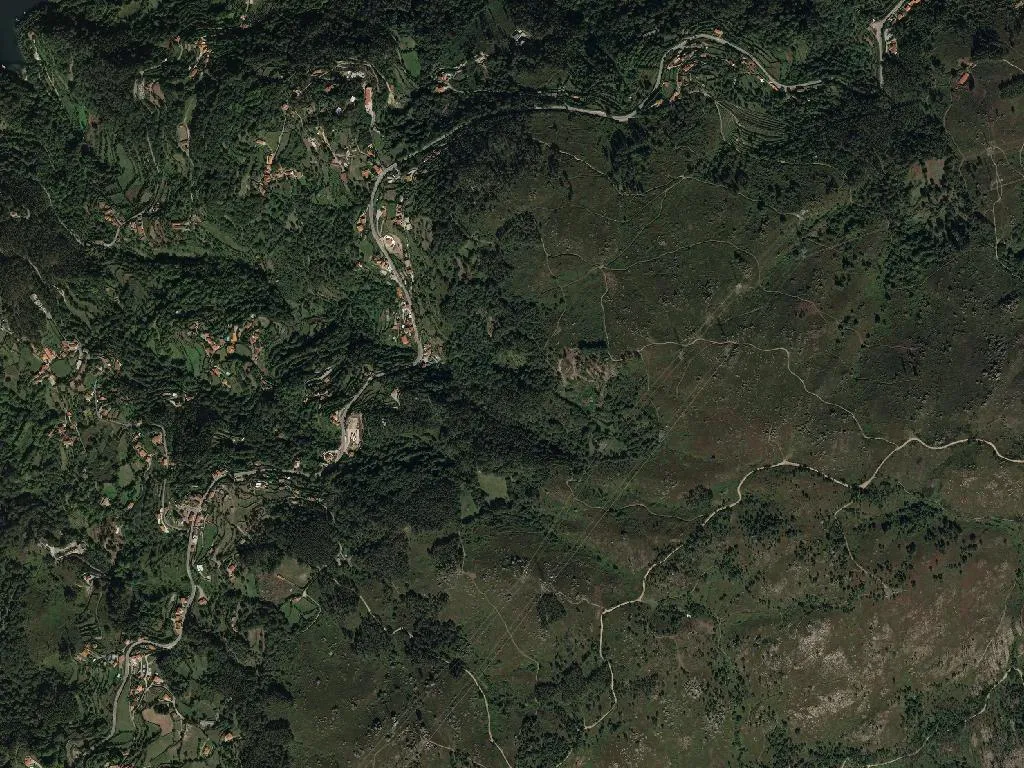
The bell strikes twelve and the note ricochets across the ridge, caroming off schist escarpments and centuries-old oaks. At 611 m the air is cold enough to sting, even when July sun warms the granite thresholds. Ventosa and Cova—merged on paper in 2013 but still spoken of as two villages in local mouths—count 577 inhabitants scattered across nine square kilometres of Minho upland. Verticality sets the tempo here: every path climbs, every view drops away, every breath is rationed by altitude.
A calendar kept by saints
Time is arranged by four Marian feasts, not by the municipal planner. On the last Sunday of May Cova honours Senhora D’Orada; the first Sunday of June belongs to Senhora da Fé in Ventosa; August opens with Senhora da Lapa, again in Ventosa; and 8 December is Senhora da Conceição at Ventosa’s mother church. These are not folkloric set-pieces for strangers; they are parish council meetings with incense. The 174 residents over 65 and the 61 children under 15 process behind wooden biers rebuilt in the 1960s by local improvement commissions. Women line the niches with crêpe-paper blooms bought at Costa’s stationery shop down in Vieira do Minho; the village band, founded 1887, strikes up “A Minha Aldeia” whose brass chords bounce to the next valley. Grilled chouriço fat drips onto hot basalt, mingling with frankincense from São Vicente church (consecrated 1723); trestle tables spread beneath oaks that were saplings when the Jesuits left.
Tastes that carry a mountain passport
Barrosã beef, PDO-certified, has summered on these slopes since the municipal abattoir opened in Vieira do Minho in 1952. Fifty-two farms still move their cattle slowly through 600–800 m pastures threaded with subterranean clover and meadow fescue. In ground-floor smokehouses, hams cure for two winters on the draught that slides off the Gerês massif 15 km away. Honey from the Terras Altas do Minho, produced by six registered beekeepers, owes its dark-amber colour and chestnut-sweet bite to late-blooming heather (August–September), chestnut (June–July) and genista (April–May).
Vinho Verde climbs this high, but altitude rewrites the recipe. Loureiro and Azal vines struggle, ripening three weeks later than in the valley; the local co-op bottles barely 500 litres a year at 9–10 % abv with a razor-sharp 7–8 g/l acidity. It is a wine that remembers August nights dropping to 15 °C.
Sixty-eight front doors left ajar
Since 2018 the national holiday-letting register lists 68 cottages—stone-and-schist houses rescued with EU rural-development funds. Density remains 66 people per km²; silence is still the default soundtrack. The Currais footpath (12 km, 350 m ascent) links Cova to the hamlet of Tourém; the EM568 municipal road climbs 8 km from the N311 at ramps of 12 %. This is country for slow walkers, second-gear drivers and conversations outside the last grocer’s, Café Central in Ventosa, which unlocks at 7 a.m. for coffee laced with bagaço brandy.
In winter, fog wells up from the Rabagão valley, turning the settlements into islands suspended above 500 m. In midsummer the same altitude offers natural air-conditioning: 16 °C nights, dew that soaks trainers at dawn, crickets broadcasting from pastures abandoned since 1990.
Arithmetic of resistance
Thirty percent of the 2021 population is over 65; barely 10 % is under 15. Most silver hair is inherited from the Paris-Lyon exodus of the 1960s–80s. Yet the primary school built in 1958 still enrolls 40 pupils for 2023–24; knees still dirty on the 2 km lane that takes 45 minutes to walk. Forty-two registered vegetable plots are still hoed in May; October’s communal working days rebuild schist walls stone by stone; the festa committee, elected each January, plans processions six months ahead.
After dusk, lights switch on one by one in 250 scattered houses—35 % occupied only at weekends. Woodsmoke rises straight when the wind is still, twists when the nortada funnels 20 km/h off Gerês. Cold—the constant companion at 611 m—presses against 5 cm-thick chestnut doors. Comfort is not granted here; it is earned daily with six cubic metres of oak and chestnut logs, woollens from the old Cabeceiras de Basto mill and the same obstinacy that kept the Brandões and Andrades on these ridges since the sixteenth century.