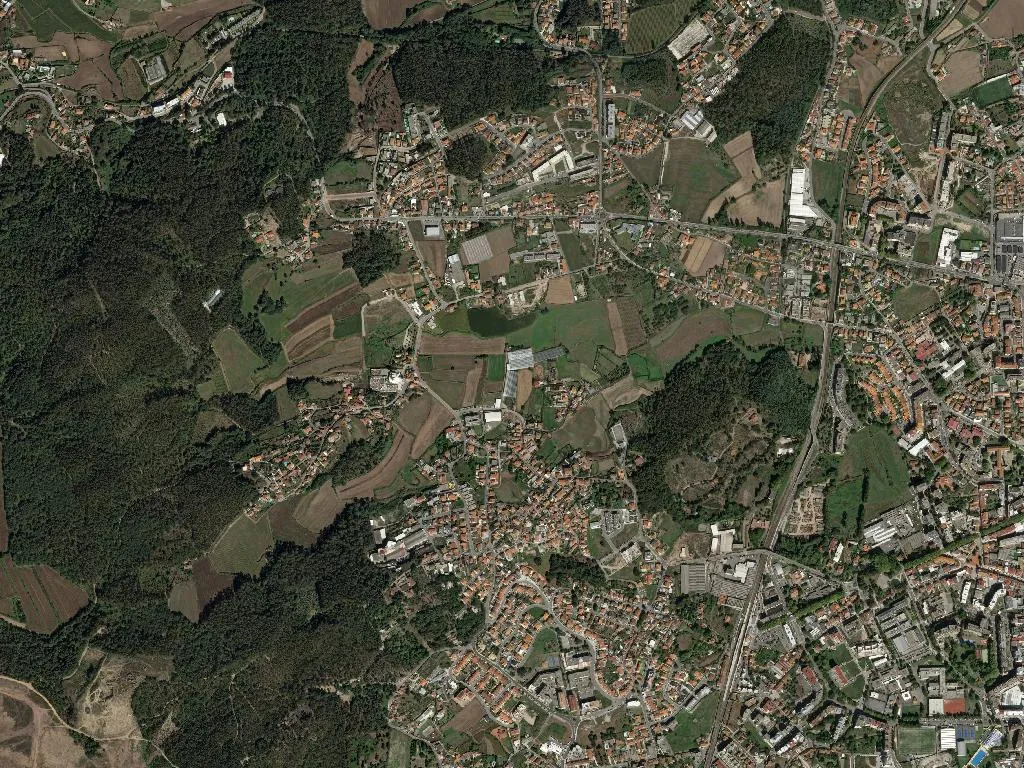
Full article about Brufe: cherry-blossom hamlet above the Ave
Wander 13th-century lanes where 1,200 cherry trees snow petals onto granite manor balconies.
Hide article Read full article
First light over cherry stone
Sunrise slips sideways through the orchards, turning every cherry petal translucent. By mid-March Brufe’s 1,200-odd trees detonate into a pale-pink canopy so dense the granite field-walls underneath seem to float. Below them the Ribeiro da Forcada threads freshly-ploughed maize terraces, its water glinting like pewter against the red-brown earth. On mornings when the wind drifts in from Vila Nova de Famalicão, the air carries a ribbon of oak-wood smoke from the chimney of Casa do Eido, one of the parish’s 17th-century manor houses whose balconies still bear the ironwork initials of the first owner.
Deep-rooted names
The place first appears in 1081 as villa Berulfi, the farmstead of a Visigothic landowner called Berulfo whose boundary stretched between the Cávado and Ave rivers. By the 1220 royal inquests the settlement had become “Sancto Martino de Beriffi”, a priory under the House of Braganza tucked inside the ecclesiastical couto of Vilar de Frades. That Benedictine link survives in the parish church of São Martinho, its Romanesque portal carved with the same wheatsheaf-and-cherries motif that now adorns the municipal coat of arms. Around the church square, a loose ring of 18th- and 19th-century solares—Casa Jácome, Casa do Engenheiro Reis—map the rise of a small gentry who grew wealthy on flax, rye and the first cherrygrafts brought from the Minho valley in 1852.
The spring that whitens soil
Locals still fill bottles at the Fonte da Forcada, a limestone spring that 19th-century geographer Pinho Leal noted for “bleaching the ground as if with lime.” The water is drinkably soft, low in nitrates and impregnated with calcium carbonate that leaves a pale halo on the surrounding shale. From the source the stream powers two surviving watermills—one converted into a holiday cottage, the other a taberna where owner Dona Albertina serves vinho verde under the mill-wheel. Footpaths follow the levadas east toward the 143 m summit of Monte Serita, threading oak and cork forest that supplied tanbark to Famalicão’s leather factories until the 1970s.
Cherry, sponge-cake and winter fires
Brufe’s cherries carry the European PGI label Cereja do Minho. Picking starts the last week of May; by mid-June the orchards are a lacquer of scarlet. The fruit is distilled into a sharp aguardente and folded into dense, sunken sponge-cakes known simply as pão-de-ló de Brufe. Roast kid, rojões (pork belly cooked in blood and cumin) and pumpkin rice appear on feast-day tables, followed by cavacas, brittle conventual biscuits dipped in lemon icing. On the weekend nearest 17 January the village celebrates the Festas Antoninas: cattle are led to the churchyard for blessing, bonfires of vine-prunings light the crossroads, and every household receives a fist-sized pão-de-Deus, a cardamom-scented bun that must be eaten before sunrise for luck.
Way-markers to Compostela
Both the Coastal and the Central Portuguese routes of the Camino de Santiago skirt Brufe. Walkers enter along an 800-metre stretch of Roman paving that once linked Bracara Augusta (Braga) to the Atlantic, the original cart-ruts still visible beneath moss. Bronze scallop-shell plaques guide pilgrims past the 16th-century Capela de São Bento, where a stone bench bears the inscription “Peregrino, se estás cansado, respira; a meta é só um rumor distante” (“Pilgrim, if you’re weary, breathe; the goal is only a distant rumour”). From the chapel the path climbs toward the ridge, revealing the Ave valley’s patchwork of rye and vinho verde terraces stitched together with eucalyptus windbreaks.
Copper dusk
Evening light ignites the west-facing granite; house-walls glow like embered coal. The stream turns molten, reflecting a sky the colour of oxidised copper. Somewhere a gate hinge squeals, a blackbird rehearses the opening bars of night. In Brufe time is still measured by blossom fall, by the first fig, by the slow whitening of soil beneath running water—small, recurrent miracles that need no translation.