Full article about Ribeirão: Where the Ave River Sings Through Vineyards
Vines, granite crosses and silent granaries in Vila Nova de Famalicão’s riverside parish
Hide article Read full article
A watery murmur where two pilgrim roads briefly touch
The first thing you notice is the Ave’s voice: a low, even hush, more household tap than Alpine torrent. It slips between polished granite boulders, nudging irrigation ditches that braid through maize stripes and Loureiro vines. Then the air itself – damp earth, moss warming on schist, and a green, almost citrus lift from the Trajadura grapes that climb overhead like oxygen made fruit. Ribeirão inhales through these vines and exhales through the river; everything else is footnote.
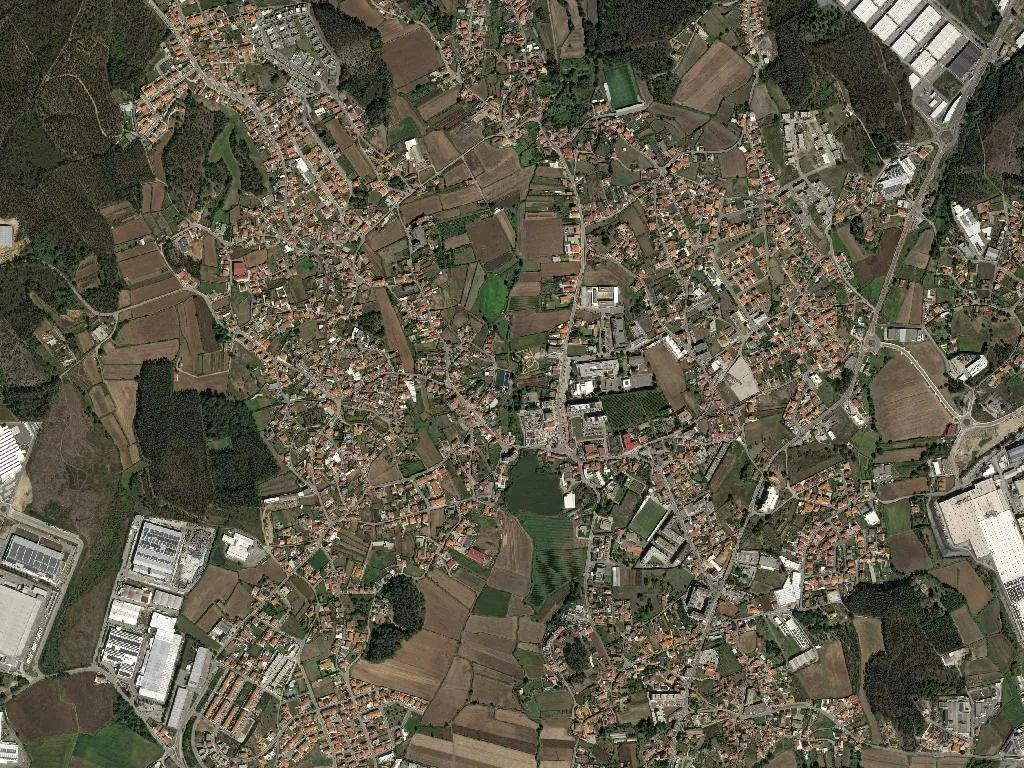
The parish sits in a shallow bowl of the Ave valley, rising from 30 m at the quays to 150 m on the Franqueira ridge. Ten square kilometres contain 9,061 people – a density higher than Leeds – yet a two-minute detour off the EN105 drops you into a different century: stone granaries propped on mushroom-shaped staddles, ox-eye daisies growing from wall joints, and a silence that smells of turned soil.
Stone, cross and the pilgrim’s footnote
The parish church of São Tiago wears late-neoclassical restraint: triangular pediment, single lateral bellcote, whitewash that throws back the morning light like a photographer’s reflector. In the churchyard a granite cross, 1892, carries a Latin couplet: Hic peregrinus pausat et orat, nam Iacobi iter prope est. No marketing copy: the Coastal and Central Portuguese Caminos genuinely overlap here for 2.8 km before peeling apart at Lugar do Canto. Way-markers are yellow, scallop shells fresh from the printer, and the only sound is gravel under trekking boots.
Walkers pause at the Capela de São Sebastião (1698) in the hamlet of Casal for the obligatory stamp: baroque gilt inside, swallows nesting in the cornice outside. From here the medieval freight route to Guimarães once crossed the single-arched Ponte de Ribeirão, first mapped in 1758. The bridge’s granite is now bruise-black with moisture, but carts of green wine still rattle over it in September.
June smoke, January blood
Festas Antoninas turn the parish into a scented kiln. On the night of 12 June a twelve-metre pyre of cork bark and pine cones ignites to bless the fields; heat ripples the air above the rooftops, and resin drifts like cheap incense. The folk group Os Caminheiros strike up on concertina and side-drum, sardines blister over cane-thin grills, and Caldo Verde is ladled into Barcelos pottery bowls. Allegorical floats draped in marigolds and maize sheaves crawl along Dr Leonardo Coimbra Street, proving that harvest wagons can still outshine diesel tractors.
Ribeirão’s year, though, tastes of sarrabulho – pork and cumin-darkened blood stew, served beside Minho-style rojões that have been marinated overnight in house white, bay and garlic. January’s São Sebastião feast lays the same table in the open air: cabidela rice, smoked morcela, and a priest who sprinkles holy water over geese, tractors and pet Labradors. Dessert is local turf war: fatias de Ribeirão – a 1960s puff-pastry-and-egg invention from Pastelaria Central – compete with almond charutos from Casa Katy and the heavier, yolk-rich toucinho-do-céu of Confeitaria Silva. All three cafés sit within 200 m of each other; neutrality is impossible.
Vine terraces and the last granaries
The signed Ave Trail runs five kilometres upstream to the Pedra Salgado viewpoint, threading past kingfisher banks and water-mill ruins whose millstones have frozen mid-rotation. Terraced Loureiro gives way to oak and alder, then to maize plots loud with corn buntings. The streamside section lies inside the Natura 2000 network, so dragonflies and midwife toads get the same legal protection as the vines.
Ribeirão’s wine is Vinho Verde by geography and temperament. In 1952 the local co-op became the first in the region to bottle rather than bulk-ship – the labels read simply Adele de Ribeirão and went to Rio de Janeiro by sea. Today Quinta da Lixa still sells wine in 5-litre clay talhas, and the first August weekend corrals 22 producers into the Feira do Vinho Verde, pouring Arinto alongside corn bread and peppery chouriço.
Across Portugal the wooden granary is almost extinct; here seven survive, more than anywhere else in Famalicão. The Casal example has been mini-museified by the Ave Valley councils – rye straw still on the floor, maize cobs hanging from the cross-beams, a smell of dried thyme and mouse dust. Stand inside and you understand the economy that built every wall you have walked past.
Two yellow arrows, one decision
Back on the Camino the shared stretch ends abruptly at a T-junction of dirt. A yellow arrow points west to the coast, another inland to Braga and the Spanish border. Most hikers stop at the stone trough on Rua do Meio – once the communal laundry – to splash chlorine-cold water on sunburned necks. From here the bell tower of São Tiago is a paper cut-out against the ridge; beyond it, unseen, a cork-and-pine bonfire will already be stacking for next June. The air carries exactly three notes: resin, vine leaf, wet granite. You will smell them again, years later, in some other country, and know you are remembering Ribeirão.