Full article about Seide’s Dawn Bell Still Rings for the Fields
In Vila Nova de Famalicão’s merged parish, woodsmoke, saints and chourička coins endure
Hide article Read full article
Woodsmoke at Seven, a Bell at Nine
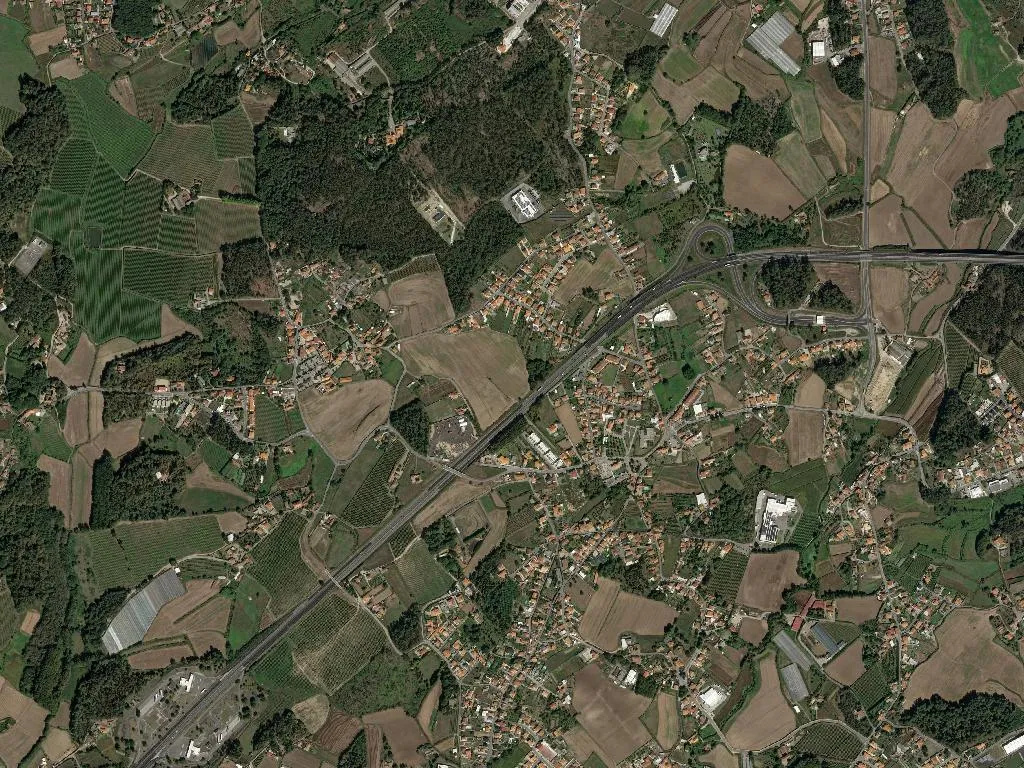
By seven o’clock the air in Seide is already laced with woodsmoke. Kitchen fires are catching, coffee is brewing and the village’s two bakeries have yet to raise their shutters. At nine precisely the lone bell of São Miguel rings, not for Mass but for the fields. Nine slow strokes recall the hour when labourers once shouldered hoes and headed for the small, hedge-bound plots that stripe the Ave valley. Only twenty-four registered farmers remain, yet the ritual survives.
The parish itself is a 2013 administrative marriage: 847 souls in São Miguel, 667 in São Paio, each side keeping its own council chamber—one in the mothballed primary school of 1956, the other in São Paio’s 1982 community hall financed by migrants who had spent the Seventies on Renault lines in the Paris suburbs. Each half still guards its feast day. On 29 September São Miguel auctions off “blessings” (bottles of wine, a year’s supply of bread) and parades two eighteenth-century giants freshly restored in 2018. São Paio waits until 15 January, when every household receives a slab of bolo de São Paio—sweet dough baked with coins of spicy pork chouriça, a recipe lodged with the local business association in 1996.
Gilt Wood and Carved Granite
Inside São Miguel the high altar is not the usual Baroque confection but the signed work of José Álvares de Macedo, Braga’s master carver, completed in 1756. Twenty-three kilos of 22-carat gold leaf sheath solid cedar; the central panel shows St Michael pinning the dragon while the Sampaio coat of arms—paid for with Brazilian wine profits—occupies the predella. Outside, the 1784 granite cross was ordered by one Manuel Gomes “in memory of his father”; the lettering is still legible. Up the hill at Lameiras an 1872 cross marks the cholera boundary and the edge of the Morgados de Seide estate; on Palm Sunday villagers gather there first for the blessing of branches before walking to church.
Green Wine and Smoked Sausage
The Festas Antoninas, run by a residents’ committee since 1984, land on the weekend closest to 13 June. Saturday night ignites a pyre of old vine stumps in Dr Francisco Sá square; 350 kg of sardines freighted up from Matosinhos that morning are grilled over the embers. In the APAF parents’ association tent the caldo verde is stirred in a copper vat: 50 kg of Galega kale from Dona Alda’s garden, 80 kg of local potatoes, 40 smoked-meat chouriças cured by Sr Arnaldo in the disused olive press behind the church.
The wine on the tables is Lagar de São Miguel’s Loureiro 2022—3 000 bottles from a 1.2-hectare schist vineyard at 180 m. If you sit down to cozido at the parish’s only restaurant, A Ramada, the sausages come from Domingos the butcher in Riba de Ave, the broad beans from 0.8 ha behind the football pitch, the porco bísaro fat from a farm in nearby Vilarinho das Quartas. After Sunday Mass the bolo de São Miguel is sliced by four women who have been up since five: 4 kg of flour, 24 yard eggs from Dona Rosa, and aniseed bought at Costa’s grocery, open since 1957.
Stream, Vines and Stone Paths
The Seide stream rises at 240 m in the Bouça hamlet, slips past smallholdings and tumbles into the Ave by the Calçada watermill. Rebuilt in 2021 with €38 000 from the national recovery fund, the mill’s 2.2 m oak wheel—sourced in Caminha—once ground 50 kg of maize a day when the river allowed. Beside it the medieval bridge, an eight-metre arch consolidated in 2019, carries the 12 km circular River Ave Trail up to the 1698 hermitage of Nossa Senhora da Saúde, built to house a plague statue that toured parishes during epidemics.
Vines cloak 42 ha of hillside in pocket-sized plots averaging 0.3 ha. Loureiro and Arinto are trained high on ramadas so vegetables can grow underneath. Pickup trucks converge on the cooperative press, founded 1962, on the Tuesday after 15 September; twenty-five friends and cousins foot-tread the grapes for two days. A private watermill at Outeiro still shelters a 1934 cast-iron press stamped “Fábrica de Leões, Guimarães”, silent since 1987.
Pilgrims on the Central Portuguese Way rarely linger, choosing the variant that drops to the sixteenth-century bridge and the river path beyond. Those who do stop will find the parish stamp in their credencial: a hand-drawn Santiago cross super-imposed on São Miguel’s bell tower, posted from Paris in 2015 by a Seide emigrant who wanted his village on the map.