Full article about Woodsmoke & Loureiro: Atiães in Spring
Café aroma, baroque gold, river-cooled vinho verde: Atiães, Vila Verde
Hide article Read full article
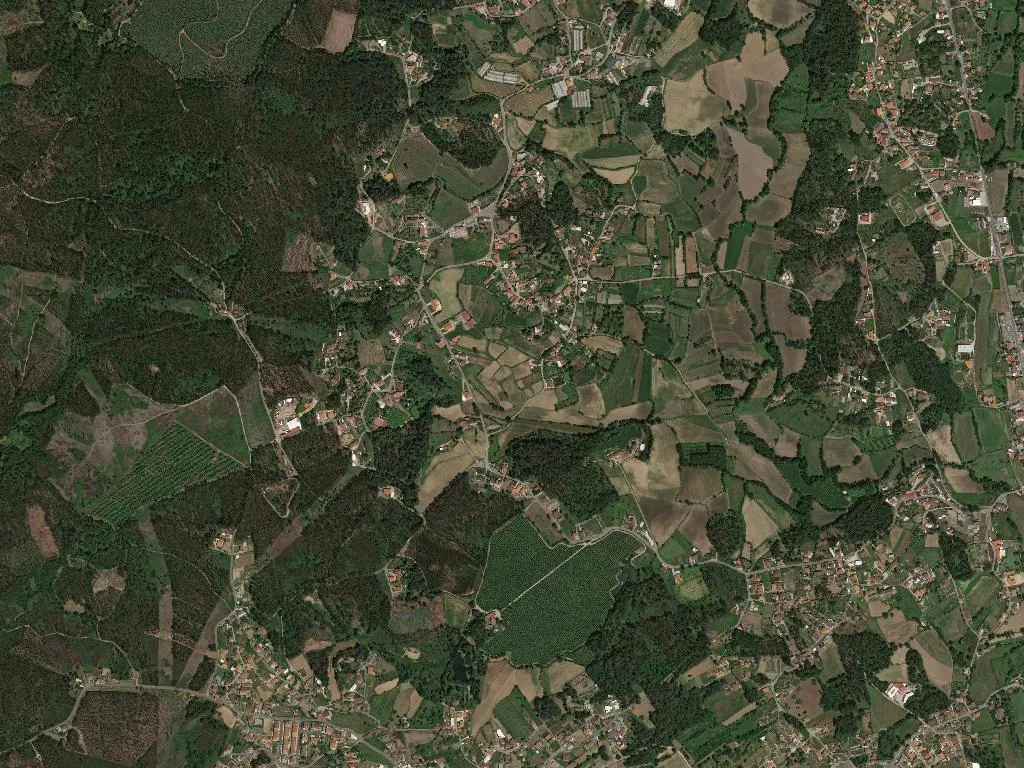
Woodsmoke drifts through the open doorway of the only café in Atiães, braiding itself with the vanilla-sugar breath of cavacas cooling on wire racks. An elderly farmer lowers his voice: the loureiro vines are budding early this year, the bunches already tight as fists. Outside, the river slips between terraces of vines stitched to wooden pergolas in 18th-century geometry; the water’s murmur accompanies every footstep along the narrow, packed-earth paths that ribbon the 60-metre valley.
Stone that remembers
The parish church of Santo António anchors the square like a gilded ship. Inside, candlelight ricochets off a carved-and-gold-leaf baroque altarpiece, throwing amber halos onto whitewashed walls. In the forecourt a granite crucifix, dated 1783, leans slightly from centuries of processions shouldering past. Walk ten minutes towards Casal and you meet the chapel of Nossa Senhora do Bom Despacho; on the first Sunday of May its single nave fills with pilgrims who have walked from neighbouring valleys, concertinas squealing, folk dancers clacking sticks in time.
Scattered through the parish are the working relics of earlier economies: watermills gutted by the river they once harnessed, stone granaries still storing corn above ground, two perfect-back medieval bridges that once ferried pilgrims between Barcelos and Braga. The name Atiães first appears in the 1258 Inquiries as ‘Athianes’, probably from the medieval verb atiar – to kindle, to set something alight – a reminder that this has always been a place where things are made.
A lunch that tastes of the valley
At “O Moinho” the menu is the landscape rearranged on a plate. Papas de sarrabulho – a rich, cinnamon-dark stew of pork blood and cumin – arrive steaming, sharpened by a glass of loureiro vinho verde whose citrus snap slices through the fat. Roasted kid, glazed in the wood-fired oven, is served on a bed of rice laced with the peppery bite of turnip greens. On feast days the star is Cachena beef from the Peneda hills, its deep flavour the result of cattle that graze above 1,000 m; dessert is local heather honey, the hives wrapped in traditional cork jackets.
Yet Atiães is known, above all, for its cavacas – brittle domes of egg-white dough iced with powdered sugar, light enough to shatter at first bite. They travel to markets throughout the Minho, each one a edible postcard of grandmothers’ kitchens.
Walking among vines and Roman arches
The PR1 Vila-Verde–Atiães drops from the village to the riverbank where grey herons stand motionless among reeds. The trail passes ruined mills still smelling of damp granite and flour. Link onto the PR2 Atiães–Rio and you cut through orange groves and Quercus robur woods before emerging onto alluvial terraces that roll like gentle swells toward the horizon. There are no signposted selfie spots, only the crunch of your boots and, occasionally, a blackbird’s metallic call.
At Quinta do Outeiro, beside the chapel, the grower pulls corked bottles from a fridge under the vines and pours vinho verde straight from the tank. His pergola frames a single-arched Romanesque bridge that has carried everything from pack animals to combine harvesters; the stone is polished to a low sheen by 900 years of traffic.
The procession of work
On the Sunday closest to 13 June, agricultural tools replace saints: hoes, ox-drawn ploughs, wicker baskets line the route of the procession of St Anthony. Locals call it the cortejo do trabalho, a slow-motion parade that thanks the soil for sustaining all 547 residents. After Mass, sardines blister on open grills, a folk-dance circle widens on the churchyard stones, and the night air smells of charcoal and fennel.
When the last accordion chord fades, house lights click on one by one, revealing the river’s steady glint as it threads the valley east to west, carrying with it the memory of everyone who ever stopped, worked and stayed a while in Atiães.