Full article about Vila Verde e Barbudo: Vinho Verde vapour at dawn
Low vineyards exhale into the Tâmega, granite posts stitch green nets, wine is the land.
Hide article Read full article
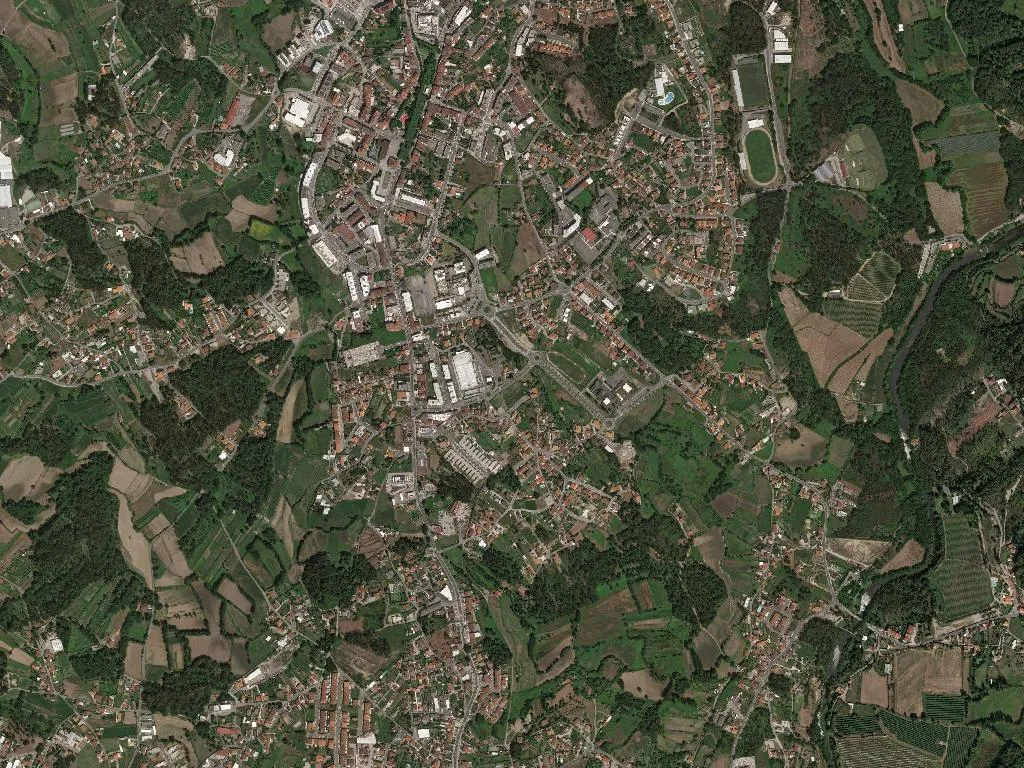
The scent arrives before the sight: a green, faintly sharp perfume of unripe grapes rising from the soil while the last of the dawn mist still clings to the vines. At barely 66 m above sea-level, the vineyards of Vila Verde e Barbudo lie so low that the foliage seems to exhale straight into the River Tâmega. Walk any farm track here and the trellises spread out like low green nets, stitched to the ground by granite posts. Footsteps sink into springy turf; the only other sound is irrigation water ticking along stone-lined channels. This is Vinho Verde country, but the wine is not a marketing flourish—it is the very warp of the landscape.
Two banks, one parish
The place name itself records an 18th-century marriage. On one side stood Vila Verde, already the municipal seat; on the other, Barbudo, a scatter of houses on the east bank of the Tâmega. Administrative tinkering in 1836 fused them into a single parish, yet the two temperaments remain. Around the town hall and the parish church the streets feel sociable and slightly compressed, while across the water Barbudo dissolves into meadows, arbours and a silence broken only by a tractor’s uneven heartbeat. With 7,376 inhabitants squeezed into 752 hectares, population density is high for rural Minho, but the horizon is so wide that nobody notices.
Granite, faith and three days of Saint Anthony
The parish church, built of pale local granite, anchors the civic calendar. Mid-June belongs to Santo António: processions move at a processional pace under midday heat, brass bands echo off whitewashed façades, and long outdoor tables buckle under clay bowls of sarrabulho rice—pig’s-blood rice spiced with cumin and bay. Two smaller festivals follow in quick succession—the Romaria de Nossa Senhora do Bom Despacho and the parish’s own Saint Anthony fair—one devotional and candle-scented, the other louder, lubricated by plastic jugs of white wine thrust into your hand before you can refuse.
What ferments in Barbudo
Outsiders still associate this corner of Minho with ox-carts and granite granaries, yet the most celebrated craft brewery in northern Portugal—Letra—was started here in 2013 by former University of Minho students. They chose Barbudo for the same reasons the Romans planted vines: pristine water, stable temperatures and quick access to Braga’s thirsty student population. Inside the modern brewhouse, stainless tanks glow like oversized laboratory glass; outside, the same watercourses that feed the hops irrigate Loureiro and Trajadura vines. The resulting wines taste of wet stone and green apple, while Letra’s imperial stouts age in bourbon casks once used for Port. Order a flight at the tap-room bar and you can pair both worlds—tangy mineral white followed by coffee-dark beer—without leaving your stool.
The jurist who walked out of the vines
Barbudo also produced one of Portugal’s more unlikely cosmopolitans: Machado Vilela, born in 1871 in a farmhouse now marked only by a marble plaque. After reading law at Coimbra he served as a judge in Alexandria, mixing with the cotton traders and Levantine diplomats whose disputes he mediated. Letters sent home describe camels on the quayside and the smell of cumin drifting across the Nile—sensory memories that must have sounded hallucinatory to neighbours who had never seen the sea.
Walking at water level
The relief is so gentle that the river itself becomes your handrail. A three-hour circuit starts at the Romanesque bridge in Vila Verde, crosses the Tâmega, then follows field edges to the Castros of Barbudo and S. Julião—Iron-Age platforms now turfed over and grazed by cattle. You need trainers, not hiking boots; the only vertical gain is the flight of steps up to the 1950s cooperative winery, currently being converted into an interpretation centre where the original cement lagars will double as exhibition plinths. Between the vines, irrigation channels catch the sky like strips of polished pewter; when the sun drops they turn matte and silent, until an eel flicks and the whole mirror shivers.
There are just nine places to spend the night—two self-catering apartments carved from haylofts, a pair of 19th-century manor houses with iron verandas, and five modest rooms above cafés. None has a concierge; check-in is often handed over by the baker once he has locked up. Braga, with its Roman temples and Friday-night crowds, is 18 km away—close enough for dinner, far enough that the drive back feels like rewinding the calendar by several centuries.
Evening settles with the smell of wood smoke and crushed vine leaves. The granite glows rose, then grey; finally the only light comes from mercury lamps hung above the trellises to deter wild boar. Stand still and you will hear it—a liquid pulse in the drainage channels, steady as a small heart. It is the sound of water returning to the river, and it stays with you long after you have driven west towards the coast, a low-frequency reminder that this plain is breathing.