Full article about Caldas de Vizela: Vila Where Warm Earth Breathes
Caldas de Vizela’s steaming Roman springs, Belle Époque spa villas and Queen-approved Thermal Hospital await in Braga’s Minho hills.
Hide article Read full article
Caldas de Vizela: where the earth still exhales steam
The first sensation is not visual — it is thermal. A low, moist heat rises through the grille that covers the Fonte de São João, brushing your ankles like a cat. Close behind comes the smell: struck-match sulphur, iron-rich and faintly metallic, the olfactory signature of water that has spent millennia underground dissolving rock. Locals step forward, fill battered plastic bottles without ceremony, and tuck them into shopping bags as if they were picking tomatoes from a neighbour’s plot. The water emerges warm even in January, naturally carbonated, and is still taken home to ease chests and soften skin. Caldas de Vizela grew up around this perpetual exhalation; the village is literally built on what seeps through the ground.
The vapour that lured a queen
The name is honest: caldas derives from the Latin for warm waters. By the early nineteenth century doctors were prescribing the springs for both respiratory and dermatological complaints — one of the very few Portuguese spas cleared for both. Word reached Queen Maria II, who sampled the cure in 1852 and conferred instant prestige. Architect José Ferreira Costa gave that prestige granite form: the Thermal Hospital, begun in 1881 and now a listed monument, rises with institutional gravity at the end of a chestnut-lined avenue. Its sober neo-Pombaline façade still overlooks the same park where Victorian bathers in top hats and crinolines once promenaded between appointments for sulphurous baths and controlled steamings.
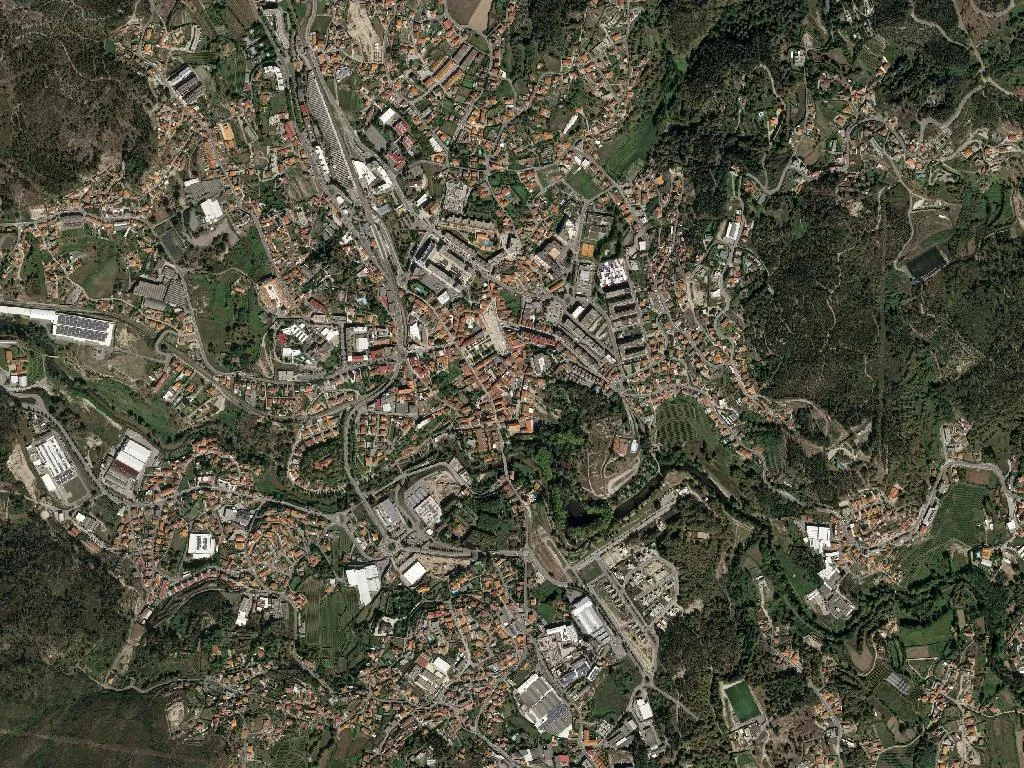
The spa trade shaped the street plan. Bourgeois villas from the 1890s — wrought-iron balconies, ornamental string-courses, hand-carved doorways — line Rua Dr. António José Ferreira like pages torn from a catalogue of Minho Belle Époque. In the middle of it all, the bandstand in Praça da República still hosts summer concerts; the brass echoes off stucco and stone exactly as it did when the village was elevated to vila status in 1925 on the back of medicinal tourism.
Gilded woodwork and azulejo-filtered light
The parish church of São Miguel, raised to National Monument in 1910, is the other anchor of local pride. Step inside and baroque drama takes over: a gilded altarpiece catches slanted light, throwing caramel reflections onto eighteenth-century blue-and-white tiles that narrate the life of the archangel in comic-strip panels. Walk five minutes and you can complete a miniature architectural circuit: the smaller Igreja de São João, then the 1882 railway terminus, its narrow platform and glass-and-iron canopy intact, even though the last train left in the 1980s. Everything sits within a ten-minute radius; the village fits comfortably into the palm of one hand, with room left for the obligatory sun-drunk cat on the pavement.
Minho on a plate: rojões, caldo verde and a liqueur that tastes of the spring
Caldas eats like the Minho always has — unapologetically. Rojões arrive in a clay dish, pork shoulder glossed with paprika and its own rendered fat, flanked by a brick-red papas de sarrabulho thick enough to hold a spoon upright. Kid goat is roasted slowly in a wood-fired oven until the aroma drifts out of kitchen vents and colonises the street. Between courses, a tureen of caldo verde delivers the silky texture of hand-shredded kale; afterwards, convent sweets — toucinho-do-céu and the local pudim de São Miguel — supply the sugar rush perfected by nuns with time on their hands.
The sub-region of Basto supplies the wine: young Vinho Verde with a razor-line of acidity that slices through pork fat. Finish with the house licor de ervas da Calda, still made by former spa families who cut the spirit with water straight from the spring. One swallow and that same metallic note returns, a liquid souvenir of the Fonte. Drop into Zé do Pipo for an espresso and you will find an unlabelled bottle parked on the counter; ask and a thimble is poured gratis — hospitality before marketing.
Vine terraces, river pools and a railway turned cycle path
The Vizela valley lies at 145 m above sea level, its slopes quilted with pergola-trained vines and orchards that flicker white with orange blossom or yellow with persimmon according to season. Behind the spa, the Mata da Quinta das Caldas offers 12 ha of deciduous woodland threaded with footpaths; blackbirds tick in the undergrowth and traffic noise is replaced by leaf-fall.
Follow the river south and the water widens into mirror-calm pools where kingfishers dive. For distance, take the ecopista that reuses the abandoned Guimarães line: 12 km of dead-flat tarmac skirting vineyards and smallholdings, silent except for bicycle hum or the occasional farm dog. Morning is best, when valley mist lingers and dew turns every spider web into silver filigree. Take an empty pannier: on Fridays a man from Famalicão sets up a card table at the crossroads and sells homemade couratos — cured pork skin that shatters like toffee.
São John’s bonfires and the pilgrimage of São Bento
Festas still govern the calendar. On 24 June São João brings bonfires and street dancing; on 29 September São Miguel reprises the ritual with the extra gravitas of a patron saint. But the high point is the Romaria de São Bento das Pêras every July: procession, brass bands, open-air ball, and smoke from sardine grills thick enough to rival the usual sulphur plume. During the week-long fair, the weekly market swells to include wood-turners and ceramicists whose families once served spa visitors — proof that Caldas has always been a place people pass through and end up staying.
When the last firework dies and the square empties, the thin white thread of steam is still rising at the spring. A resident screws a cap onto a filled bottle, pockets it, and walks home without looking back — a gesture repeated so often it no longer requires thought.