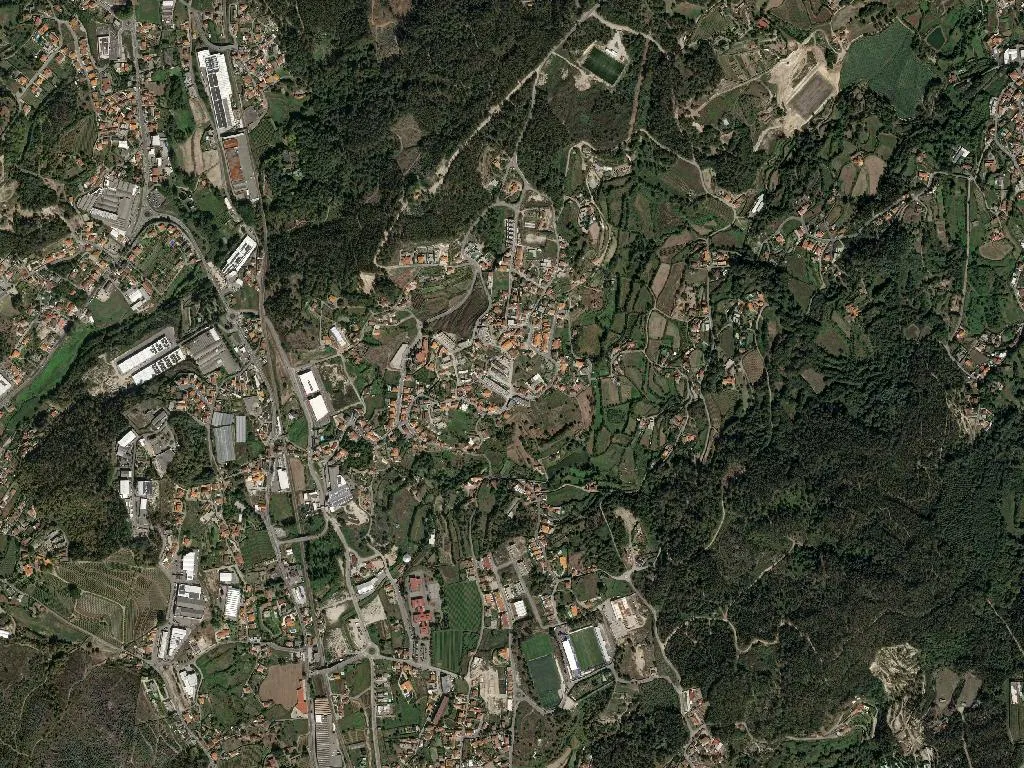
Full article about Infias: Where Granite Fountains Still Tick Like Clocks
Vizela’s village of 42 spellings, 18th-century spouts and vineyard terraces above the Ave.
Hide article Read full article
The granite fountain that still keeps time
Even at high noon the granite of the Água Nova fountain sweats moisture. A single spout has run without interruption since 1753 — the year chiselled into the stone — feeding a stone tank where cabbages are still rinsed and aluminium watering cans refilled. Behind it, the parish bell tolls three o’clock, the metallic note ricocheting off nineteenth-century manor walls before dissolving among the vineyard terraces that step down to the Ave valley. Infias keeps two clocks: water and bronze. Neither has ever been retired.
Forty-two ways to spell the same place
Between 1527 and 1911 the parish name appears in tax rolls, marriage licences and council edicts in forty-two different orthographies — Inffias, Enfyas, Hynhiias — a paper trail of illiterate scribes trying to trap local speech. Linguists argue over the root: the 1756 Diccionario Geográfico suggests “infa”, meaning low, fertile ground, while others point to the dense, soggy undergrowth that still fringes the Fermil stream. Whatever the spelling, the topography is constant: maize terraces climb to 300 m, Azal and Loureiro vines root in acidic granite, and the stream slides over quartz-white stones into deep swimming holes locals call “pozas”. At the centre stands the parish church of Santa Maria, rebuilt 1723-45. Inside, a 1734 gilded altarpiece catches flickers from 1742 blue-and-white tiles depicting the life of the Virgin. In the forecourt a modest monument honours Father Adelino Rosas (parish priest 1958-92) who bullied the state into building a primary school in 1963 and an agricultural co-operative five years later.
The climb to Santa Ana
From the church a cobbled lane climbs five kilometres to the chapel of Santa Ana on Monte de Alijó, past threshing floors, ruined water-mills and waist-high stone gutters once used to pipe drinking water to both Infias and the spa town of Caldas de Vizela. The chapel was erected in 1920 by land-owner José Alves da Silva; ownership passed to the parish only after decade-long pilgrimages in which entire families hiked uphill carrying lit candles. The ritual survives every 26 July: procession, open-air mass, almond-and-pumpkin pastries sold from card tables, then dancing on the dust until the sun drops behind the ridge. At 285 m the view stretches across Vizela’s amphitheatre of vines, the contours drawn like green contour lines on an OS map. Oak and cork oak shade the slope; the only sound is wind sorting the leaves.
Cast-iron pots and convent pears
Kitchen protocol is strict. Rojões — nuggets of pork shoulder — are braised in white wine, garlic and bay, served with door-stop wedges of warm maize bread. Salt cod is roasted over a wood fire with potatoes cut “like French toast” so the edges crisp while the centres fluff. Turnip-and-bean soup smokes under a lattice of bacon. On 21 March, fields are blessed and “St Benedict pears” appear: hand-moulded egg-yolk sweets dusted with cinnamon for the parish’s spring feast. Meals are washed down with Vinho Verde from the Vizela sub-region, and in late summer the illicit aroma of strawberry-tree aguardiente drifts from backyard stills, the recipe whispered father to son.
Stone that remembers
The single-arched bridge over the Fermil carries the coat of arms of António da Silva Araújo, a Paris émigré who paid for fountain and church repairs in 1925. Similar escutcheons pepper the granite manor houses, reminders of fortunes made in Brazil and France yet never severed from the village. Local teacher and ethnographer Maria José Oliveira catalogued these memories in her 2003 book Memórias de Infias, rescuing oral histories that otherwise would have drained away with the stream. When engineers cut the Vizela bypass in 1998 they uncovered medieval stone granaries — proof that cereals were stored here long before sixteenth-century American maize reached the Minho.
Today the Ave Valley cycleway skirts the parish edge, linking Vizela to Guimarães through pine, vine and open meadow. In the café a slice of São Bento cake arrives mid-morning beside a bica served in a glass thimble. Outside, the Água Nova fountain still overflows, cold and constant, while moss colonises the joints of the granite. Infias is measured in gestures that refuse to expire: fill the can, toll the bell, climb the hill with a candle in your hand.