Full article about Vilarelhos: granite silence & saffron feast days
Hear the 1758 São Vicente bell echo over chestnut terraces where goats age cave cheese
Hide article Read full article
The granite hush of Vilarelhos
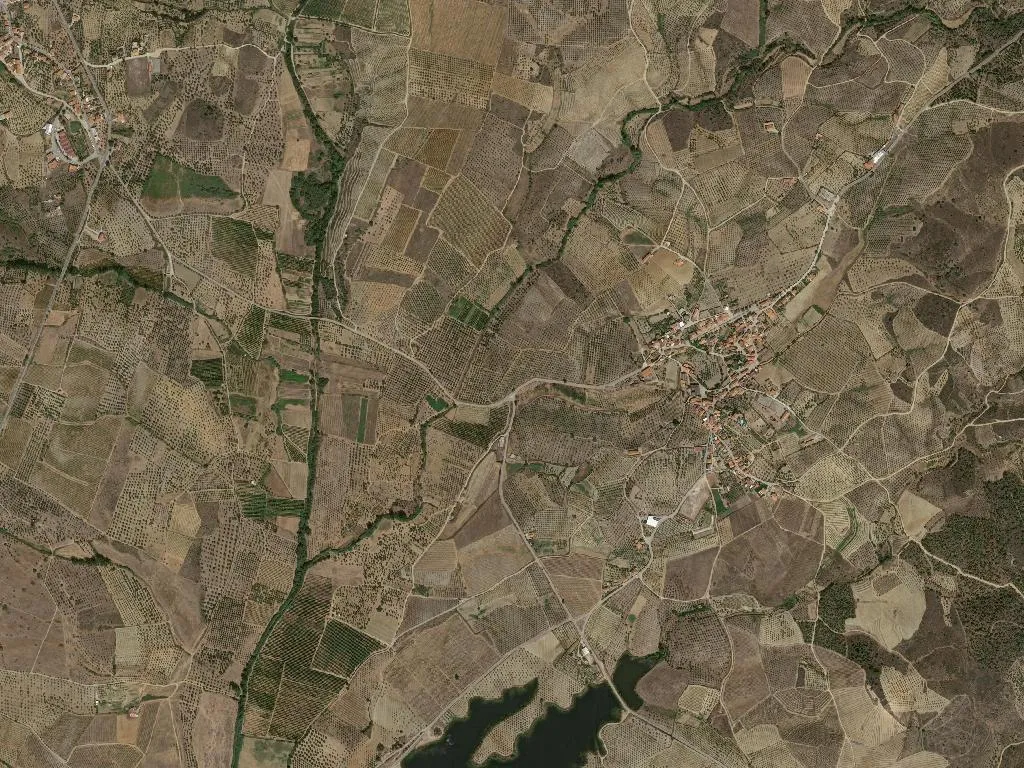
Dawn sidles through the slats of wooden shutters, laying diagonals of light across stone floors. In Vilarelhos, 214 metres above the Sabor valley, the only sound at this hour is the faint drift of the 1758 bell of São Vicente, commissioned by Canon Manuel de Sampaio and still tolling the quarters. Granite walls store the night’s cold; even after sunrise you feel it through your fingertips. Two hundred and seventeen people inhabit 1,103 hectares of gorse, olive and chestnut, a parish that fits inside London’s Hyde Park with room to spare.
A calendar kept by saints
The year is organised by four feast days. On 5 August the village honours Nossa Senhora das Neves; the procession inches down Rua da Igreja to an 18th-century stone cross where women in black mantillas once gossiped and men smoked in silence. Thirteen May belongs to Our Lady of Fátima, a devotion imported after 1917 by families returning from Brazilian coffee plantations. The third Sunday of January is given to St Sebastian, whose 1683 chapel shelters a confraternity that once doubled as the plague-watch committee. The final date, 17 January, is for Santo Antão da Barca: animals are led into the churchyard to be blessed, horns, hooves and Labrador paws clattering on basalt.
On these weekends the head-count triples. Grandchildren fly in from Paris, from Porto, from the outskirts of Lyon. Tables stretch under the weight of ovo-à-malbar (a saffron-scrambled egg loaf), rojões simmered in bay and pig’s-ear stock, and the olive-oil cake Dona Natália has baked in the communal oven since Churchill was in Downing Street.
The Transmontana larder
Vilarelhos sits inside the Planalto Mirandês sub-region, so every lamb grazing the cork-and-oak scrub is potential Terrincho DOP: 12–14 kg of milk-fed meat that ends up in terracotta dishes across Bragança. In back-yard dairies the black Serrana goat gives milk for Queijo de Cabra Transmontano, cave-aged 60 days on rye straw until it tastes of pepper and cellar stone.
From November onwards smokehouses wear necklaces of Presunto Bísaro de Vinhais IGP, hams that lose a third of their weight to the north wind sliding down the Sabor gorge. Inside every kitchen a clay bowl holds the formula for chouriça de carne: 70% shoulder, 30% dewlap, sweet paprika grown on the parish allotments, a splash of rough white. The chestnut groves, first planted by Benedictines from Castro de Avelãs in the 1200s, still cloak 42 hectares; their DOP fruit is roasted on metal sheets during the Magusto festival, the skins peeled with calloused thumbs.
Silence measured per square kilometre
Population density here is 18 souls per km²—lower than the Shetlands. Since 1981 the parish has lost 62% of its residents, a haemorrhage that began the moment the tar road reached Alfândega da Fé in 1963. One hundred and fifty-two dwellings are scattered across ridges, each with its bread oven, its concrete tank for washing, its fig tree pruned into a low umbrella. The only listed monument is the 1787 wayside cross where the parish council once met under the gaze of the Crown’s travelling magistrate.
There is just one place to stay: Casa da Fonte, the former forester’s house restored in 2017 with slate sills and a wood-stove that burns esteva—rockrose—whose resin perfumes the air like hot pine. At night you hear Mr Joaquim’s sheepdog, the last transhumant shepherd who still walks his flock up to the Marão for summer grass, and you understand why silence, too, can have terroir.