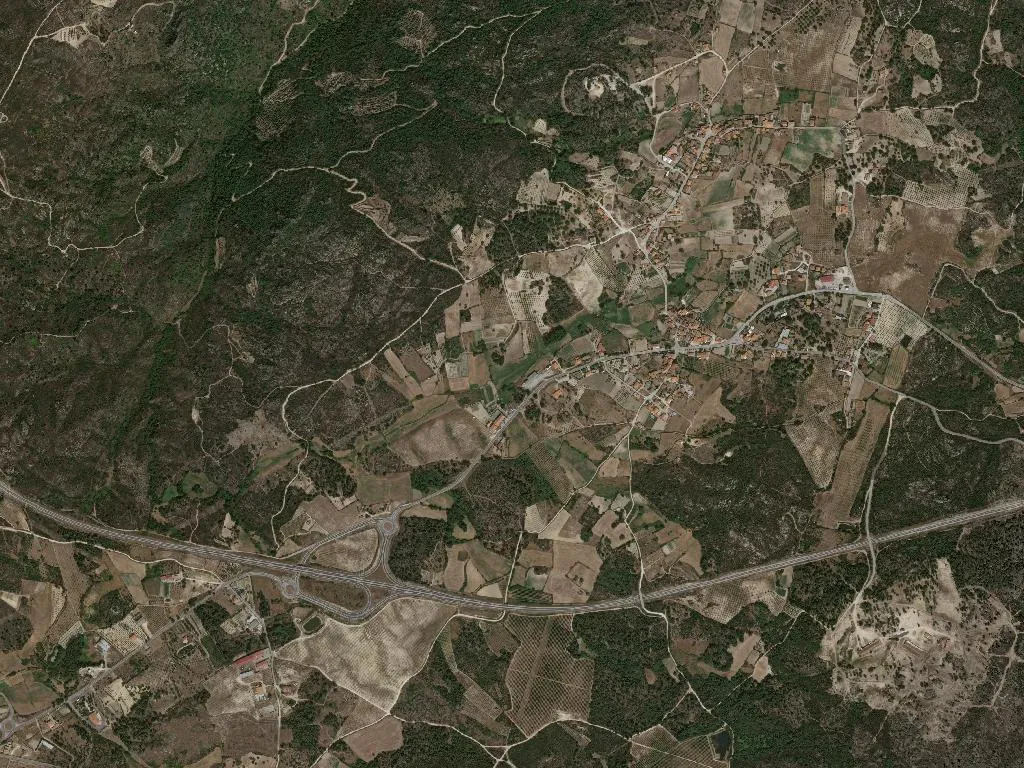
Full article about União das freguesias de Belver e Mogo de Malta
Walk a medieval flagstone road to hilltop sanctuaries above olive terraces in Trás-os-Montes
Hide article Read full article
Stone, Faith and Medieval Footprints
Granite warms under the late sun in the churchyard of Belver’s Igreja Matriz. A wind drifts up the Cabreira valley carrying thyme and the smell of parched soil. At 753 m the village justifies its name—"beautiful view"—with a horizon that loosens into olive terraces, wheat stubble and the rumpled edge of the Trás-os-Montes plateau. Only the bell or the thin cry of an eagle disturbs the hush.
History begins in 1194, when King Sancho I handed the land to the Knights Hospitaller on condition they build a castle. The Manueline charter arrived in 1518, yet memory is fixed more vividly in two Baroque churches: Nossa Senhora das Neves in Belver and Santa Catarina in Mogo de Malta. Whitewash catches early light; inside, gilded carving glints against cool gloom. Higher still, the hilltop sanctuary of Nossa Senhora da Saúde gives an aerial ledger of shale slopes, dark-green cork oak and the silver thread of the Ribeira da Cabreira.
The Calçada do Mogo, a medieval stretch preserved between dry-stone walls, coils westward like a vertebra of the old route that once linked Trás-os-Montes with the Beira Interior. Every uneven flag remembers merchants, pilgrims, flocks.
Carved Circles No One Can Read
Below the Fontelonga dam, the Fraga das Ferraduras exposes granite scored with concentric rings, crosses and semi-circles—Bronze-Age ritual graffiti still unpersuaded to give up its meaning. Yellow lichen powders the grey; secrets stay locked while water slaps the concrete and a blackbird rehearses phrases from somewhere upstream.
Plateau Flavours with Papers
The menu is not hypothetical. Queijo Terrincho DOP arrives firm, sheep-rich and gently sharp; Cabrito Transmontano DOP spends four hours in a wood oven until the skin lacquers itself. Local olive oil—Trás-os-Montes DOP—leans grassy on the tongue, its pepper catching the back of the throat when mopped with warm, rough-crumbed bread. During the romarias of Santa Eufémia or Nossa Senhora da Assunção, presunto and chouriça de Vinhais IGP are sliced so thin you can read the sky through them, washed down with tinta-amarela-based reds that stain the glass violet.
The Pace of Who Remains
A head-count of 364 souls—127 over sixty-five—sets the tempo. Processions still assemble at dusk, brass bands squeezing through lanes no wider than a hay-cart. Cantares ao desafio—improvised duelling ballads—ricochet across the churchyard. Walk the Calçada do Mogo at golden hour and each twisted olive and schist wall seems to recite the names of those who never left.
When the sun slips behind the Marão, the granite turns the colour of heather honey and the valley becomes a tapestry of long shadows. Oak-wood smoke lifts from chimneys, braiding with the dry night air that settles over the plateau like a second, invisible skin.