Full article about Sun-baked Schist & Smoke-cured Ham in Lagoaça-Fornos
Roman stele, vanished lagoon, 17th-c. Jewish palaces: a 786 m-high border plateau
Hide article Read full article
Afternoon on the Schist
The sun drops fast here, striking the tilted strata so that every flake of mica ignites. At 786 m the air is thin and scrubbed; it smells of sun-baked earth, crushed thyme, and, when the breeze skims a smoke-house, of sweet-curing ham drifting into the valley. Lagoaça and Fornos—formally fused into one parish in 2013—have always shared the same granite stubbornness and the same echo-minimum population of 443 souls. Silence is not empty; it is simply built of the same stone as the walls.
Stone with a Memory
Lagoaça’s Romanesque church squats on its ridge like a block of iron until you step inside: azulejos flare gold, candle-light ricochets off gilded carving, a single lump of granite, scooped into a baptismal font, holds four centuries of whispered names. Walk twenty minutes north-east and you are in Fornos where older layers surface: the Late-Neolithic site of Arcal, the Cruz do Montinho, the Moors’ mine. On the scrubby crown of Cabeço da Escória medieval graves are still cut into the bedrock, lids long gone. Even the railway halt—abandoned in the 1980s—yielded a Roman funeral stele, proof that this plateau has always been a corridor, a lookout, a place people passed through and stayed only if they were tough enough.
Manor Houses and a Vanished Lagoon
The name Lagoaça probably fuses “lagoa” (lagoon) with “ansa” (bend), though no waterbody remains; locals will gesture vaguely towards a field that floods in March. In the warren of lanes a handful of two-storey “palacete” houses still display 17th-century Jewish signatures—granite doorposts carved with candelabrum motifs. Fornos spent a brief, administratively confused interval (1896-98) inside Torre de Moncorvo’s council boundary, but its identity stayed anchored to the collegiate church across the river in Freixo de Espada à Cinta. Time is measured in transhumance cycles, not statutes.
Holy Week in Seven Movements
Easter here is choreographed like a slow ballet. On the Thursday before Good Friday the Seven Steps procession forms: no drums, only the scuff of rope-soled shoes and the creak of timber as men shoulder the heavy platforms. Women follow in black wool, lace veils snapping in the wind. Statues of Christ and the Virgin leave their side altars and advance through the village, pausing at seven candle-lit “stations”—a doorway, a corner, a fountain—before returning at dawn. The rest of the year keeps its own tempo: romarias to Nossa Senhora da Graça in August, stalls set up outside the chapel, wine drawn from plastic jeroboams, children darting between trestles while the brass band rehearses the same single-chord march it has played since 1952.
What the Land Gives
There is no menu, only the calendar. In March the first Terrincho lamb appears, shoulder slowly roasted with potatoes, bay and a rub of smoked paprika. April brings kid goat stewed until the bone gives up its marrow. Queijo Terrincho DOP, firm and butter-yellow, is cracked into rough shards and eaten with Negrinha de Freixo olives, small and ink-dark. Hams from Vinhais hang in every other kitchen; paper-thin slices dissolve on the tongue like alpine snow. Almonds—Douro DOP—surface in sugared slivers or simply roasted, their skins popping between molars. The wine is a dark, closed Douro red, poured from an unlabelled bottle that will be empty before the cheese rind is cold.
River Below, Ridge Above
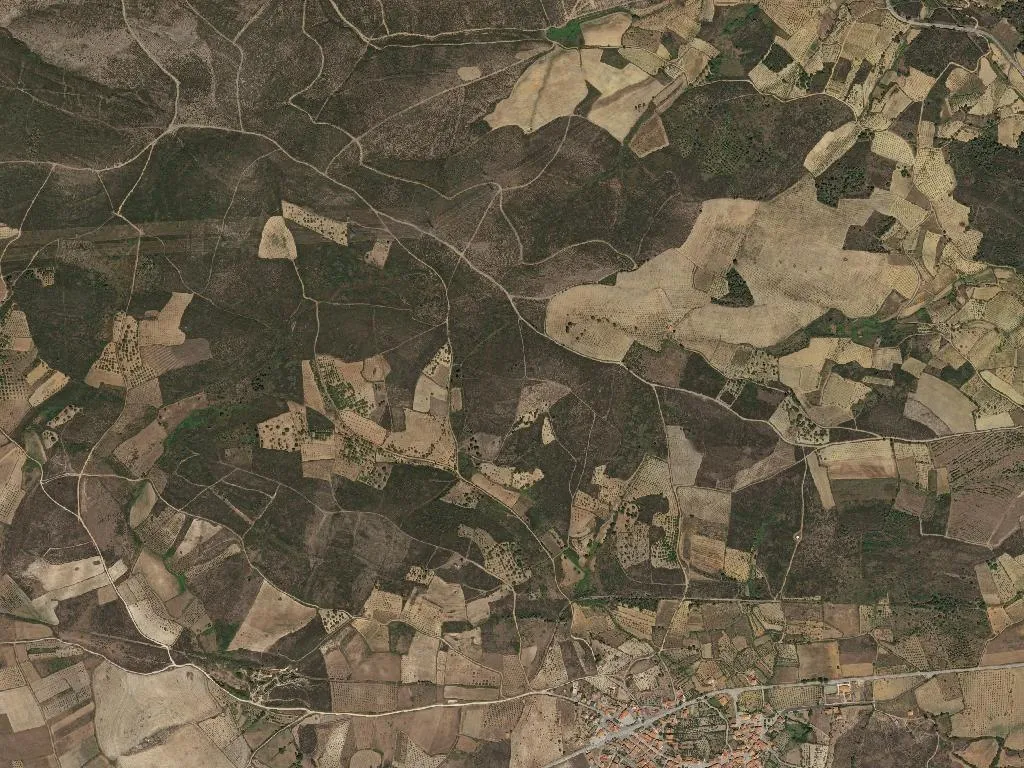
The parish lies inside the Douro International Natural Park; although the river itself is a 400-metre plunge away, its presence lifts the light and widens every horizon. Walking trails braid the plateau—between almond terraces, olive trunks warped into serpentine shapes, low maquis loud with the yelp of Bonelli’s eagles. The Carvalha path zigzags 6 km down to the water through holm-oak shade and resinous strawberry tree. You will meet no one, only the occasional shepherd on a Honda 90 returning from checking snares. Most visitors don’t come to rack up kilometres; they come to sit on the stone bench beside the Carqueja spring and let the wind do the moving.
Night arrives without announcement. House lights click on one by one, a dog barks once, and from across the dark the church bell counts the hour—not to hurry anyone, simply to remind the stones that time, like schist, is just another layer.