Full article about Poiares: Bragança’s Silent Almond-Scented Hamlet
Granite, goats and 327 neighbours in 40 km² of Douro canyon air.
Hide article Read full article
The Arithmetic of Silence
Sunlight ricochets off irregular cobbles, the heat so dense it feels almost liquid. At 473 m above sea-level, Poiares measures time by the pause between a blackbird’s phrase and the soft thud of a closing door. Its 327 souls are scattered across 40 km² of almond terraces and olive groves that tilt toward the Douro canyon, where the wind carries the resinous snap of rockrose and warm schist.
Eight People per Square Kilometre
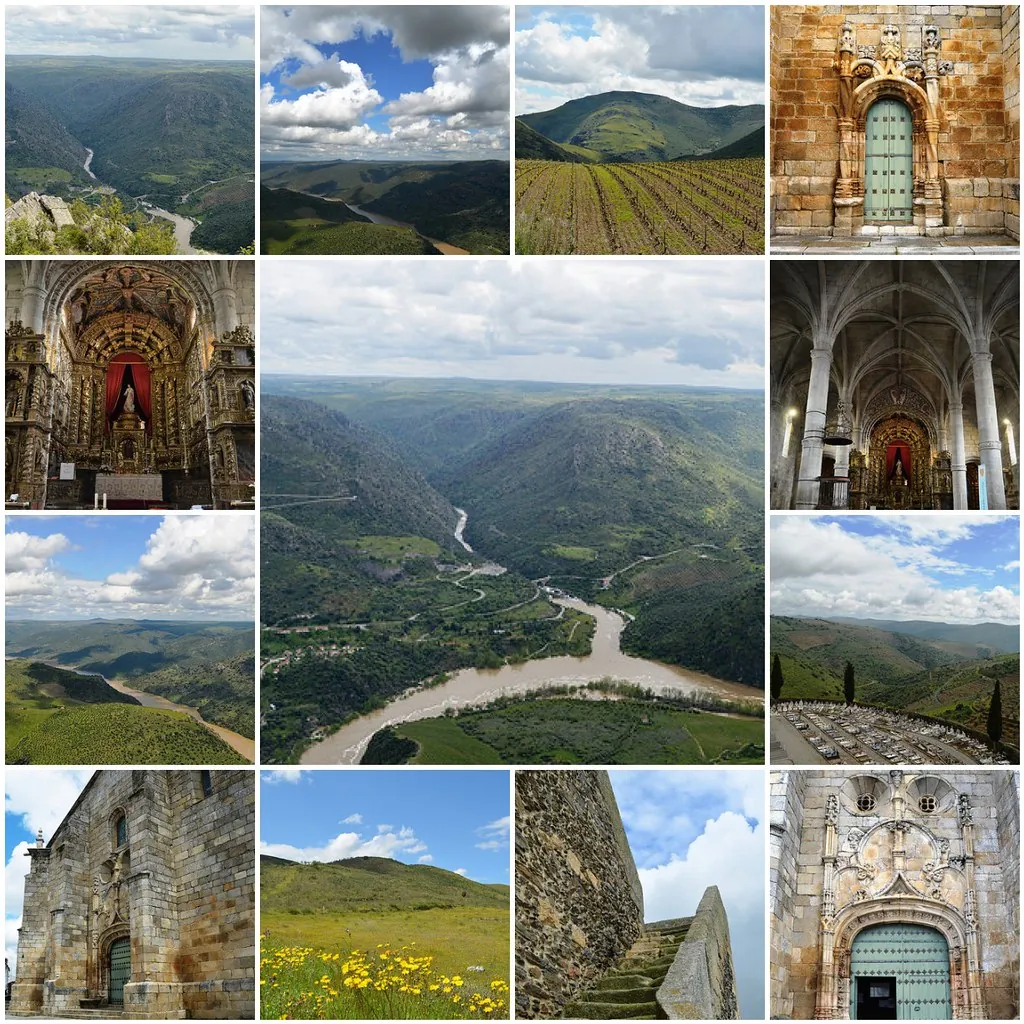
Walk thirty minutes in any direction and you will meet no one—only a far-off ribbon of chimney smoke and the sweet, tannic breath of oak logs stacked for winter. Hamlets are built in two materials only: blue-bleached timber shutters and granite that has forgotten its original colour. Two monuments interrupt the stone tapestry—the 16th-century Igreja de São João Batista, its Manueline portal carved with ropes and seaweed, and the granite Calvário cross that once guided trans-Sierra shepherds toward Bragança. Interpretation boards do not exist; memory is the only audio guide.
What the Lardon Holds
Food is portioned by the season, not the menu. Breakfast might be a shard of Terrincho DOP sheep’s cheese, sharp enough to make your salivary glands ache, followed by wood-oven kid whose crackling shatters like caramelised glass. In the sideboard you’ll find almonds sun-dried on terracotta roofs, then folded into linen sacks; Negrinha de Freixo DOP olives, small and liquorice-dark after months in brine; and Terra Quente honey, the colour of aged Madeira, its rosemary and gum-cistus notes lingering like a slow chord. If you’re invited for lunch, accept: the table will be laid with whatever ripened that morning—spring lamb and roasted potatoes, tomato salad bleeding peppery olive oil into the glaze.
River at the Edge of Hearing
Fifteen minutes east the tarmac stops and the Douro International Natural Park begins. From the miradouro the river appears as a blade of polished tin, snaking 200 m below the Spanish frontier. Griffin vultures ride the thermals; below them, cliff plants scent the air with thyme and chalk. Once a year the village breaks its cadence for the Festa dos Sete Passos, a candle-lit Good Friday procession whose incense drifts through alleys already perfumed by gunpowder from celebratory petardos. By nightfall the crowd disperses, and silence settles back over the rooftops like fresh snow.
Dusk ignites the sky in marigold and damson. Cicadas cut out mid-phrase. All that remains is the low gossip of wind in almond leaves and the metallic sigh of a gate. Nothing happens—and that is the entire point.