Full article about Arcas: Dawn Song Over Olive-Quilted Plateau
Mist lifts above stone tanks, accordion-led feasts & oak-smoked chouriça in Arcas, Bragança’s tinies
Hide article Read full article
Before the Sun, the Purple Jackdaw
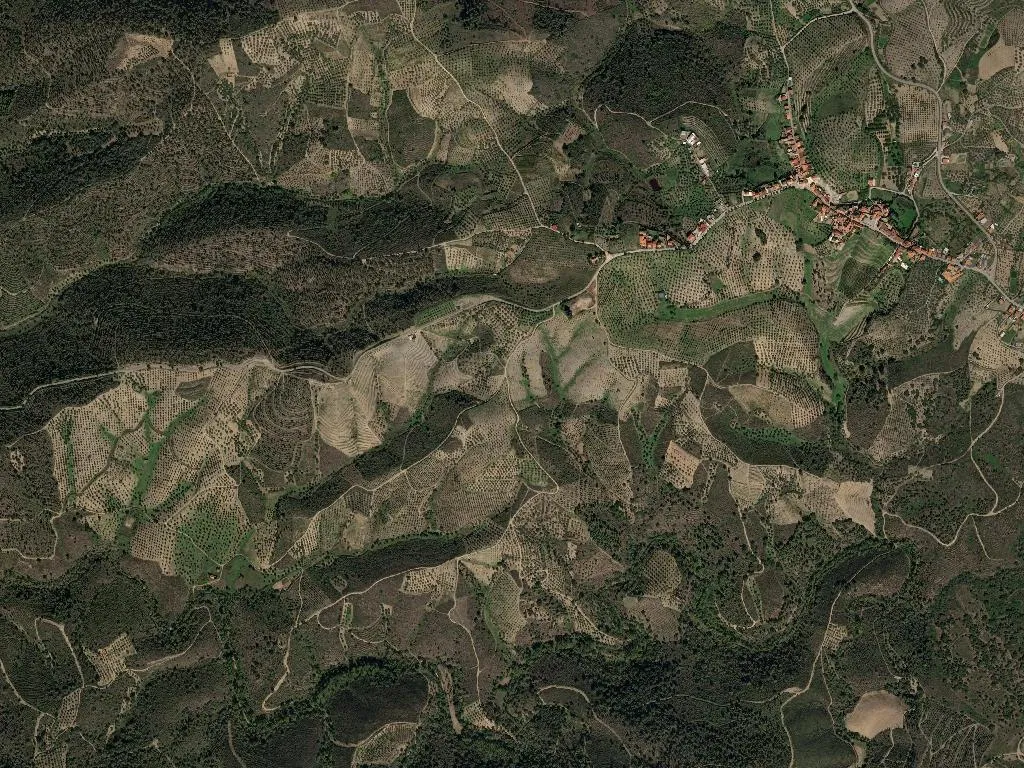
A purple jackdaw sings before the sun is up. Mist still cuffs the Ribeira de Arcas valley; the note cuts the dawn air and ricochets off schist walls that enclose vegetable plots. Arcas—215 souls, the smallest parish in Macedo de Cavaleiros—awakens. Below the houses, centenarian olive terraces quilt the plateau in a silvery-green pelt, trunks corkscrewed by Atlantic winds that barrel down the Serra do Viso.
Stone that Remembers
The granite parish church of Santo Ambrósio stands in the village centre, pediment plain yet quietly magisterial. Late-afternoon light drips through tall side windows, igniting the polychrome baroque retable inside. In the churchyard an eighteenth-century calvary marks the spot where women once paused on their way to the communal laundry—stone tanks and sculpted spouts still there, still wet with decades of scrubbed linen and gossip. A few metres on, the tiny chapel of São Pietro waits for 29 June, when accordion-led processions and drumbeats stir the lanes, raising dust that settles over a feast of malhadas—dense cornmeal cakes baked in wood-fired ovens that warm entire back gardens.
A Pantry in Slow Motion
Arcas does not invent; it refines. Migas of wild asparagus and smoked pancetta arrive steaming; DOP Trás-os-Montes olive oil pools on toasted rye. Lamb stew carries river-mint from the valley plots; kid goat chanfana is coaxed for hours in red wine until the meat sighs from the bone. On the board, Vinhais salpicão and oak-smoked chouriça share space with Terrincho DOP ewe’s cheese, coarse salt and a cool rosé from the Valpaços sub-region. Finish with Terra Fria DOP chestnut pudding, honey and cinnamon layering the palate with mountain sweetness.
Eight Kilometres of Breath
The Trilho dos Moinhos loops eight kilometres between Arcas and Vale de Prados, brushing three restored water-mills whose wooden paddles still turn when the stream swells. At dawn the Sabor valley fills with fog so dense it erases the trees; birdsong becomes the only compass. Later, from the Viso lookout, golden eagles and black-winged kites plane over Paleozoic schist and quartzite outcrops—rocks that hold four millennia of human footprints, including a polished Calcolithic axe unearthed during roadworks on the municipal 514.
Ten kilometres away the Azibo reservoir glints under open sky, but Arcas keeps its own tempo. In November, Quinta do Viso’s olives are hand-combed into baskets while low sun backlights each silver leaf. Evening brings chanfana to the iron pot at “O Sabor da Nossa Terra”, potatoes boiled in oil and coriander alongside. A final thimble of aged medronho brandy arrives in a stone cup, burning throat and chest like liquid peat.
When night drops, the church bell counts the hours; the echo lingers between stone walls. No one hurries to leave. There is only the scent of wood smoke drifting from hearths and the late-May chill that Maiato bonfires still try to push back—just as grandparents, and their grandparents before them, lit flames at crossroads to guard the herds and remind the valley that here time is measured in gestures, not hands.