Full article about União das freguesias de Castelãos e Vilar do Monte
Granite hamlets share slate roofs, Templar echoes and chestnut-scented winters in Trás-os-Montes.
Hide article Read full article
A cock’s crow ricochets off schist walls, then the slow scrape of a wooden door across uneven granite. Dawn at 583 m on the Serra de Bornes ridge is knife-clean; oak-wood smoke drifts down the lanes before the sun has time to dry the dew cartography between the stones.
Two hamlets, one bone
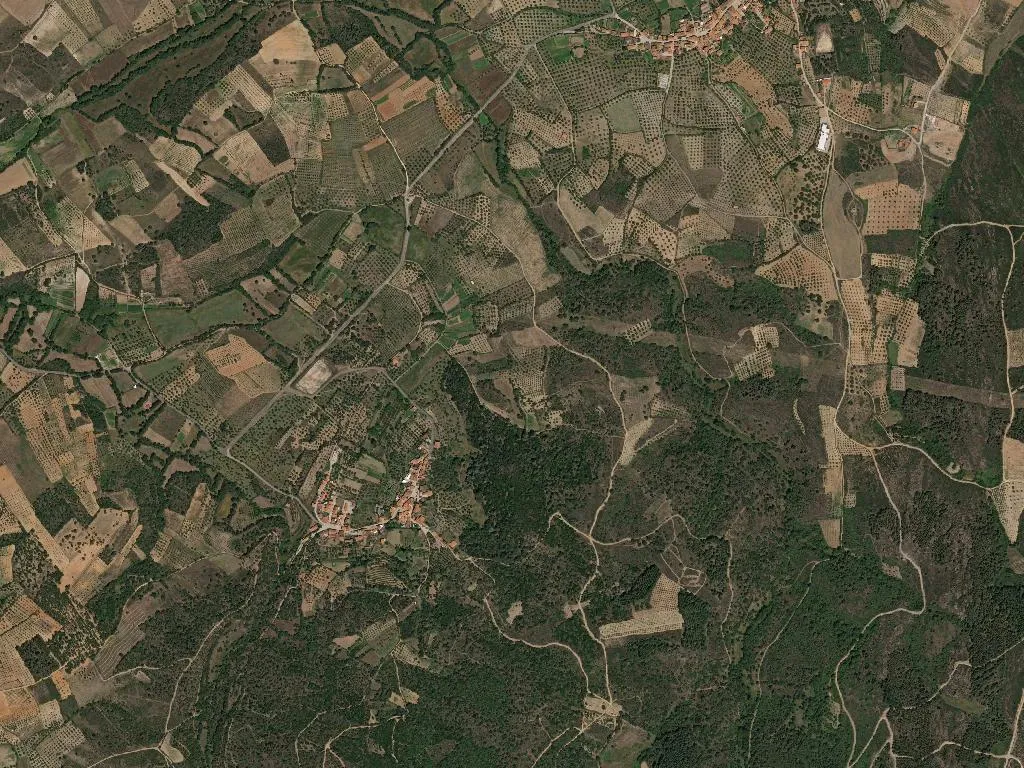
Castelãos and Vilar do Monte were welded together by the 2013 local-government shake-up, yet the landscape had already done the job. Both settlements are carved from the same caramel-coloured granite, terraced by identical dry-stone walls and capped with identical slabs of slate. The name Castelãos remembers a Roman watch-tower—later a medieval castellum—that once eyeballed these valleys when the Knights Templar and local counts squabbled over Trás-os-Montes. No battlements survive; instead you sense the fortress in the street plan: houses huddled shoulder-to-shoulder around the 16th-century Igreja Matriz, their backs forming an unintentional rampart against the winter wind.
Granite belief
Chapels here wear the same austerity as the houses—grey stone, zero ornament, designed for frost rather than flourish. On 7 December the parish honours St Ambrose with a dawn mass followed by chouriça from Vinhais roasted on vine prunings; 29 June brings São Pedro, when a brass band marches through lanes barely two metres wide and rocket smoke mingles with the resinous scent of eucalyptus. The bronze bells are irregular, deliberate, each strike travelling kilometres across the oak and chestnut canopy.
Fuel and memory
Food is not theatre; it is ballast. A thread of Trás-os-Montes DOP olive oil turns a wedge of hot corn-and-rye broa into something almost luminous. The regional feijoada spends an entire morning in a black-iron pot with Miranda beef and Vinhais ham, the flavours stratifying like geology. In October roadside braziers roast Terra Fria DOP chestnuts, their skins splitting to reveal honey-sweet flesh. Dessert is a slab of terrincho—a raw-milk ewe’s cheese, firm and faintly barn-yardy—on granite that keeps the loaf cool even in August.
Water and time
Five kilometres south-east the Azibo reservoir interrupts the plateau. Inside the Terras de Cavaleiros Geopark the lake is a mirror for 400 million-year-old schists, its margins a shuffle of heather, broom and holm-oak. Kingfishers stitch the surface; way-marked trails skirt centenarian olive trees whose trunks have been twisted by drought and nortada gales into living sculpture. The water is warm enough for wild swimming until late September, and the adjacent river beach of Fraga da Pegada has Blue Flag status—an anomaly this far inland.
The arithmetic of absence
The parish measures 19 km² and contains 457 souls—barely 24 per km². Census data reveal the imbalance: 202 residents are over 65. Morning activity is an elderly man pruning an olive tree, a woman feeding chickens, smoke curling from a fumeiro where alheira sausages swing like pendulums. Yet the silence is not vacancy; it is acoustic space in which every sound—water over granite, a distant tractor, chestnut husks popping in the fire—registers as small, stubborn permanence.