Full article about Corujas: smoke-houses, saints and 143 granite-silent souls
Above the Douro basin, the village of Corujas keeps its sausage-scented schist heart beating
Hide article Read full article
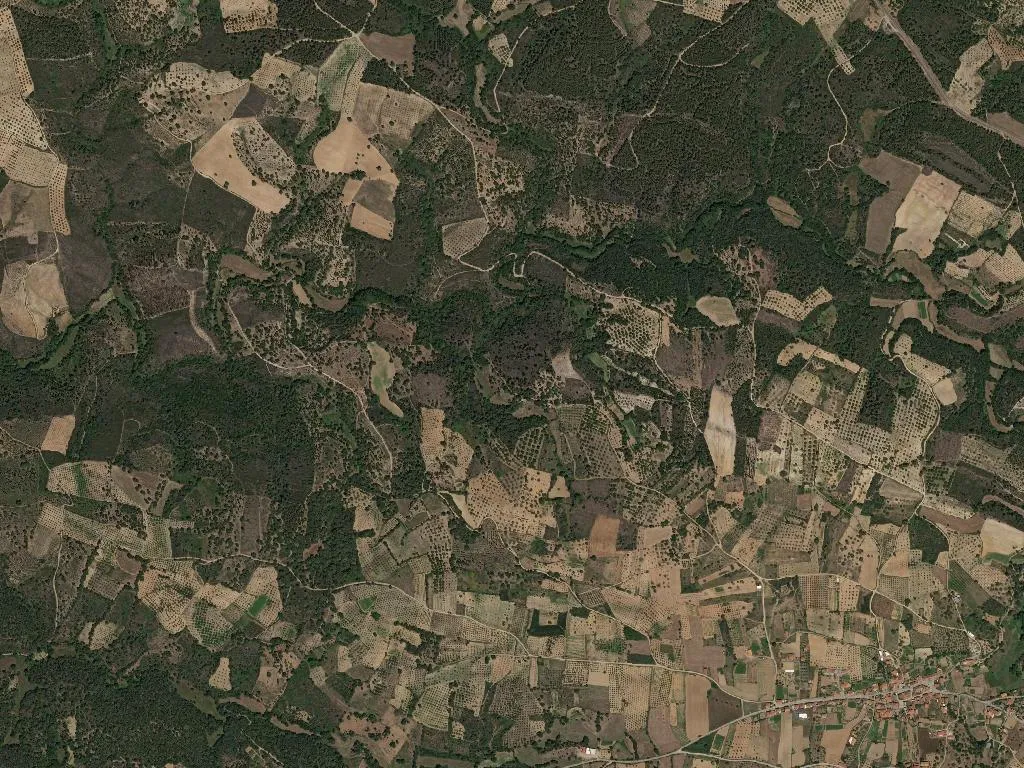
Oak-wood smoke coils lazily from the chimneys of Corujas, mingling with the scent of curing sausage suspended inside dark schist smoke-houses. At 668 m above the upper Douro basin, the hamlet’s roofs seem soldered to a granite rib of the Serra de Bornes; only 143 souls occupy these thousand hectares, and the silence is as solid as the stone.
Who stays, and how
The arithmetic is brutal: eight children, sixty pensioners. Morning belongs to the slap of carpet slippers on uneven cobbles, the low murmur of doorstep gossip that has recycled the same topics since the 1950s. Yet stubborn continuity thrums beneath the statistics. Smoke-houses are still restocked weekly, vegetable plots remain ruler-straight, and every passing stranger is announced by a volley of mongrel barking. The parish council keeps the font in working order; the bakery van calls twice a week. Life is pared back, not packed up.
Between Saint Ambrose and Saint Peter
Two dates punctuate the year: 7 December, Saint Ambrose, and 29 June, Saint Peter. On those nights the population quadruples. Emigrants from Paris and Nevers, construction workers from Lisbon, grandchildren who have never seen a wheat threshing, flood back. Long tables sprout under pergolas; Vinhais sausages – chouriça de carne, salpicão, presunto – emerge from hibernation, sliced thin and served with potatoes that taste unmistakably of high-plateau frost. Kid goat roasts over vine prunings, basted only with coarse salt, cracked garlic and Trás-os-Montes olive oil whose peppery bite can make you cough.
A landscape with protected flavour
The pantry around Corujas is a lesson in European labelling law. Terrincho DOP cheese, from the local Churra da Terra Quente sheep, carries a citrus-sharp tang that tightens the jaw. Terra Quente heather honey arrives in jars stamped with GPS coordinates; taste it blind and you can still identify the urze and chestnut blossom. When October fog settles, Terra Fria IGP chestnuts are slit and fire-roasted, their sweetness balanced by a faint schist smokiness. Every mouthful is a topographical map: altitude 600-800 m, granitic soils, winter minima of –8 °C, summer maxima that bake rosemary into the air.
Inside the geopark
Corujas sits within the Terras de Cavaleiros Geopark, a UNESCO designation earned for its glacial cirques and 500-million-year-old pillow lavas. Five kilometres south, the Azibo reservoir shimmers like an intruder – Portugal’s first river-beach awarded Blue Flag status, busy with stand-up paddlers and weekenders from Bragança. Up here, however, the horizon is serrated with knife-edge ridges; stone is bare, sky is wide. The afternoon breeze carries the single toll of Santo Ambrósio’s bell, a sound that still measures time for men who lean against the churchyard wall, caps low, discussing rainfall and a tractor’s sick carburettor. Nothing dramatic is said, yet in that quiet cadence the hamlet reasserts itself: no spectacle, no promises, only the dense, deliberate persistence of a place refusing to vanish.