Full article about Ferreira: bells echo across empty schist ridges
Village of 192 souls, 573 m high, where Azibo’s Jurassic shore meets smokehouse scents
Hide article Read full article
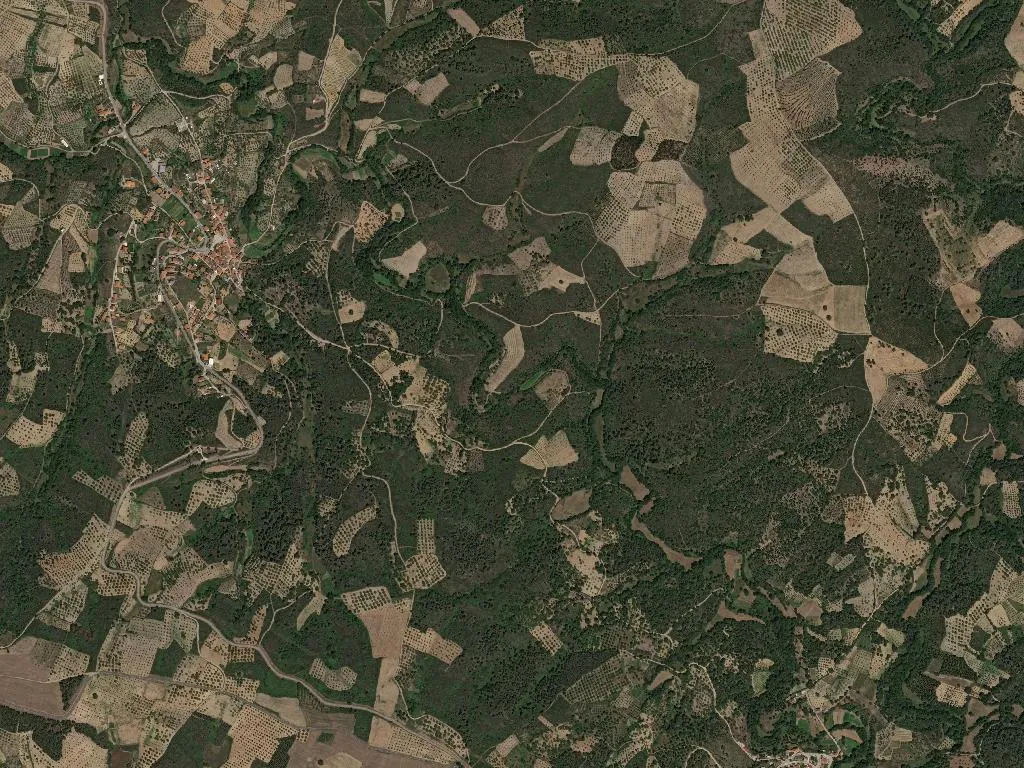
The first thing you hear is metal on stone: sheep bells ricocheting off schist, a sound sharp enough to slice the dense Transmontano hush. Ferreira stretches across 1,964 hectares at an elevation of 573.5 metres, where the air bites in winter and the sun beats down in summer like a steam iron. Just 192 people call this place home — fewer than ten per square kilometre, a density that rivals the queue for a Benfica match ticket. Here, emptiness is not absence; it’s texture.
Between the reservoir and the geopark
Three kilometres to the south, the Azibo reservoir begins — a sky-coloured mirror officially classed as a Protected Landscape and threaded into the Terras de Cavaleiros Geopark. Pick up a chunk of granite on its banks, rub your thumb across the crystals and you’re touching Ordovician seabed 480 million years old. A Ferreira cockerel can still be heard from the shoreline, the crow carrying farther than any mobile signal.
Stone hamlets scatter across the slopes as if someone played dominoes with the mountains and left the pieces where they fell. Twenty-three children race the lanes; their eighty-eight grandparents watch from doorways. Grandchildren are the village’s rarest currency, yet the counters of depopulation — padlocked gates, roofless cottages — are softened by the stubbornness of those who stay: cabbages standing to attention in allotments, smokehouses where salpicão and chouriça hang like crimson bunting.
A calendar of two alarms
The year is wound by two saints. On the first weekend of April Santo Ambrósio pulls home emigrants whose French accents slip after the second Super Bock. São Pedro, at the end of June, arrives when heat lies over the plateau like a wet blanket. Neither feast wastes money on fireworks; instead there is Mass under the single nave, a procession of twelve bearers, and pop-up tavernas that unlock their doors with keys remembered only for these days.
The winter pantry
Ferreira’s cuisine refuses to pose for social media. Cabrito Transmontano DOP — kid still scented by thyme and rockrose — roasts for five hours in wood-fired ovens that double as the village social club. Chouriça de Carne de Vinhais DOP needs nothing but local paprika, garlic and time; no Instagram filter improves its scarlet bloom. Olive oil from the region’s centenary trees is splashed with the abandon of someone who never sees an electricity bill, anointing everything from potato and cavolo nero soup to the memory of bread long finished. In January the smokehouse exhales sweet, resinous air; in August Terra Quente honey slides onto toasted rye as slowly as golden pledges that actually arrive.
Logistics of silence
Reaching Ferreira demands patience and a car that doesn’t sulk at 12-per-cent gradients. From Macedo de Cavaleiros you wriggle 14 kilometres through cork oak and umbrella pine, the road mimicking a snake with OCD. There are no crowds — mercifully — no cafés advertising Wi-Fi, no viewpoints fitted with selfie stanchions. What exists is the wind combing through olive groves, the metallic perfume of rainfall on hot schist, and a silence thick enough to carve with a pocketknife.
Come late afternoon, when the sun drags every ridge into bronze relief, that silence deepens until only the distant bells remain — not measuring hours, but centuries.