Full article about Lombo: Drums, Gold Leaf & Crimson Maize
Echoing Entrudo drums, 1753 gold altars and blood-red maize seed vaults on a chestnut ridge.
Hide article Read full article
The Resonance of Stone and Silence
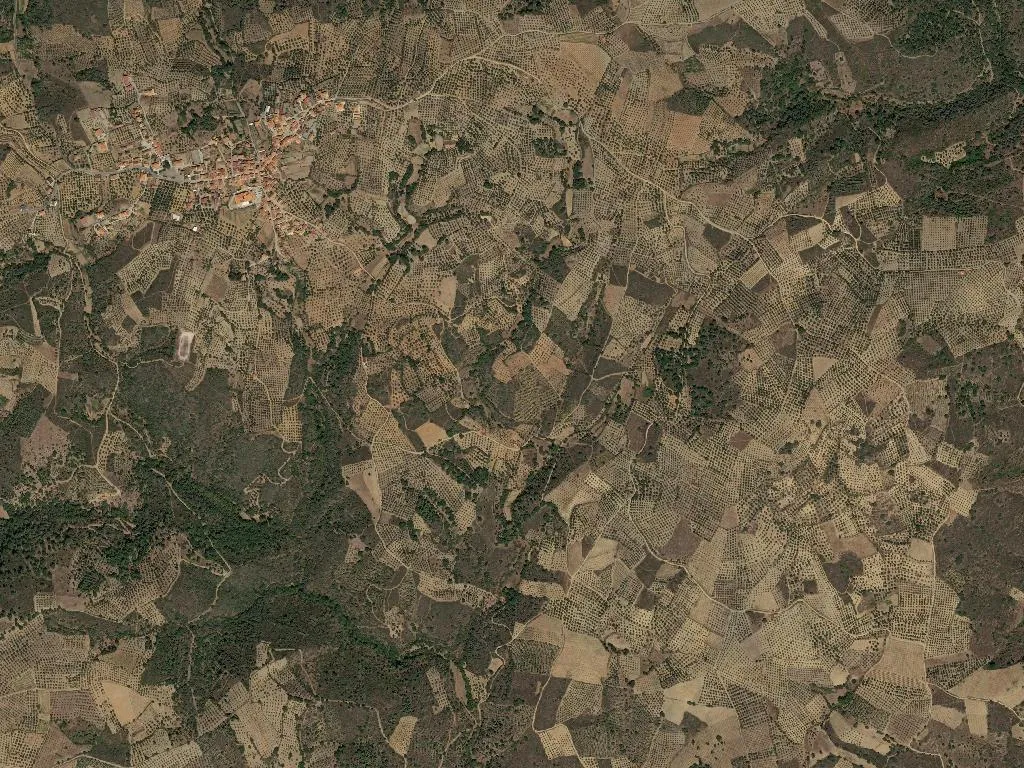
The sound arrives before the image: the deep, steady beat of a drum on a cold February afternoon in Entrudo, echoing between the granite houses. By dusk, masked groups descend the main street of Lombo, knocking on doors to distribute the bolo do entrudo, a yeasted cake scented with cinnamon and lemon. Wood-smoke drifts from chimneys; the wind carries the low murmur of the river Sardoal up the valley. At 487 m above sea-level the land folds like a horse’s back—lumbus in Latin—giving the village its name and its topography: a gentle spur that commands a mosaic of ancient chestnut groves and olive terraces.
Granite & Gold Leaf
The parish church of Santo Ambrósio stands in the geometric centre, a single-nave rectangle finished in 1624 with a mannerist pediment. Inside, a Baroque gilded altarpiece—six tiers of twisted columns and vine-scrolls—catches the late light that slants through high windows. The gold leaf, applied by Bragança workshops in 1753, still warms the nave like a low-burning fire. At the village entrance an 18th-century stone cross displays the Crucifixion in shallow relief; higher up, the whitewashed hermitage of São Pedro (rebuilt 1920) waits for the romaria of 29 June, when locals climb the footpath carrying baskets of mimosa, mountain cheese, and smoked-veal pastries for an open-air mass followed by lunch on the threshing floor.
Seeds, Chestnuts & Memory
For sixty-three years Lombo has maintained a community seed bank for Milho Crioulo, a landrace maize with blood-red kernels that survives the short Trás-os-Montes season. In 2022 the village chestnut grove produced the first fruit to earn the DOP seal of Terra Fria in the entire municipality. Every October the square fills with the resinous smell of roasting chestnuts; shells crack underfoot while the fogareiro spits sparks. A hundred metres downstream the water-mill—cracked timber and granite blocks—still turns on demand, grinding maize into fine golden meal for broa, the corn-and-rye loaf that anchors every meal.
Fire, Clay & Cast-Iron
In kitchens the material world is as weighty as the landscape. Posta mirandesa—thick haunch of mature ox—grills over cork-oak embers, served with IGP potatoes and greens sautéed in local DOP olive oil. Chanfana, kid goat, stews for five hours in a black clay pot sealed with rye dough; red wine and sweet paprika stain the meat a deep ox-blood. Vinhais IGP chouriça hisses on the brasero, its paprika fat mopped up with broa straight from the wood-fired oven. Dessert is pumpkin preserve sweetened with Terra Quente DOP honey, the same amber that backlights the church altarpiece.
Trail, Witch-Pond & Starlight
The signed Caminho do Sardoal describes an eight-kilometre loop through riparian oak, medieval irrigation channels, and ruined mills. Six kilometres east lies the Azibo reservoir protected area—kayaks available, black-winged stilts easy to spot. Locals avoid the river bend called Poço das Bruxas after midnight; legend says witches laundered shrouds there under a waning moon. At night the sky opens to a Dark-Sky rating awarded by the Geopark Terras de Cavaleiros—borrow the parish telescope (reserve at the council office) and Orion reassembles itself above the chestnut canopy.
The village has neither traffic lights nor roundabouts. Speed is negotiated at a single granite ridge—polished smooth by tractor tyres—known simply as “the donkey’s back.” When the bell of Santo Ambrósio strikes six, the note rolls downhill and dissolves among the chestnut blossoms, carrying with it the precise weight of 304 inhabitants and sixty-three harvests of maize still breathing in the seed room above the council chamber.