Full article about Picote: Where the Douro Gnaws at the Edge of Portugal
Quartzite cliffs, schist houses and vultures rule this granite village above the border gorge.
Hide article Read full article
Granite that scorches
The quartzite burns against your palm. At Fraga de Puio the wind tastes of crushed heather and stone-dust grinds between your teeth. Far below, the Douro looks idle, yet the moment you stop breathing you hear it gnawing at the gorge. When the Bonelli’s eagle sails past it is not only silence that shatters – the whole mountain seems to sway in the up-draught.
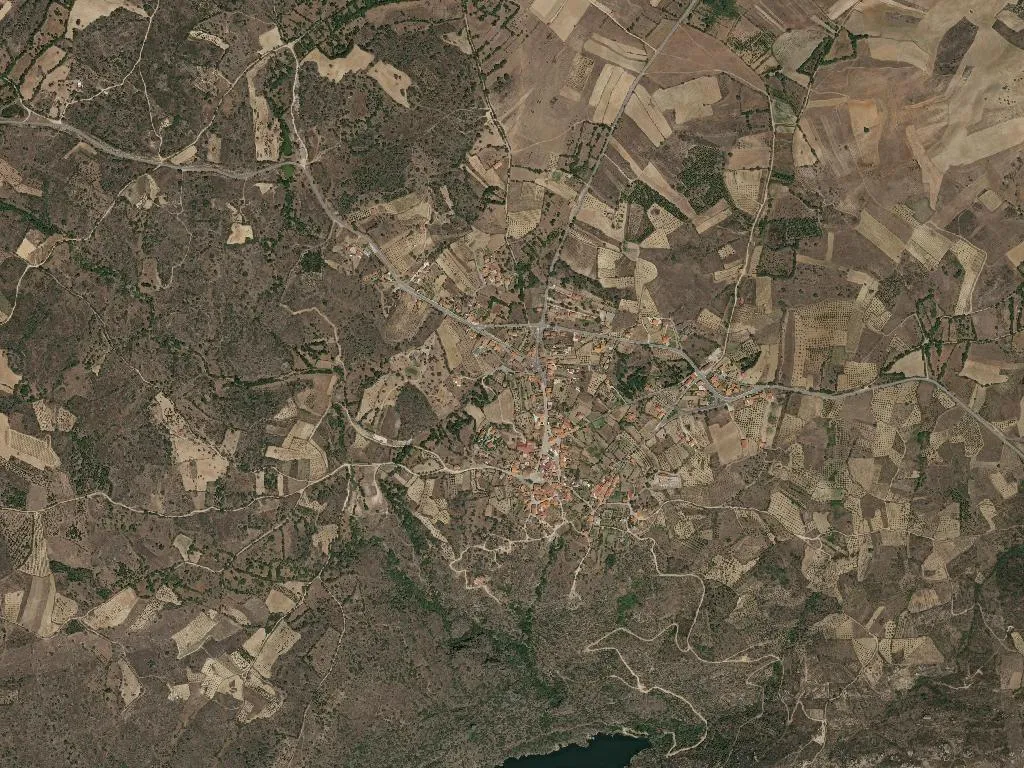
Picote clings to the slope like a survivor: schist houses re-roofed with fresh orange tile that can’t hide the stitches of time, doors the colour of kingfisher wings slapping to the canyon’s rhythm. In Casa do Toural the hinge still squeaks in the same spot it did when I was nine; the lintel still bears the polish where the donkey scratched its back every afternoon on the way home from the fields. The parish church still smells of beeswax and starched linen on Sundays, but now only ten souls occupy the rear pews and the priest drives over from Sendim. The chapel of Nossa Senhora de Fátima is another matter: thrown up overnight with surplus concrete from the dam site, its iron reinforcements still rust above the door. The labourers nicknamed it “the cement church” – they attended an early shift Mass, body as well as soul, before the six-o’clock siren.
Where the river becomes the border
The International Douro Natural Park folds round the village like a scarf of dry air: scent of baked rockrose, crushed arbutus, a whisper of snake. The Ribeiro de Picote does not so much flow as loiter – in the stone tanks where women once beat linen until their knuckles bled, in the smooth granite slide where we taught children to swim. Griffon vultures do not glide here; they govern. They know every ledge, every nesting pocket. When the glass viewing-platform opened, Zé Mário had to come at night and tape over the LED strips – the birds slammed into what they thought was open sky, bewildered by their own reflection.
A language slipping through the cracks
Mirandese – officially recognised since 1999 – lingers in Picote like wood-smoke in a jumper. You will still hear “bom día” from Dona Alda, though she no longer leaves her kitchen. Frauga keeps words the way others keep seed corn; in her shop the honey labels are handwritten – the printer gave up three years ago and no one bothered to mend it. In the ecomuseum my grandfather stares from a fading photograph, hoe on shoulder, little finger missing – he lost it to a reaping hook the year I turned six.
What the table can tell
Prime Mirandesa beef never stops here; it heads straight to the restaurants of Miranda. We eat what is left: Antonio’s lame lamb, the November pig whose carcase still supplies the chouriço dangling over the hearth. The ham comes from my brother-in-law in Vinhais, but the bread is ours – leavened with my 84-year-old mother’s starter, carried to the communal oven before first light. The wine arrives in five-litre garrafões from the Thursday market in Bruçó. It carries no label, only the flavour of soil and of grapes my cousin could not shift to the co-op.
What remains
Up on the hill the Iron-Age castro is no more than a pile of stones with a view, yet after dark when a dog barks they say it is the “Moorish guardian” counting his lost treasure. The hydroelectric plant has been locked since 2015, but water still threads through the grille, playing a tune that reminds me of my father’s boots – he used to bring them home full of tiny fish trapped in the turbines.
Today the wind smells of singed eucalyptus. The griffin has landed on its usual rock – we call it “the priest’s chair”. It sits motionless, yet it is watching time itself, aware that soon there will be no one left to tell the strangers that this stone was once an altar, then a millstone, then a doorstep – and is now merely a perch for photographs before the bus leaves.