Full article about São Martinho de Angueira: River, Stone & Steak Above 700 m
Iron-Age ramparts, gorse-fed Mirandesa beef and a whispering stream at 734 m in Bragança’s remotest
Hide article Read full article
A River That Speaks for Itself
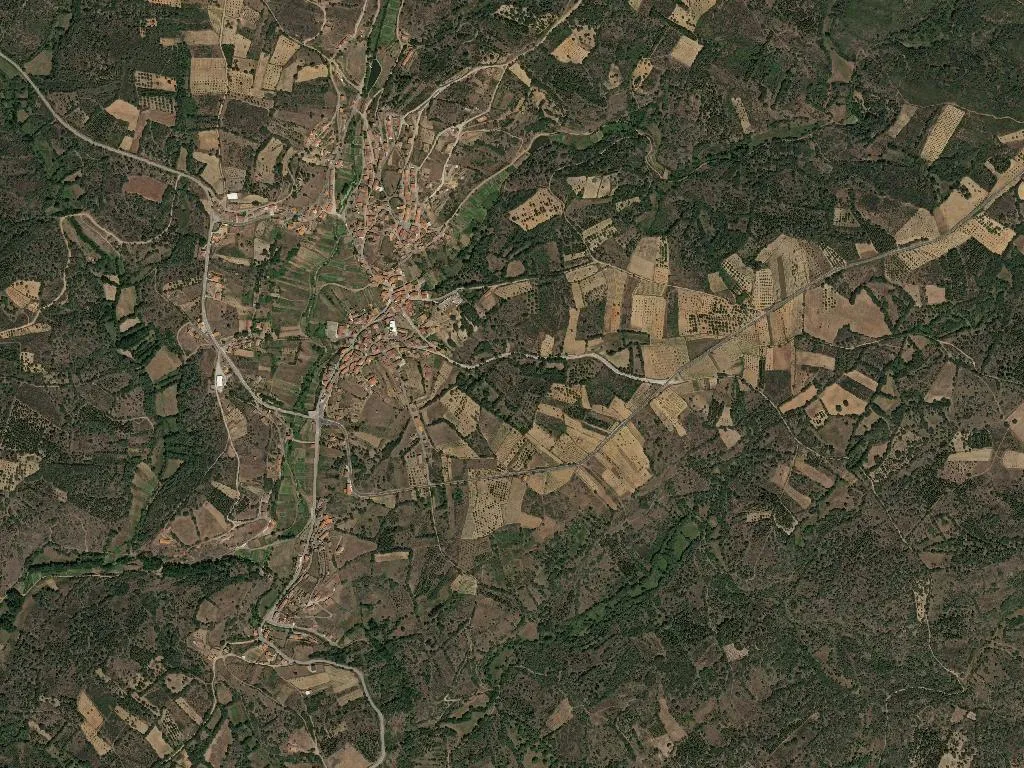
The Angueira stream — the parish takes its name from it — slips through heather-dark gorse and silver-grey schist. Approaching from Miranda do Douro on the EN 221 you hear the water before you see it: at Carvalhal de Espanha the road drops to 680 m, then climbs again like a companion who refuses to let the river out of sight. At 734 m the plateau flares open and three settlements — Angueira, Vilarinho and Soutinho — scatter across 36 km². The national statistics office has recorded the same population density here since 1864: 6.5 souls per square kilometre.
Stone That Needs No Interpreter
Two kilometres above the church, the summit called Cabeço do Pisão still carries four artificial terraces and a dry-stone retaining wall 1.8 m high. Excavated in 1998 by Lisbon University, the site yielded indigenous Iron-Age pottery and a first-century Roman fibula — proof of continuous occupation. In 1758 the parish priest, Luís Cardoso, sketched “ditch and wall remains” in his report to the bishop; today two concentric enclosures, 90 m and 60 m across, are clearly visible. Long before the Mirandese tongue spoke of “mourões” (moorish traces), there were Castro hill-fort builders, then Romans, then a medieval village granted by King Sancho II in 1248 to the bishopric of Miranda.
The parish itself was created on 10 November 1543 when Bishop Jorge de Ataíde promoted the chapel of São Martinho to full status, detaching it from Constantim. The first recorded vicar, Domingos Viegas, received an annual stipend of 1,200 réis — about the price of a kid goat.
Beef That Tastes of Gorse
Of the 239 residents counted in 2021, 89 gave their primary occupation as “farmer”. The parish grazes 470 Mirandesa cows, 2,800 Churra sheep and 320 feral goats. Mirandesa beef gained Protected Geographical Indication status in 1998: the animals spend a minimum of 120 days above 700 m, producing meat with 3–4 per cent intramuscular fat and a final pH of 5.4–5.6. After slaughter in Vimioso, 18 km away, carcasses are broken down in the Vinhais cold-room, held at 0–2 °C. On Monday mornings middle-men pull into Angueira’s small square to buy 30-day-old white lambs weighing 12 kg; in 2024 the price was €7 a kilo, double the 2004 rate.
Festivals Still Held Door-to-Door
Trinity Sunday — fifty days after Easter — brings the principal feast. The procession leaves the 1892 church at 9.30 am, escorted by Constantim’s brass band playing Joaquim Fidalgo’s 1953 “Hymn to the Trinity”. After mass, an average of 68 communicants sit down to onion soup, kid roasted in the communal bread-oven and sponge cake whisked by hand by 84-year-old Olimpia Caetano. On 15 August the image of Our Lady of Light is borrowed from Constantim — Angueira’s own statue perished in the 1959 church fire. Santa Bárbara, patron of the Miranda fire brigade, is honoured on 4 December with three bonfires in the churchyard, each built with wood brought by every household.
The Douro That Hides Itself
A cobbled lane descends 9 km to São João da Pesqueira, then a dirt track continues 3 km to the river itself. Here the Douro flows at 350 m through Cambrian schist; from the Penedo Durão viewpoint the cliff falls 220 m straight down, white-rumped vultures wheeling at eye level — 15 breeding pairs were counted in 2023. The return climbs the Malhada footpath where slate grain-silos still stand, built in 1942 to hold maize requisitioned during the Second World War.
The December sun sets at 17.48; by six o’clock the smell of burnt rock-rose drifts from hearths. Forty-two village houses have been locked since 2010 — keys left with a neighbour, their lower walls whitewashed against damp. Every Wednesday the parish council office opens all the same: inside, a 1957 agricultural map shows fields now returned to pasture, and the president — António Marques, third term — notes each request for a residence certificate in blue Bic biro, the first step to renewing a Portuguese ID card.