Full article about Abambres: Where Mist Weighs on Schist Roofs
Wander Mirandela’s quiet parish of 338 souls, maize-drying huts and 1591 church scents
Hide article Read full article
The weight of mist on schist
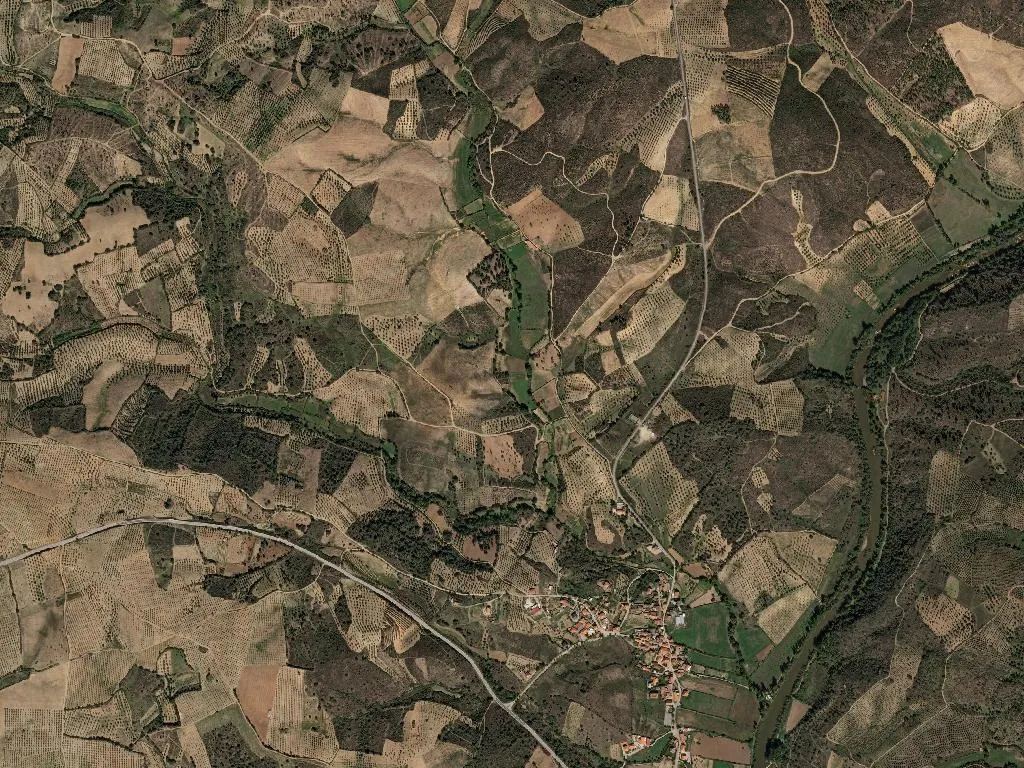
Morning in Abambres arrives like a held breath. A vapour-laden wind climbs the Tua valley, condenses against slate roofs and settles into the joints of dry-stone walls. Wood-smoke drifts in perfect verticals; no draught disturbs it. The only punctuation is the scrape of a Wellington boot on granite setts and the echo of a single dog somewhere beyond the last olive terrace. Three hundred and thirty-eight souls occupy this 18 km² wedge of Trás-os-Montes, the altitude—245 m—just high enough to lift the parish clear of the river’s winter fogs yet low enough to feel the brute swing of Iberian temperatures.
Thin air, thick silence
Seventeen inhabitants per square kilometre: the arithmetic explains the landscape. Farmsteads sit half a field apart; maize cobs dry in palheiros—circular stone huts without mortar—whose gaps ventilate the harvest. Footpaths, more idea than infrastructure, wander between hamlets whose names—Valverde, Aldeia Nova—read like whispered promises. The school roll numbers thirty-three infants; the cemetery bench holds 134 pensioners. When the children shout in the playground the sound ricochets across the plateau as if someone had turned up the volume on an almost silent film.
What the stones remember
The parish church, Santo Estêvão, was begun in 1591 on the footprint of a medieval chapel. Inside, a Manueline altarpiece gilded in Lisbon workshops travelled by sea to Porto, by mule to Miranda do Douro, finally by donkey across these ridges. Beeswax soot still blackens the carving; the scent lingers after the last Mass of the year. Outside, a 1627 granite cross marks the spot where coffins once paused so the pall-bearers could hear the deceased’s will read aloud. The Christmas Eve fast survives: no meat passes anyone’s lips until the cockerel’s crow, a restraint inherited from the days when pigs were slaughtered only after St Thomas’s day, 21 December.
Boys’ day in winter
On 26 December the Festa dos Rapazes reclaims the streets. Teenage lads rove from door to door collecting donations, their pockets weighed down with smoked sausages and coins, authorised by an ancient licence to make noise. Weeks later comes the Serrar da Belha, a Lenten satire in which a straw-and-rags effigy of Carnival is tried for the crime of excess, sentenced and sawn in half while the crowd roars with mock solemnity. Both rituals swell the population overnight: emigrants fly back from France, Switzerland, London; cars with foreign plates line the lane to the cemetery as if death itself had become an international conference.
Flavours that carry passports
Abambres eats from its own geography. Alheira de Mirandela—garlicky bread-and-game sausage invented by crypto-Jews to fool the Inquisition—sizzles in local olive oil stamped DOP Azeite de Trás-os-Montes. Kid goat, certified IGP Cabrito Transmontano, roasts slowly over vine prunings until the skin bronzes and the juices caramelise. Hams from Vinhais cure for eighteen months in rooms scented with oak and chestnut smoke; the outer flesh tightens to mahogany, the inner marbling melts on the tongue. Chestnuts from the Serra da Padrela burst open in iron pans; heather honey, collected at 800 m, pours like slow amber glass. Thirteen products in the parish’s larder enjoy protected European status—an edible map of micro-climates and stubborn husbandry.
Listed stones, living walls
Only one building bears an official plaque: Santo Estêvão. Yet the entire terrain is an open-air archive. Dry-stack terraces climb the slope in exact gradients, built during the famine years of 1867-68 when the municipality paid labourers in soup. At Valverde a group of unsupervised corncribs—conical, slate-roofed, no cement—still keeps harvests safe from rodents. A wayside crucifix dated 1627 served as a rest point for funeral cortèges climbing to the graveyard; the chiselled inscription is being scoured away by lichen at roughly the same pace as the collective memory of those processions. Vineyards have been documented here since King Afonso III’s 1255 charter; the soil is poor, the grapes thick-skinned, the wines tasting of sun-stored granite and resin.
One key, one address
There is a single guesthouse. Rua da Igreja 23—once the village doctor’s surgery for four decades—has been restored by Joana and António, Lisbon architects who traded Alfama staircases for olive roots. Bedrooms open onto a balcony where the only traffic is the occasional shepherd urging his flock towards night pens. Guests do not come for pillow menus; they come for the moment when the generator-calm of 22:30 arrives and the darkness is so complete that the Milky Way feels like a civic installation. In that hush the parish finally reveals its true monument: an acoustic void where every footstep, every fire crackle, every chestnut bursting its shell is catalogued by the night.