Full article about Santo Estêvão smoke drifts over Avidagos-Navalho-Pereira
Winter sausage songs echo through Mirandela’s three-village parish of schist and oak
Hide article Read full article
A Morning of Smoke and Song
The smoke rises straight from the chimney, fine and white against the grey January sky. In the streets of Avidagos, Navalho and Pereira, the clatter of cowbells and the cracked voices of adolescent boys announce the Festa de Santo Estêvão – a pre-Christian winter rite in which roving bands of lads sing for smoked sausages and fortified wine, filling wicker baskets as they go. Oakwood drifts on the cold air, echoing off walls of mica-flecked schist and granite, and the hamlet wakes.
This three-village parish was stitched together in 2013, yet its seams are medieval. The name Avidagos probably derives from abade – the abbot – hinting at ecclesiastical estates recorded as early as the twelfth century. Roman roof tiles have been turned up in olive groves, and Visigothic millstones lie half-buried on the Tua riverbank. At 507 m above sea level, the parish occupies a fold of the Terra Quente, the ‘hot land’ that ripens olives while the Serra da Nogueira still carries snow.
Calendar of Earth and Fire
Life is governed by the agricultural year. After the Epiphany processions, attention turns to Serrar a Belha, a communal chainsaw-and-axe day when men cut, split and stack the winter’s fuel while women simmer pots of borrego assado. The work ends at a long table in the fire station yard; no invitations are issued – you simply appear with a bottle of aguardente. In a parish of 446 souls, 158 are over 65 and only 49 under 20, yet the rituals persist because retirement pensions finance the brass band and WhatsApp organises the wood brigade.
Tastes with Postcodes
The Transmontano larder here is geographically precise. Breakfast is a slice of alheira de Mirandela – the horseshoe-shaped garlic sausage that once fooled Inquisition inspectors – fried until the skin blisters and served on rye baked in a wood oven the size of a Peugeot. Lunch might be kid goat braised with potatoes that never see a fridge, the meat tinted amber by pimentão smoked over holly wood. In the larder hang chouriças de Vinhais with their DOP seal, and wheels of Queijo Terrincho aged on chestnut boards. Olive oil carries the IPG seal of Trás-os-Montes, peppery and green enough to make a Tuscan weep. Dessert is roasted chestnuts from the Terra Fria, peeled with fingernails still black from gathering them, then soaked in honey that carries the faint scent of rosemary from the plateau.
Olive Groves in Place of Pasture
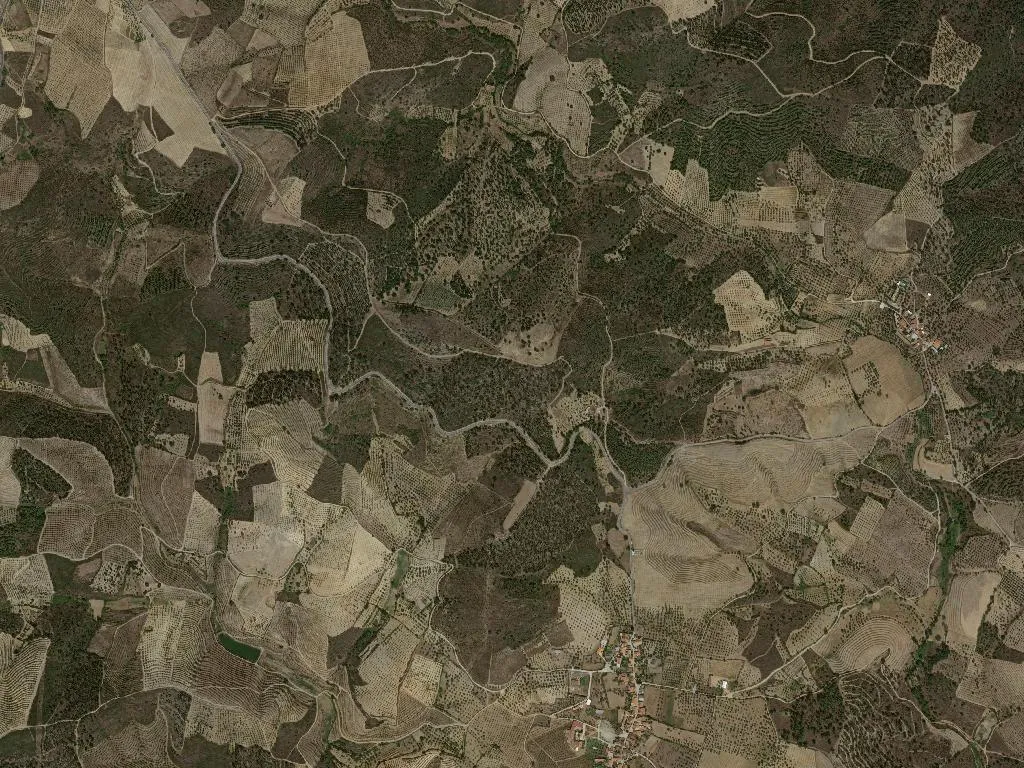
Spread across 31 km² of undulating schist, the landscape is a mosaic of olive terraces, some of whose trees were already bent with age when Wellington marched through in 1809. Dry-stone walls built without mortar divide smallholdings measured in alqueires, an acreage system dating from the Visigoths. Scots pine and Pyrenean oak survive on north-facing scarps, but it is the olive that dominates, its silver-green canopy turning black during the November harvest when mechanical rakes shake the branches and tarpaulins shiver under the falling fruit.
Walking to the Sound of Your Own Boots
The parish council has way-marked three rural circuits – the shortest 4 km, the longest 12 – that lace the settlements together, crossing seasonal streams where dippers bob on granite boulders. You are unlikely to meet another walker; the only soundtrack is the metallic clink of a distant tractor or the church bell striking the agricultural hour. For the night, Casa do Lavrador in Avidagos offers two simply furnished rooms above a vaulted stable; the key is fetched from the café opposite, where the television is permanently tuned to agricultural prices.
When darkness falls the scent of oak smoke rises again, drawing a thin white line between earth and sky. It is the signature of a place that has learned to live within its means: heating only the rooms that are used, eating the meat that was cured last winter, speaking the dialect that the telephone never required. Follow that line and you know someone is at home, waiting for the olives to turn, for the boys to finish their songs, for the year to begin once more.