Full article about Torre de Dona Chama: olives, bells & burnt archives
Trace medieval crosses, taste emerald oil and hear an 1894 bell toll over whitewashed 1512 stones.
Hide article Read full article
New oil on old stone
The first press of the season drips emerald along Rua Dr José António Marques. Inside the co-op, a modern hydraulic cylinder has replaced the granite screw, yet the outcome is identical: a ribbon of green-gold meets the warm papo-seco from Padaria Visconde. Mário, the millman, wipes dark pomace from his fingers while heat rises off 1958’s granite walls, once loud with 250 tonnes of olives. Outside, the parish bell—bought by the council in 1894 for 125,000 réis—strikes nine and ricochets off whitewashed façades that mask 1512 stones carved with Manuel I’s royal coat.
Torre de Dona Chama has never forgotten it was a chartered town with its own council and judge. On 20 August 1512 the king granted the privilege; it survived until 31 December 1853 when, after protests from all 400 residents, it was folded into Mirandela. The granite pillory still stands, base rubbed each dawn by 87-year-old António Rosa—‘My mother swore it brings luck.’ Who Lady Chama actually was disappeared in 1890 when the notary’s archive burnt, but her name clings to the landscape like lichen to schist.
Granite & gilt altars
The parish church of Santa Maria rises in sober baroque bulk, rebuilt 1695-1720 over a 1285 foundation. Inside, José Fernandes de Macedo’s 1734 retable glints against raw light that sneaks through narrow windows. Nossa Senhora da Assunção—acquired in 1742 for 12,500 réis—awaits her mid-August procession: shoulder-borne by twelve men, followed by an 1867 brass band, sardine stalls in Praça 5 de Outubro and the drift of grilled alheira. A scattering of fourteen granite calvaries still traces the medieval street plan; the 1642 Corgo da Serra cross is lettered ESTA E A VERDADEIRA FE—‘This is the true faith’—a Reformation-era warning carved in stone.
Thursday market & smoke
On Thursdays the market colonises 3,500 m² of the square. Joaquim’s 1972 tractor idles beside a bar that sells 200 alheiras before lunch. The Mirandela sausage—IGP-protected, smoked for thirty days over olive-wood—hits the grill at 200 °C, spitting fat onto bakery flatbread. In winter the wood-fired ovens of O Tua roast fifty Terrincho lambs each weekend; the meat is pulled tableside, soothed by chestnut broth from the Bornes hills (€3.50 a bowl) that warms lungs as well as hands.
Sunset trail
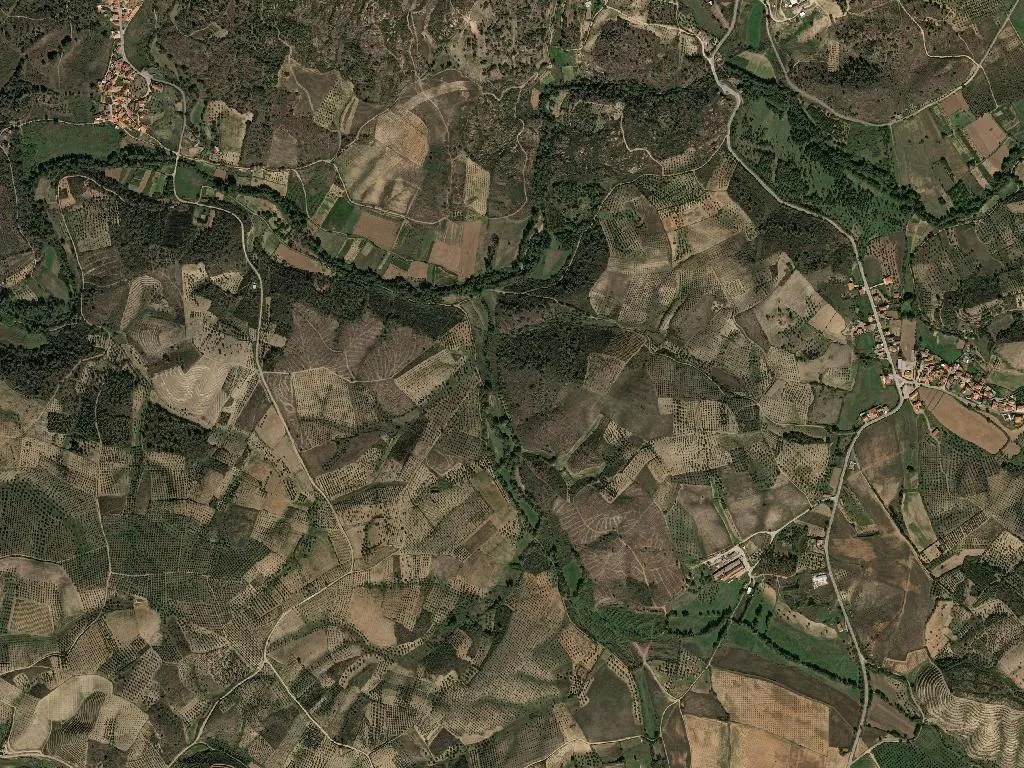
The land folds from 250 m at Corgo da Serra to 450 m at Quinta do Paco. Forty-five hectares of centenarian olives—some planted 1850—alternate with small vineyards and Valencia-orange groves that pump 28 kg of nectar-scent into the April air. The Tua River slips south between poplars and willows, feeding the 1963-abandoned mill race at Pereira. PR1 MIR, a 3.2 km shale and dirt loop, climbs gently; by 19:30 the low sun ignites the olive leaves into dull gold. Up top, the breeze carries rockrose and rosemary, blackbirds flit through strawberry-tree scrub that yields 800 kg of fruit per hectare. A short-toed eagle circles overhead—nesting here since 1987—above the valley it treats as private airspace.
January at the door
January brings the Janeiras: bass voices that move from door to door requesting €5 chouriça and a glass of warmed wine. On Easter Sunday communal tables in the sports pavilion break sweet folar loaves stuffed with eight hard-boiled eggs, shared without ceremony. Mid-August delivers the parish romaria: open-air mass for 2,000, dancing until 4 a.m. when Sr Albano finally shuts Café Central. When the accordions fall silent and grill smoke disperses, what remains is the dense hush of the serra, the Tua whispering 50 m away and the scent of woodsmoke that still clings to the 1512 stones like an unspoken promise.