Full article about Bruçó: lamb smoke drifts above 32 stone granaries
At 722 m, Mogadouro’s hill hamlet keeps its communal oven, slate espigueiros and winter maize ritual
Hide article Read full article
Wood-smoke mornings
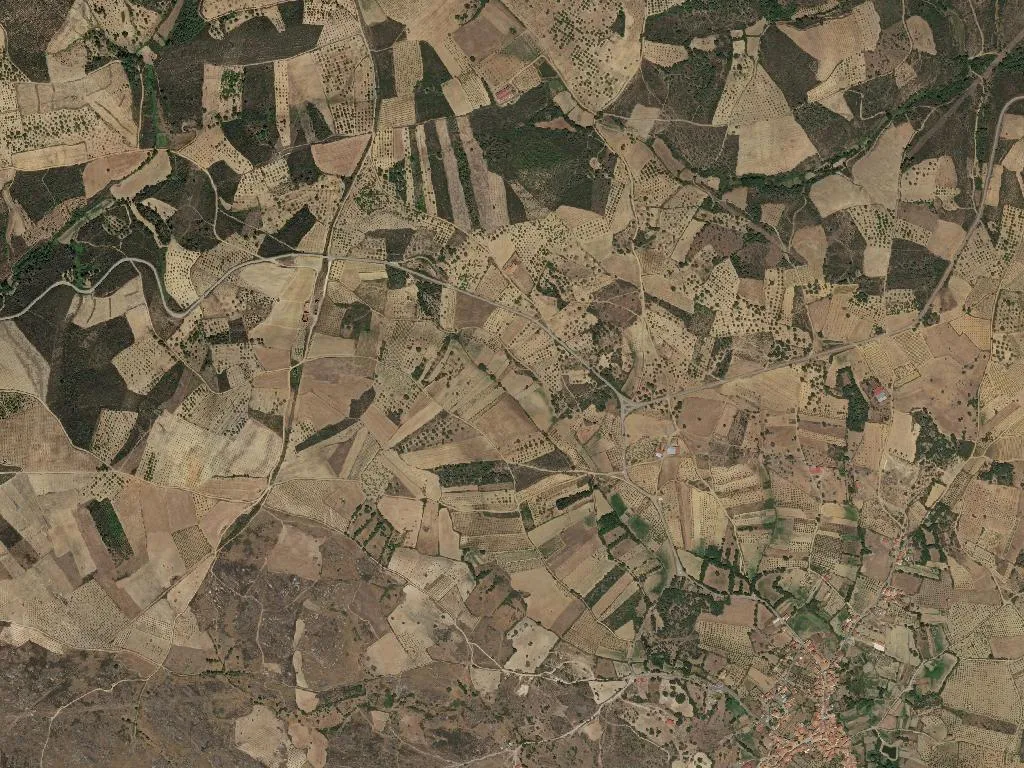
The smoke from the communal oven rises in a dead-straight column through the motionless dawn. Behind Zé Mário’s house three women massage a shoulder of lamb: Maria da Cuca works garlic through an iron press, bay leaves come from the tree behind the cistern, the wine is the same rough red their sons ferry back from the market town of Marco. Bruçó wakes slowly, 722 m above sea-level, caught between a sky-rim of schist and a stream that gave the village its name but almost never runs.
From scrub to settlement
Bruçó probably derives from the Latin brutium – thicket – and the heather still fights the chestnut groves for ground. Listed in the 1258 Inquirições as part of the Santa Cruz da Vilariça court, the hamlet later passed to the House of Braganza. What survives is utilitarian: a granite church whose timber roof creaks like a ship in winter, 18th-century azulejos that Father António scrubs with vinegar to lift the candle soot. Higher up, the chapel of Santa Ana sheltered my grandfather during the week-long snow blockade of 1954.
Thirty-two stone granaries
There are thirty-two, not thirty – I counted. Toninho’s is said to be 184 years old; Aunt Albertina swears it looked ancient when she was ten. Slate slats let the wind sieve through so efficiently that maize dries in January, when everything else is sodden. Beside the chapel stands the first to be restored; local schoolchildren are marched in to learn how their great-grandparents threshed with a flail, though none lasts five minutes.
The mountain’s pantry
On the feast of Nossa Senhora do Caminho the population doubles. The lamb enters the stone oven at five a.m.; Zé Mário feeds the fire every two hours until the skin crackles to unanimous female approval. Joaquim supplies wild-boar alheira – he is the only hunter left – while Zé do Telhado’s home-slaughtered pig becomes peppery chouriço. Ana’s migas are made with her own corn bread, ground at her brother’s mill after hers gave out. Terrincho DOP cheese arrives from a neighbour’s dairy, but the honey is hyper-local: António da Bemposta keeps hives on the sun-steeped south slope.
The trail and the unfailing well
The footpath starts behind the church, climbing through João Português’ chestnut plot. Eight kilometres of track continue to Sendim, but most turn back at the spring – the water tastes of granite and moss and stays ice-cold even in August when the rivulets are dry stone. Griffon vultures have not been seen for two years, yet red kites still tilt overhead. The final ascent deters weekend walkers; locals bypass it on the irrigation channel the Old Man of Telhado hacked out with a hoe in 1973.
In the single grocery D. Fernanda lifts the shutters at nine-thirty “or when the talk show ends” and closes for lunch. Cheese is wrapped in the same paper used for loose Golden Virginia. Outside, the church bell strikes the hour – except when the priest lingers in Mogadouro. The sound drifts downhill, vanishes into the heather, and no one remarks on the hush that follows.