Full article about Castelo Branco: Where Chestnut Smoke Clings to the Stones
Granite lanes, rye-bread Wednesdays and a vanished castle above Spain’s doorstep
Hide article Read full article
Smoke in the Slate, Griffins on the Cliff
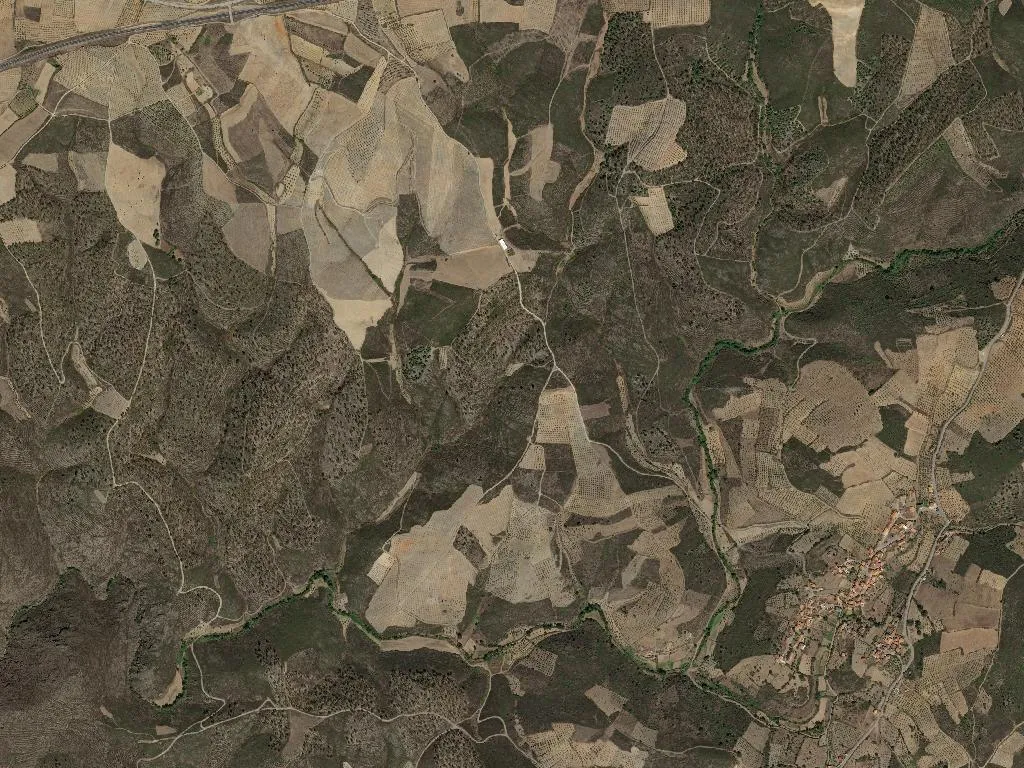
Woodsmoke threads itself between the roofs of Castelo Branco, carrying the resinous note of chestnut and the sweet-salt tang of ox-chouriço that still swings in the fumeiros. At 499 m above sea-level, twelve kilometres short of the Spanish border, the village inhales with the seasons: slow in winter, furnace-hot in July, always paced by rye bread and transhumance. The plateau wind funnels down narrow lanes, polishing granite doorsteps and silencing the stones.
A castle that was never white
The fortress that baptised the parish left nothing but a scatter of late-medieval schist and the ghost of a thirteenth-century keep on the north knoll. The “white” in the name comes not from battlements but from the limestone shepherds once quarried on the Mogadouro ridge to whitewash walls and brand cattle. At sunrise the loose blocks still flare like scattered sheets of paper, yet no visitor mistakes them for nobility.
The mother church, Nossa Senhora do Caminho, was rebuilt in 1865 after the 1855 earthquake traded its Manueline altarpiece for a plain cornice and a side door that opens straight onto the pig-killing yard. Next door, the eighteenth-century Chapel of St Anne receives pilgrims on 26 July from Brunhoso and Vale de Porco. Cork-oak bonfires are lit, string-bean broth with streaky bacon is ladled out, and red from the Vilar de Maçada cooperative is poured from tin jugs. In May the statue of the Virgin leaves the church at four o’clock, processes along Rua de Baixo—where two of the village’s last three donkeys still live—and ends with posta mirandesa seared on iron grids, not embers; the local vineyard was grubbed up when EU quotas bit.
Rye, stone and the Wednesday oven
The communal oven fires only on odd-numbered Wednesdays when Dona Amélia, born 1947, judges the flour “behaved”. For three hours chestnut logs heat the slate dome; rye loaves go in at seven, emerge at half past nine with a crust brittle enough to survive a day’s olive-picking in Torre de Moncorvo. It is the last working oven in the municipality that charges for bread: €1.20 a loaf, €0.80 if you bring your own flour. Of 330 residents, 176 are over sixty-five; in 2019 the parish council bought a minibus to ferry them to Mogadouro health centre on Tuesdays and Fridays.
Dry-stone walls climb from the 525 municipal road to Cimo de Vila, stacked between 1920 and 1960 by three generations of the Carvalhal family. No chestnut groves survive here—castanheiro needs another 200 m of altitude. The Castelo Branco–Brunhoso footpath (PR3) passes a four-legged granary still owned by the long-defunct agricultural co-op; inside rests the county’s last animal-powered thresher, last used in 1984.
Griffins, Bonelli’s eagles and a 250-metre drop
Eight kilometres away, the Picões lookout is reached by a Roman paved road restored in 2011 by the Douro International Natural Park. The timber platform hovers at 570 m, 250 m above the river’s elbow where Portugal slips into Spain. Griffon vultures have nested in granite clefts since 1993; four pairs remain. Bonelli’s eagle returned in 2008 but nests only on the Spanish side. A field notebook in the hide records twenty-three griffons on 15 October 2023.
At weekend-only tavern O Cantinho, alheira from Mirandela comes with salted turnip greens (€8), potato migas with black kale (€6) and chestnut soup between October and December. The charcuterie is smoked by Zé Mário, who slaughters on St Martin’s day and smokes over willow for thirty days. The pumpkin preserve follows the Santa Ana sisterhood recipe: 1 kg baby pumpkin, 750 g sugar, a cinnamon stick and three cloves, simmered two hours. Medronho brandy is copper-distilled at 48 %, bottled in five-litre demijohns that sell for €35 in Vale de Porco.
Dusk returns the griffins to their ledges; cold wind drains off the plateau and woodsmoke lifts again from schist chimneys. The scent mingles with stone silence and the distant bell that strikes seven for the rosary—sound that crosses the valley and fixes in memory the rough grain of a village where, in 2021, two babies were born and seven people died.