Full article about Penas Roias: Falcon-wing ridge above Trás-os-Montes
Granite keep, Bronze-Art petroglyphs and sheep-dotted plateaus crown this 748 m village
Hide article Read full article
A breeze of stone and time
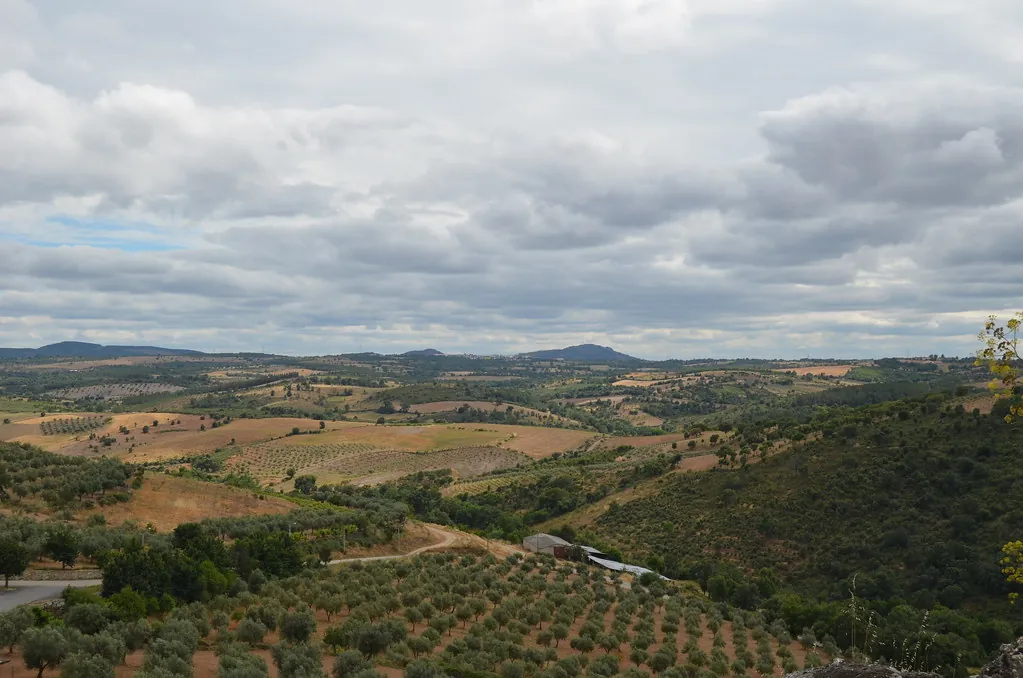
The wind moves freely across the plateau, lifting ochre dust from the road that climbs towards the walls. Above, the keep rises against the wide Trás-os-Montes sky, its granite silhouette warmed slowly by the afternoon sun. At the foot of Castelo de Penas Roias, built in 1166 on the orders of Afonso Henriques, silence has been gathering for centuries—broken only by the distant song of a skylark and the creak of an iron gate in an abandoned yard. At 748 m, the air is so clear that distances shrink; Algoso and Outeiro look a short stroll away, though they sit over separate valleys.
Falcon-wing ridge
The name comes from the Latin Penna Rostrata, “falcon wing”, and the land keeps the promise: long schist ridges that fan out like flight feathers above the Bastelos stream. Penas Roias was once a royal town and seat of its own municipality; Sancho I handed it to the Templars, and later charters from Afonso III and Manuel I restated its privileges. Little remains of the pillory beyond a few stones shaped like a bird-cage crown, yet the former administrative footprint survives in the cluster of roadside chapels—Misericórdia, Nossa Senhora das Dores, Santa Cruz—that punctuate the lanes to Variz. In the Fraga da Letra, ochre smudges of vegetable dye still cling to a sheltered slab: a Bronze-Age signature left long before kings or crusading knights.
When the train still whistled
Older residents remember the Sabor line, opened in 1938 to link the Douro at Pocinho with Miranda do Douro. The engine’s whistle rolled up the valley until 1988, when the service was withdrawn and the tracks lifted. Today way-marked footpaths and red-arrowed MTB trails re-use parts of the alignment, detouring onto the 970 m ridge of Santiago or across meadows where Terrincho sheep graze. Westward lies the Douro International Natural Park; Spanish and Portuguese golden eagles ride the thermals above the 200 m-deep gorge, scanning for carrion along the olive terraces.
Plateau cooking
Transmontana cooking in Penas Roias is built for altitude. Chanfana—kid goat simmered in full-bodied red from the Trás-os-Montes vineyard—softens over a low wood fire for hours. Local DOP olive oil, green-gold and peppery, is poured generously over country bread, then followed by cave-matured Terrincho DOP cheese that flakes like shale. At the summer romarias—St John on 24 June, St Catherine in August, St Euphemia on the last Sunday of September—grilled alheira sausages, lamb stew and thick bean casseroles laced with Vinhais IGP ham appear on communal tables. Hot-region DOP honey sweetens the sponge inherited from the convent at nearby Mogadouro; walnut cake, dense and buttery, finishes the feast with fruit from the village’s own chestnut groves.
Cold water, hot stone
The Bastelos dam feeds a small river-beach where willow-green water reflects grey granite banks. An overshot mill—wheel long stalled—has been converted into a picnic store, and on Sundays families spread tablecloths between its walls. From the castle’s cracked battlements you can triangulate Mogadouro, Algoso and Outeiro, three stone sentinels trading glances across empty kilometres of heather and broom.
At dusk, when swifts stitch the sky above the keep and the smell of oak-kindled stoves drifts upwards, Penas Roias settles into its own measure of time: not clock time, but something breathed—dense, mineral, old as the schist that pokes through every path.