Full article about Travanca’s Entrudo masks rattle off schist walls
In Bragança’s tiniest village, Shrove Sunday clappers echo past Manueline crosses and lamb smoke
Hide article Read full article
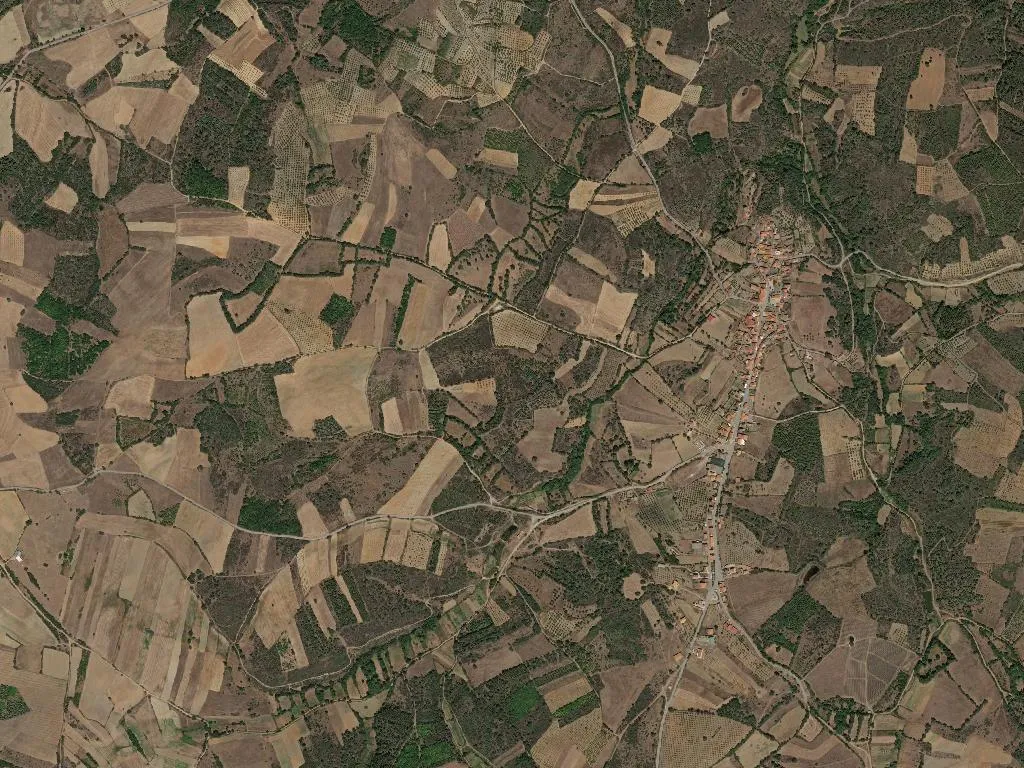
The sound arrives before the sight: a dry rattling of wooden clappers ricocheting off schist walls on Shrove Sunday. In Travanca, 119 souls strong, Entrudo wakes the village. Patchwork-cloth masks lurch through lanes barely two metres wide, the youngest locals playing the loudest parts. By nightfall the granite settles again; only the Tua river speaks, curling round slate terraces before it surrenders to the Douro.
Bell, cross and choir
Mother-church Santa Marinha holds centre stage, flanked by two Manueline stone crosses drafted in from elsewhere in the parish. Their dates—1592, 1621—are still legible after four centuries of mountain rain. Inside, candlelight skips across a gilded baroque altarpiece while 17th-century blue-and-white tiles recount the saint’s legend in comic-strip frames. On the Sunday nearest 15 August the congregation follows the statue through alleys no wider than an ox-cart, finishing in the square where whole Terrincho lamb, marinated overnight in white wine and bay, turns slowly over embers.
A mile out, the Chapel of Nossa Senhora do Caminho waits for the first Monday in September. Pilgrims climb the dirt track on foot, plastic water bottles slung like bandoliers. After the outdoor mass the priest blesses the maize fields; then everyone tears into sponge cake and rough red drawn straight from a granite trough—sharp, honest, tasting of schist and sun.
Bridge, water, memory
The medieval bridge is long gone, replaced by a timber pontoon that groans every time a tractor crosses. The name still fits: Latin trans–canticum, “crossing-place.” This was the drovers’ shortcut from the Mirandese plateau to the Douro, mules laden with olive oil and rye. Below, a ruined water-mill clutches its broken wheel, proof that bread once began here, not in the supermarket.
Travanca sits on the western rim of the Douro International Natural Park. Griffons nest in the cliffs; Egyptian vultures, scarce everywhere else, circle overhead. The Tua walking trail—eight kilometres of riverside gallery forest—passes under ash and alder where otters leave fish-scales on the stones. In May the southern barbel spawns on clean gravel shoals; old men wade in, hands poised, catching them blind in water as clear as air.
Oven lit, table laid
Once a month the communal bread-oven fires up. Dark rye and maize loaves, scented with fennel seed and honey from the Terra Quente demarcation, bake slowly while the queue lengthens. Lunch is Posta Mirandesa—veal seared in its own fat with nothing but coarse salt and crushed garlic—arriving at the table still spitting. Kid goat, the Cabrito Transmontano DOP, has stewed all morning in clay with red wine and paprika until the meat flakes at the touch. Winter desserts come from the store-cupboard: sun-dried baby-pumpkin jam, its colour the shade of late afternoon on the parapet.
In August the population triples. Emigrants fly back from Paris, Geneva, Newark; the single restaurant runs out of chairs; someone fetches a guitar. Cantares ao desafio—improvised call-and-response ballads—recount whose grandfather left for Brazil in 1893, whose cousin wired money for the new roof. The two-storey houses, built with remittances from nineteenth-century “Indians” in Rio and Caracas, glow pink in the sunset. And the Tua keeps talking below, repeating the same line it has murmured since the first mask frightened a child here: I will leave, you will stay; listen, and begin again.