Full article about Castedo: Almond Snow on a Schist Ledge
At 594 m, Torre de Moncorvo’s hill-village keeps medieval bells, Roman tiles and DOP lamb.
Hide article Read full article
Afternoon sun on schist and lime-wash
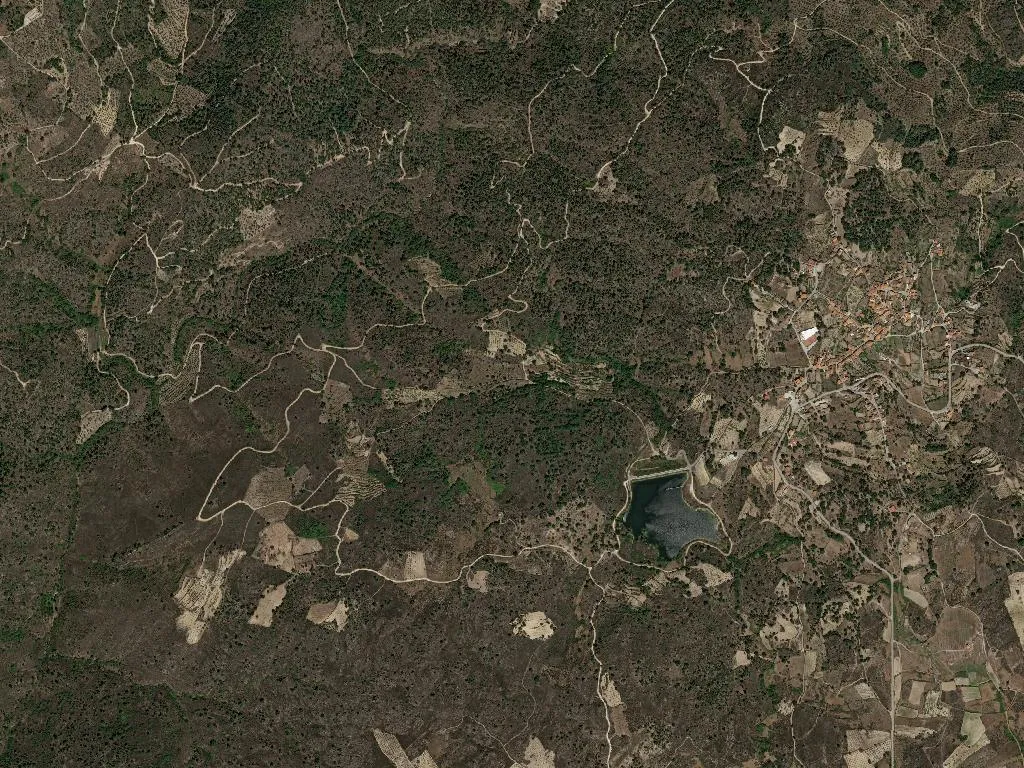
The slate walls glow like hot plates, returning the heat they hoarded before sunrise. At 594 m up, Castedo measures the day by sound: the parish bell at 19.30 sharp—winter mass—and the dry clatter of almond branches that survived the killing frost of 1991. Between 15 February and 10 March the village turns snow-white with blossom; after 8 September the grapes are cut on the first available Tuesday; olives come in before St Martin’s Day. The EM475 may skirt the settlement, but it has not altered the weekend rhythm of pruning, the November smoking of sausages, or the corn-shucking that still takes place on the old schoolyard threshing floor.
Stone with a memory
First recorded in 1258 as Castedlo—from the Latin castellum—the place-name surfaces in Afonso III’s royal survey. Walk up the Santo António path and you will find loose blocks on the hilltop that grandparents call “from the citadel”, vestiges of a medieval keep that once policed the Sabor valley. Roman engineers left heavier clues: a roof-tile stamped LEG VI, ploughed up in 1978 at Outeiro and now in Moncorvo’s museum; a stretch of paved road that linked Vale de Açor to the Cachão da Valeira, its stones reappearing after heavy rain in Ribeira field. For centuries the village belonged to the Santiago de Castedo commandery of the Military Order, yet its wealth was always earth-bound—vines, olives, almonds. Nineteenth-century Liberal reforms merely rubber-stamped what every harvest had already decreed: Castedo is an agricultural ledger written in annual increments.
A table certified by the hills
Local DOP labels dominate the kitchen. Borrego Terrincho DOP, reared within 5 km on the Felgar pastures, is roasted in Dona Rosa’s wood oven, its juices spooned over chipped potatoes. Cabrito Transmontano DOP collapses at the touch of a fork after hours in a cast-iron pot. At breakfast, slices of Moncorvo sourdough are spread with Terrincho DOP cheese made by herdsman Albano since 1972, then drizzled with olive oil from Castedo’s own cooperative mill, founded 1958. In the smoke-blackened attics hang Salpicão de Vinhais IGP and Presunto de Vinhais IGP, slow-cured over oak for three months. Dessert is a handful of Moncorvo-coated almonds or Douro DOP almonds alongside honey from the Terra Quente, brought back by villagers who follow the Douro blossom in April.
Feasts that repopulate the village
Every 15 August Castedo swells from 180 to several hundred. The Festa da Vila e do Concelho, honouring Nossa Senhora da Assunção, hauls home emigrants from Porto, France, Switzerland, cramming 47 permanently occupied houses. Mass is at 11.00, followed by a procession down Rua do Fonte to the 1892 granite cross where local “louvores” are sung. devotion is practical: garden-picked flowers, candles bought at Carolina’s shop, a promise repaid with nine consecutive Friday rosaries. On the last Sunday of October many walk over to neighbouring Felgar for Nossa Senhora do Amparo, keeping alive the chain of inter-village pilgrimages that thread the Sabor uplands like invisible rosary beads.
Walking through vines and almond snow
Castedo sits inside the Alto Douro Vinhateiro UNESCO site, though its slopes are gentler than the dizzy socalcos nearer the river. Vine terraces share the ridges with thousand-year-old olives and almonds that turn the fields into drifting pale blossom each spring. The signed Sabor River trail, laid out by Moncorvo town hall in 2018, starts at the parish church, crosses the eighteenth-century Santo António bridge, climbs past the cooperative’s 40 ha of vineyard at Ordem, then drops to the river pools where locals still haul out half-kilo barbel. Walk it at dawn and you hear skylarks, smell crushed rosemary underfoot, watch the Serra da Padrela ridge cut the horizon like a torn page.
The last light drags long shadows across the 1938 wheat-campaign dry-stone walls. A door creaks—Joaquim Romeu’s 1942 birthplace—and a woman scatters corn for hens. Wood-smoke rises straight into still air, smelling of oak and of time that is not told but simply lived.