Full article about Dawn over Felgueiras e Maçores, almond snow on schist
332 souls, 38 km² of olive and almond terraces stitched by dry-stone walls above the Sabor River
Hide article Read full article
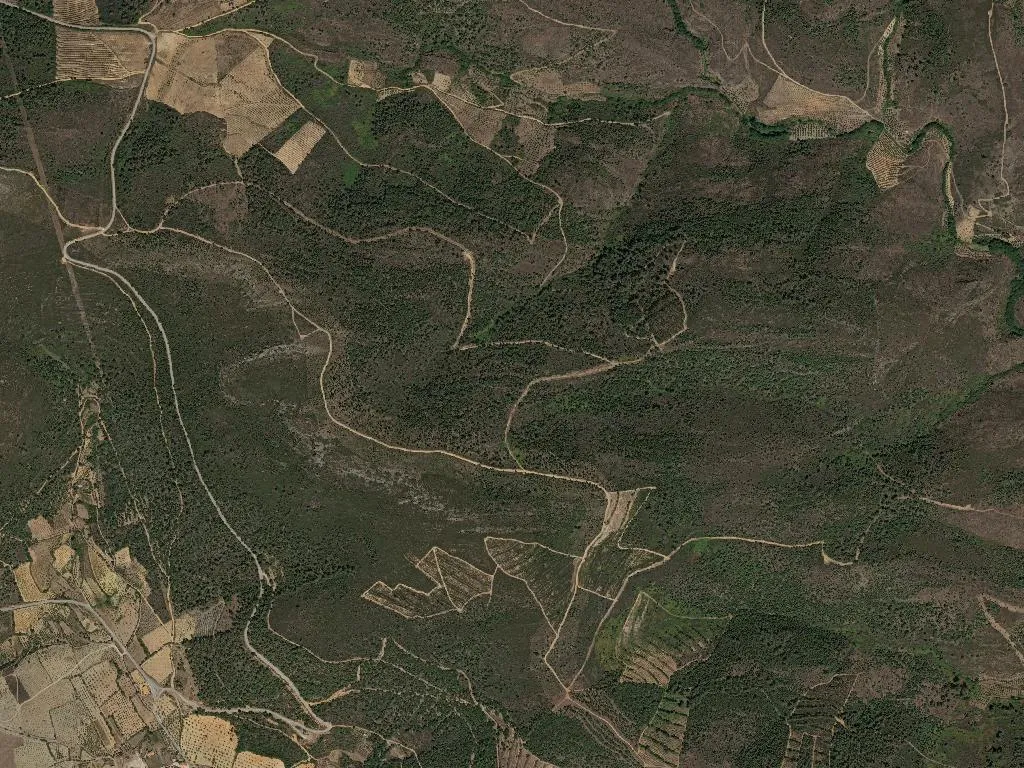
Dawn slips over the ridge at 761 m, gilding each almond branch in the high plateau of Trás-os-Montes. The air is already dry enough to make your lips tighten, yet valley draughts still carry a night-chilled snap that keeps the scent of pine resin tethered to the soil. Dry-stone walls hurry downhill in irregular steps, turning mountain scrub into ruled geometry; inside those rectangles, almond and olive alone are trusted to survive.
One valley, two parishes, shared arithmetic
Felgueiras and Maçores were welded into a single parish council in 2013, but the pairing is older than any ledger. Families have long intermarried across the schist soils, sharing droughts, wheat threshing floors and the same emigrant remittances posted from France. The entire civil parish covers only 38 km² and is home to 332 people – roughly one soul for every eleven hectares. Census statisticians add that 187 of them are over 65; on the ground that translates into shuttered primary schools, fields worked with 40-year-old tractors and cafés that open when the owner’s hip allows.
In Maçores (population 97) the school bell last rang in 2009. Felgueiras, the larger sibling, still supports a single bar, but Joaquim, 72, only turns the key after he has walked his goats and prefers not to trade on Mondays.
Almond as architecture
Moncorvo Protected Geographical Indication almonds and Douro Protected Designation of Origin fruit come off these same terraces. The trees’ root systems act like living buttresses, gripping slabs of broken slate that would otherwise slide into the Sabor River. January turns the slopes into a pale constellation: petals open weeks before anything else dares to leaf, reflecting sunlight back onto the stone and giving the illusion of snow to anyone glancing down from the IP2 motorway.
Sr Albano knew the optics were secondary. “Higher oil content,” he told me in 2019, tapping a cracked shell against his tractor wheel. “Cold winter, dry summer—no place for laziness.” Albano died the following spring, but the three hectares he planted with his father still deliver 600 kg of nuts most years, harvested by cousins who return from Lyon for two weeks’ unpaid family labour.
A larder with its own postcodes
The pantry list reads like a Michelin shorthand for the region: Terrincho lamb DOP, Transmontano kid DOP, Terrincho ewe’s-cheese DOP, Transmontano goat cheese DOP, Terra Quente honey DOP. Smokehouses in nearby Vinhais courier down chouriço and salpicão along informal circuits that pre-date refrigerated vans.
At Canada da Serra, Aníbal milks 18 ewes by 6.30 a.m., then heats the raw milk in a copper cauldron his mother carried as dowry. Wooden knife cuts the curd, muslin bags swing from the rafters, and by noon the cheese is already breathing in the curing room. “Fifty households used to make Terrincho,” he says, turning the first wheel with the heel of his hand. “Now we’re three, and I’m the youngest.”
Calendar anchored to Assumption Day
Every 15 August the parish empties its silence. Returnees from Gennevilliers, Esch-sur-Alzette and Neuchâtel drive hire-cars up the switchbacks, boots crammed with French pastries and duty-free whisky. The Festa da Vila redraws the geography of Church Street: trestle tables appear, tablecloths weighed with river stones, and the bakery—closed since 1997—reopens its wood-fired throat to roast kid and marinated ribs. At 9.30 a.m. the statue of Our Lady of the Assumption processes through rosemary smoke; by nightfall Zé Mário’s accordion has replaced the church bells, his right hand running the same arpeggios he once used to shake olives from the upper canopy.
UNESCO lists the entire landscape as part of the Alto Douro Wine Region, yet here the vine plays second fiddle. Still, the engineering is identical: hand-cut schist terraces, gravity-defying dry walls, centuries of muscle that persuaded a mountain to behave like farmland. Walk the eastern boundary at dusk and the wind lifts that warm, mineral perfume—earth baked onto flannel, resin sealed into hair—so that long after you have driven back to the coast you will find Douro dust settling from your cuffs like grey, fragrant snow.