Full article about Samões: Where Almond Terraces Breathe at Dusk
Granite hamlet above Vilariça, 338 souls, stone walls, three festas, zero fuss.
Hide article Read full article
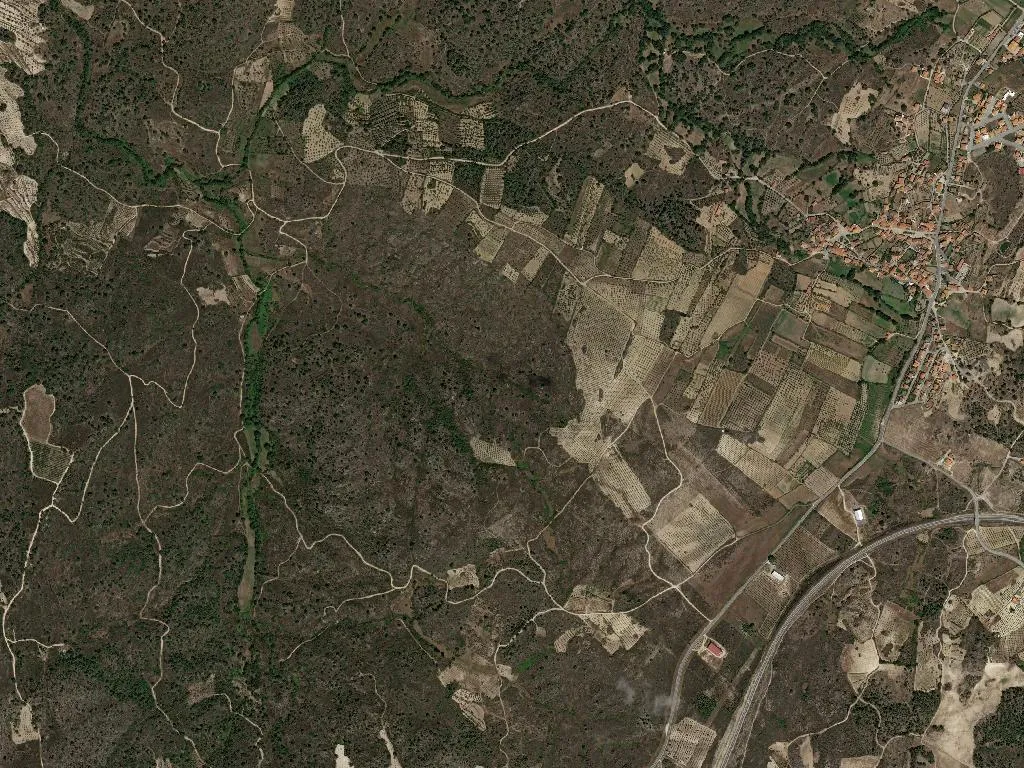
The granite thrusts itself through the winter-sere almond terraces, still hoarding the day’s heat long after the sun has slipped behind the ridges. At 547 m, Samões commands a shelf of the Vilariça valley where almond and olive alternate in stone-walled tiers; the only punctuation is a distant dog or the creak of an iron gate. Three hundred and thirty-eight people are scattered across thirteen square kilometres of ochre earth, schist and whitewash — a ratio that allows every cottage its own exhalation and every vegetable plot its private rhythm.
Medieval roots in a fertile rift
The village charter was folded into Vila Flor’s 1512 Manueline foral, yet the place feels older — perhaps Iron-Age old, when the valley floor was still a routeway between the Douro and the southern meseta. No castle keep or museum piece advertises the past; continuity is the artefact. You read it in the dry-stitching of the terrace walls, in the smoke-blackened beams of the threshing floors, in the way the parish church squats exactly on the footprint of whatever preceded it. History here is gerundival: planting, harvesting, curing, praying.
The festa calendar
Three dates force the hamlet into wider orbit. On 24 August the Festa da Vila honours St Bartholomew; by eight o’clock the Polis café already smells of espresso and bagaço. Men in pressed denim compare walking-stick carvings while women balance plates of sardines on window-ledges and shout grandchildren away from the fire-crackers. Two weeks later the Romaria de Nossa Senhora da Assunção packs the churchyard; hymn lines slide downhill through the pine tops and collide with the hiss of caldeirada cauldrons in the square. Pentecost brings the Castanheiro pilgrimage: cars nose up a dirt track to a hilltop shrine where sponge cake is sliced before the candles are even lit, and someone always recounts how the altar survived the 1958 wildfire.
A Transmontana larder
Dona Rosinha’s grocery sells almonds still wearing their sun-scorched skins — rejects from last year’s cooperative grade-out. November delivers new olive oil the colour of burnt barley sugar; locals bring five-litre demijohns to slip under the elbow. In Sr Joaquim’s loft the smoking starts on St Martin’s day: hams wearing three fingers of sweet fat, wine-scented chouriça, and salpicão that must be hung in the draught if it is to slice whisper-thin. Terrinho sheep’s-cheese, its rind impressed with schist patterns, appears on alternate mornings depending on whether the flock has grazed the bitter herbs of the upper slope or refused to give milk at all.
Days measured in gestures
There is only one place to stay — Céu’s grandmother’s house, three bedrooms liberated after the children emigrated to Lyon. Guests wake to a neighbour’s cockerel and the thump of bread being flung into a wood oven at six. The National Statistics Office claims forty-five young residents; walk the lanes and you meet twenty-eight — the rest are at university in Braga or Vila Real and reappear only at Christmas. All 105 pensioners answer to house-names: “Rosa of the Pigsty”, “Manuel the Net-maker”, “Ilda by the Spring”. When the church bell tolls the rosary at four, conversations pause, gates creak: the afternoon has tilted and it is time to retreat to the hearth.
At dusk the oblique light ignites the almond trunks and copper-washes the granite thresholds. The wind carries the scent of dry earth and wood-smoke, and you realise Samões offers no storyboard — only a slower respiratory lesson in what, elsewhere, we have forgotten to remember.