Full article about Sunlit Granite & Creaking Waterwheels of Vilas Boas-Vilarinh
Knife-sharp air, wyvern-carved church and Borrego smoke above Vila Flor’s merged hamlets
Hide article Read full article
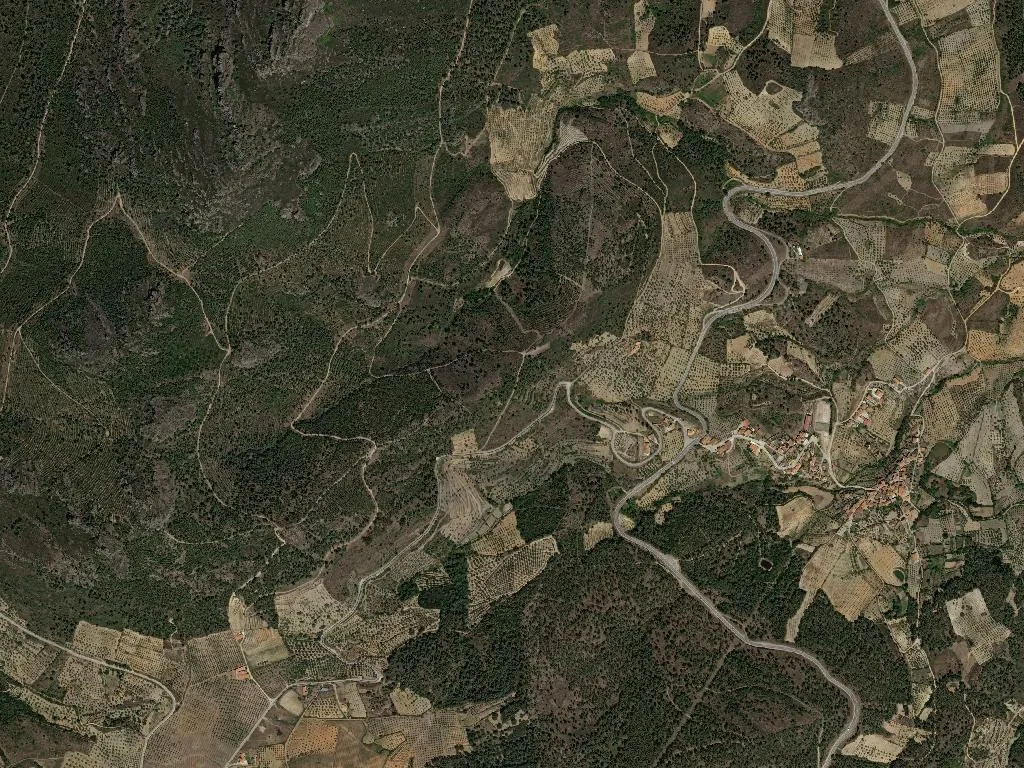
Dark granite walls drink the late-afternoon sun while, far below, the last working waterwheel of Vilarinho creaks against the stream. Between Vilas Boas and Vilarinho das Azenhas the land folds in graphite-green olive groves, wind-sculpted almond trees and schist terraces that measure time by harvests, not hours. At 534 m the air stays knife-sharp even in August, when emigrants return for the saints’ days and the villages briefly remember their own noise.
Two hamlets, one story
An administrative merger in 2013 simply rubber-stamped what geography had long suggested: two settlements divided by a shallow valley but joined by a shared medieval footprint. Vilas Boas first appears in 12th-century foral charters as crown land later gifted to the Knights Hospitaller; its church, rebuilt in the 1500s, still carries a wyvern on its portal – the badge of the Villas Boas family who once held the commandery. Vilarinho’s name preserves the watermills (azenhas) that turned local wheat into flour until the 1970s; their stone hulks dot the stream like broken gears. Each hamlet keeps its own granite chapel – dim interiors, 17th-century retábulos, the smell of beeswax and dust – anchoring the settlements visually and spiritually.
Saints, processions and smoked sausage
The calendar is stubbornly liturgical. On the last weekend of August Vilas Boas honours São Bartolomeu with a street grill of Borrego Terrincho DOP, the milk-fed lamb scented with mountain rosemary, and open-air dances that end when the accordion player’s fingers give out. Two weeks later a slow procession carries Nossa Senhora da Assunção down from the mother church in Vila Flor to Vilarinho, women in black lace murmuring the rosary while men steady the canopy against the upland wind. In the churchyard, long tables appear: clay bowls of feijoada transmontana, slices of Salpicão de Vinhais IGP, glasses of rough red from old-vine plantings on the surrounding schist. No tickets, no wristbands – just bring your own plate.
A pantry with protected status
The parish reads like a grocer’s atlas of Portuguese PDOs and PGIs. Breakfast might be Queijo de Cabra Transmontano on sourdough rye; lunch a Posta à Mirandesa, the 800 g bone-in sirloin seared over oak embers until the fat ribbons caramelise; tea spooned from a jar of dark, heather-scented Mel da Terra Quente. Even the olives are specific: Negrinha de Frexo, a tiny, jet-black cultivar cured in brine and served with chilled verdelho. Every flavour carries the weight of generational trial-and-error: the right acorn-to-oak-smoke ratio for the hams, the exact day to fold the curd for the goat’s cheese, the lunar cycle for pruning the almond orchards.
Silence by the square kilometre
Density here is 12 inhabitants per km² – one of the lowest in mainland Europe. Of the 525 residents, 215 are over 65; only 27 are under 14. The arithmetic is stark, but the upside is an authenticity no marketing board can fake. There are three places to stay: two village houses whose stone has been repointed but not repainted, and one upstairs room in a family home where breakfast arrives on a tray still warm from the hen. No signage, no key cards, no checkout time – just an envelope left on the kitchen table.
Olive terraces and altitude wine
The 43 km² roll out in gentle waves of olive, almond and rosemary scrub. Official hiking trails do not exist; instead you follow the stone-walled carreiros that once took grain to the mills. Head east at dusk and the Serra de Bornes silhouettes against a sky the colour of late Malbec. Those schist slopes are planted with century-old vines whose grapes once supplied the port lodges downstream; today small growers bottle under the altitude-driven “Douro Superior” sub-region, producing tense, violet-scented reds at 600 m. Walk until the bell of Vilas Boas tolls seven times, then turn back – the sound carries for miles, proof that someone is still listening.