Full article about União das freguesias de Algoso, Campo de Víboras e Uva
13th-century castle, Romanesque bell-tower, custard tarts on feast days: echoes of border knights
Hide article Read full article
Where the Wind Files the Stone
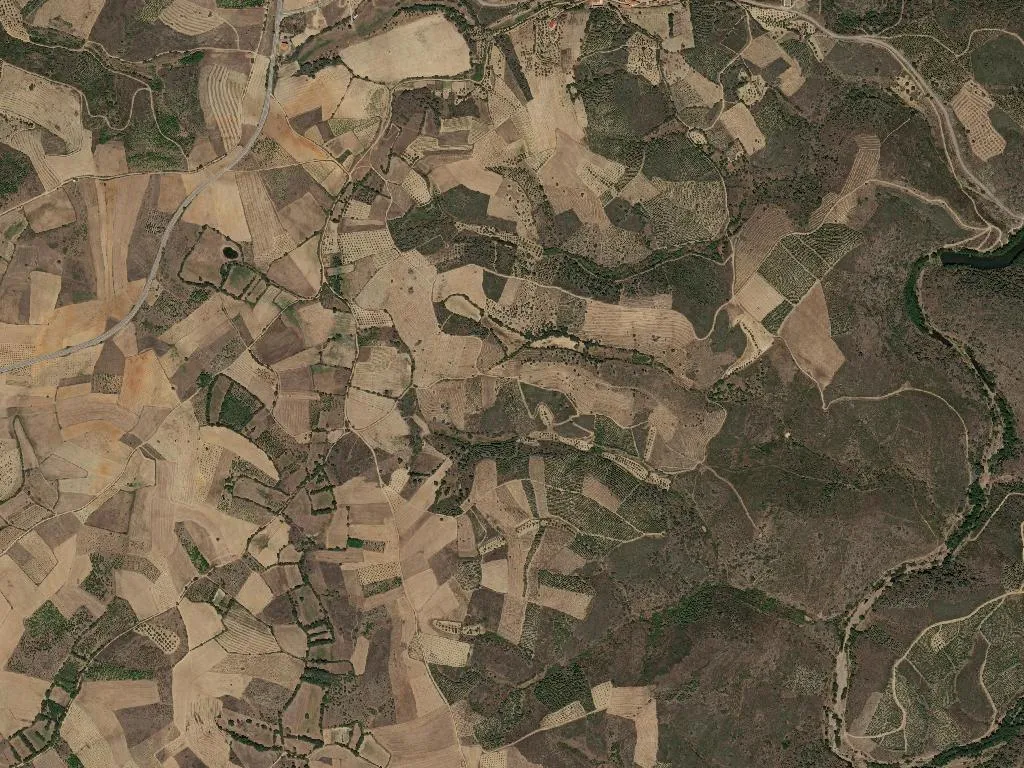
At 612 m the wind scours the shale tables of north-east Trás-os-Montes, stripping every syllable from the air. Walk through Algoso, Campo de Víboras or Uva and the only reply you’ll hear is your own footfall ricocheting off façades whose whitewash surrendered decades ago, exposing the dark masonry beneath. Light here feels uninsulated—raw, high-altitude, carving black angles across ochre earth. Come in July without a hat and you’ll understand why farmers work the rye fields at dawn; the sun does not forgive, and the sole shade is the silhouette you cast.
Architecture that Survives by Being Useless
Two state-listed monuments punctuate the plateau like fixed stars. The 13th-century castle of Algoso, headquarters of the Knights Hospitaller on the Portuguese-Leonese frontier, still lifts its keep above the scrub; jackdaws nest in the murder holes, and the stone pillory in the square below is now a coat-rack for shepherd’s capes. A kilometre away, the Romanesque bell-tower of Algoso’s mother church rises from a swell of broom and rockrose, its slit windows catching the same horizontal light that once warned of Castilian raids. Pilgrimage days are the only time these stones see traffic: 24 August for St Bartholomew, 15 August for Nossa Senhora das Graças. On those mornings Adelino’s café unlocks at six to dish out custard tarts still warm from Miranda do Douro, and the accordion that accompanies the procession can be heard long before the first banner appears.
The Mathematics of Vanishing
The civil parish totals 490 souls across 96 km²—roughly five neighbours for every square kilometre, though “neighbour” is generous. Some 270 residents are over 65; only 18 are under 14. The arithmetic translates into daily ritual: Zé do Telhado, 87, climbs to his chestnut grove every afternoon to check for raiders, while the postwoman knows to wait five minutes at each gate in case someone is shuffling to the door. Houses outlive owners; hearths are bricked up, roofs replaced by corrugated iron, but the shale walls refuse to fall.
A Kitchen Governed by Smoke
The plateau’s DOP labels read like a survival manual. Cabrito Transmontano spends six hours in a wood-fired oven until the skin lacquers into chewable black parchment. Mirandesa beef—year-old oxen fattened on wild broom—arrives in cm-thick steaks the colour of garnets, requiring jaws in good working order and a glass of the red Zé keeps beneath the counter for regulars. Smoked ham from Vinhais hangs above the cook-fire, its surface the colour of winter honey. Chestnuts are harvested by gloved hands, slit, roasted, then stirred into a three-day jam that Rosa only makes if you telephone first. The local olive oil bites the back of the throat like nettle tea, perfect for cutting through a feijoada simmered with ear and trotter.
Where to Lay Your Head
Three dwellings accept paying guests: two shale cottages whose bedrooms are heated by convection between kitchen and chimney, and a low whitewashed house in Uva where Boa Vida Maria grinds her own maize for breakfast porridge. Hot water is reliable, Wi-Fi is not. Sheets are flannel year-round; duvets are weighted with patchwork made from grandmothers’ skirts. Check-in is whenever you arrive, check-out is whenever the bread runs out.
Dusk, and Other Certainties
Late sunlight sets the village walls smouldering copper. Then the plateau cools at speed, wood-smoke rises in white columns, and men gather outside Adelino’s with hands buried in jacket pockets, discussing the price of rye. From a window across the lane D. Amélia keeps surveillance on the road, clocking every set of headlights that snakes towards the Spanish frontier ten kilometres east. By nine the wind drops entirely; silence becomes so complete you can hear chestnut husks hitting the roof. Stay up long enough and you’ll understand why the Romans, the Templars and the Hospitallers all posted lookouts here: on a clear night the Milky Way feels close enough to snag on the castle battlements, and any movement—fox, boar, or merely the moon sliding across the shale—announces itself like an intruder.