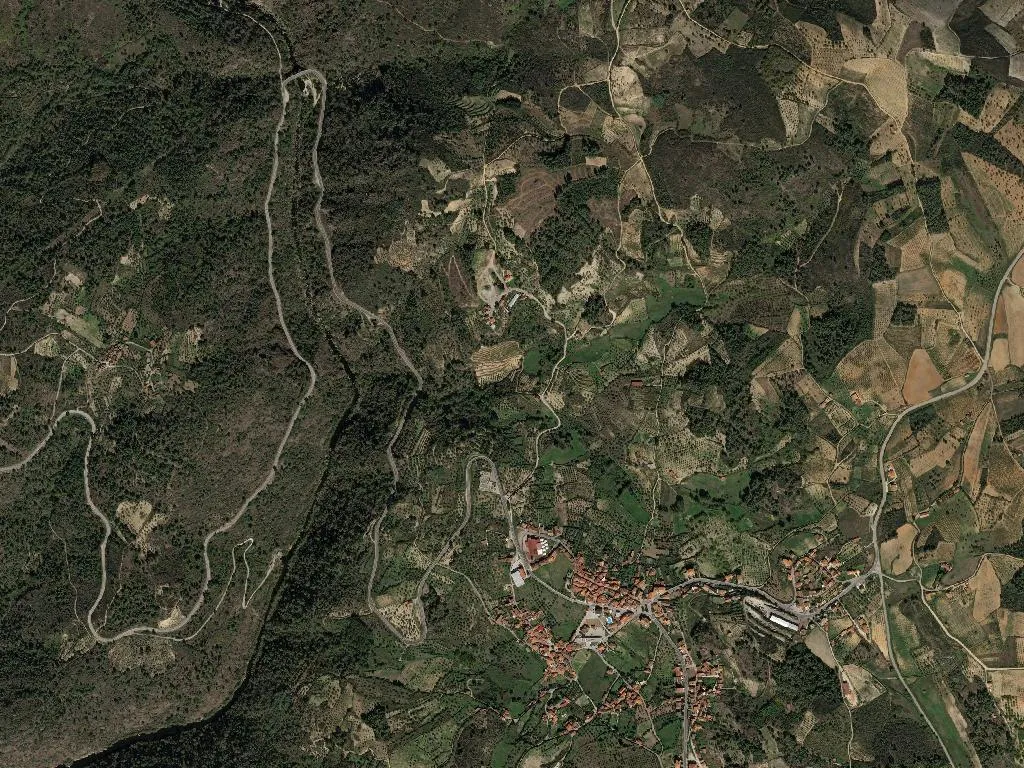
Full article about Rebordelo: where smoke writes morning over schist roofs
In Vinhais, granite chapels, wolf dusk and ham-scented air cling to a 478 m frontier ridge
Hide article Read full article
Smoke writes the morning
Woodsmoke drifts sideways from schist roofs while the sky over Rebordelo is still the colour of gunmetal. In the stone courts, animal heat mingles with damp hay and the slow burn of oak in smoking-houses where tomorrow’s ham already darkens. Northwards, the Serra de Montesinho rolls out a mat of heather and gorse; southwards the valleys drop towards the Terra Quente, Portugal’s “hot lands”. At 478 m the air carries a clarity that snaps against the skin – neither the brittle cold of the summits nor the baked flatness of the plain, but a hinge altitude where two weather systems briefly shake hands.
A boundary in the stone
The name comes from the Latin rebordeare: to redraw a frontier. Monks of Santa Maria de Bouro and the Aviz kings spent the fourteenth century bickering over deeds, yet the border they quarrelled about had already been limned by shepherds moving flocks between summer and winter ground. Their footpaths are still visible on the Ordnance Survey-style Portuguese military maps – faint dotted lines that ignore every subsequent surveyor.
The parish church of Nossa Senhora da Assunção rises from that quarrel, its successive centuries of rebuilding readable like tree rings: Romanesque ribs, Manueline door, Baroque gilt. Inside, the smell is of beeswax and granite cooled by five-hundred-year shadow. On the retable, cherubs roll their eyes at pilgrims who still count harvest prayers on wooden beads polished by field sweat.
Scattered through the hamlets are tiny chapels, granite crosses, maize granaries balanced on mushroom-shaped staddles. No architect taught these proportions; they were learned from the weight of local stone, from the precise pitch that lets rain run without dripping, from the draught that dries corn without scorching it. With only twenty-eight inhabitants per square kilometre, silence has density here. Footsteps echo down the calcada; wolf packs move through the dusk unseen, advertised only by the drawn-cork howl that lifts the hair on a moonless night.
Eating the map
Geography turns edible in the kitchen. Roast kid carries the resinous bite of rock-rose the animal grazed on; chanfana – goat stewed in red wine until the meat slides from the bone – stains lips the colour of Episcopal vestments. The real cartography, though, is in the charcuterie. The Chouriça de Carne de Vinhais and Linguiça de Vinhais, both IGP-protected, coil like edible compasses pointing to the oak woods where pigs snuffle for acorns. The Presunto de Vinhais hangs for three entire winters in mountain air cold enough to freeze salt but never warm enough to turn it; Salpicão borrows smoke from oak until the flavour is as ingrained as memory. The Bisaro pig itself – half-wild, chestnut-fattened – tastes faintly of walnut, a note impossible to replicate in intensively reared pork.
Chestnuts, DOP-branded as Castanha da Terra Fria, appear in cakes, soups and the winter dessert grandmothers make by pouring new olive oil over yesterday’s bread. The local potato, Batata de Trás-os-Montes IGP, is so dense and yellow it drinks up the juices of cozido à transmontana and collapses on the tongue like edible gold leaf. Each mouthful is co-ordinates rather than flavour: 41° 31' N, 7° 10' W, altitude 478 m, slope south by south-west.
Between ridge and river
Montesinho Natural Park begins where the village ends. Oak and sweet chestnut darken into a canopy where wild boar root for Arbutus berries, leaving prints the size of a child’s clenched fist. At dusk the red flash of a fox tail reads like a semaphore against the bracken. Shepherds study wolf prints the way City analysts read futures – fresh or old, solitary or pack, inbound or outbound.
Granite streams run clear over water-smoothed boulders the colour of pale ale. The old caminhos de pastor climb with zoological logic: the shortest gradient between summer pasture and winter byre, where keys to dry-stone huts still hang on nails inside the door. The eastern branch of the Caminho de Santiago passes within 5 km; the occasional scallop-shell waymarker appears like a polite footnote. Pilgrims who detour to Rebordelo find a single guest-house whose night silence is so complete you can hear blood moving in your ears.
August in procession
On the morning of 15 August the Festa da Nossa Senhora da Assunção renegotiates the village’s contract with time. Oak pews creak under the weight of bodies scented with lavender water and honest sweat; the priest’s sermon competes with cicadas. Then the procession spills outside: banners snapping, hymn lines repeated in descending dialect cadence. Every generation is present – the 32 children of the last census dart between skirts, while 288 elders swap Arabic-Latin hybrids the television has never managed to erase. They step deliberately over the same slab of granite where Rosa, ninety-three, still places only her right foot, superstition being the one crop never left to rot.
In the churchyard, an accordion plays vira rhythms that seem to inhale and exhale at once. Glasses of rough red clink like muted bells; long knives carve salpicão into translucent petals. When the last set of headlights snakes down the mountain soon after midnight, Rebordelo exhales. Smoke climbs again from the curing huts, diagonal as ever when the wind shifts, carrying the smell of meat that keeps mountain time – not a day more, not a day less – measured by moons, frosts and the slow tick of resin in oak logs.