Full article about Sobreiro de Baixo e Alvaredos: Portugal's silent ridge
Granite cottages, wolf country and ham that ages longer than mortgages in Vinhais
Hide article Read full article
The silence that keeps you on the bench
The hush at 708 m isn’t an absence but a low, steady pulse: the Montesinho Natural Park inhaling between granite ridges. A chestnut branch cracks; a blackbird miscalculates a bend. That is all. The morning air arrives tasting of wet schist and birch-smoke, the flavour of a grandmother’s kitchen even if yours was a sixth-floor flat in Manchester. Sobreiro de Baixo e Alvaredos do not unveil themselves at once; they come forward like a packet of sepia photographs dealt one by one—hamlet by hamlet, eyebrow-arching doorway by doorway.
Cork, granite and the stubborn houses of 1945
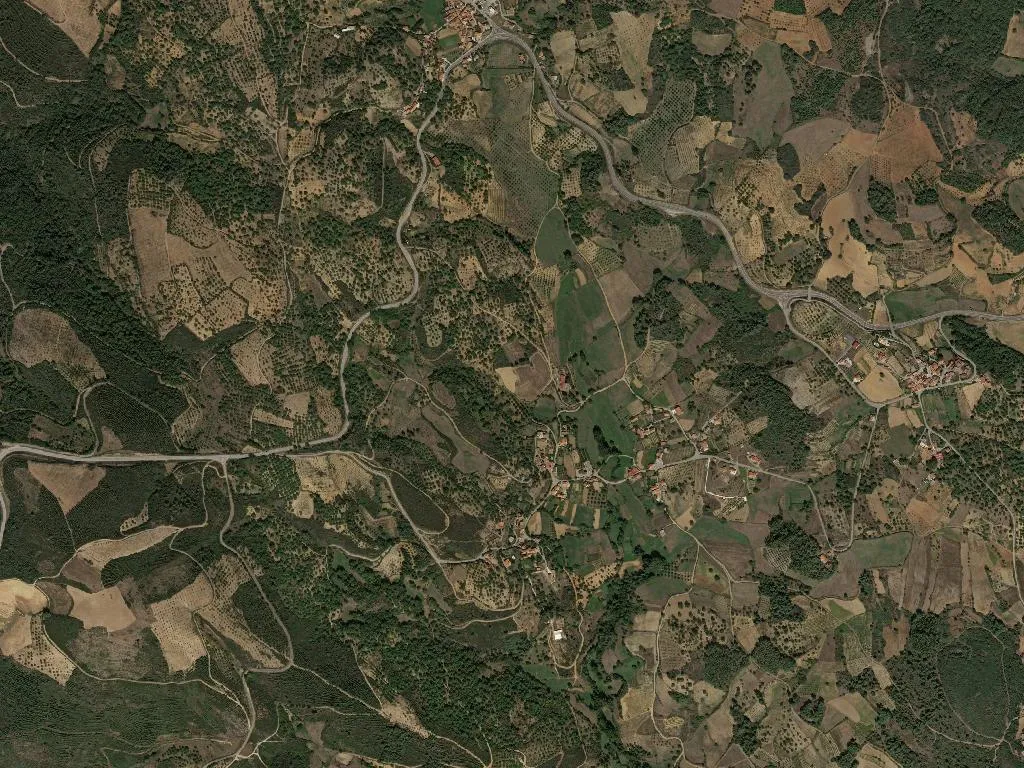
The name still advertises the trade that once paid for everything: cork oak, stripped, boiled, trucked to the mills. Today you are likelier to find a padlocked café than a tree being harvested. Of the 275 residents, many still sleep where their grandfathers slept before the Second World War—thick-walled cottages built low enough to make a tall visitor bow, a courtesy you learn after the first bruised forehead. São Mateus church, three blocks of granite and a single cross visible from the ridge road, passes for the local skyscraper. Beyond it scatter Soutelo, Caroceiras, Cobelas—micro-villages that fit inside a single sentence and still manage to wrong-foot Google’s cartographers.
Where the Iberian wolf writes the rules
Step off the lane and you enter an auditorium run by wolves. Oak and strawberry-tree weave a dark green curtain around schist outcrops that look casually dropped by a giant. Minor streams sprint towards the river Sabor; silence re-opens behind you like water over a stone. The GR 38—Caminho Nascente—crosses the parish: if you’re walking to Braga, carry an extra litre and a smaller ego; some gradients feel infinite and the only spectator is your own heartbeat echoing in your ears.
Ham that hangs longer than most mortgages
Winter gastronomy is insurance, not theatre. In ceilinged smokehouses the Presunto de Vinhais IGP drips resin for twelve months, a calendar of patience. Salpicão and chouriça de carne represent what is politely called “the noble cuts”; everything else becomes the father-in-law’s anecdotes. Carne Mirandesa and Cordeiro Bragançano arrive on pewter so wide the plate beneath disappears. Olive oil tastes of dried summer herbs; potatoes arrive with terroir before the word existed. When the first frost hits, chestnuts rule: charred in ash, floated in caldo verde, or folded into sweets that grandmother wraps in grease-proof paper—take two, one for the mouth, one for the pocket, because tomorrow is uncertain.
August, when the diaspora comes home
Our Lady of the Assumption on 15 August is the Trás-os-Montes equivalent of New Year’s Eve. Suddenly every hire car sports Paris, Zürich or Luxembourg plates. São Mateus throws its shutters wide; processions climb the lanes like slow-motion mountaineers; trestles lengthen until feijoada is eaten standing because chairs have run out. For three days the demographic pyramid inverts: the 117 pensioners become a minority, out-chattered by returning offspring. Silence is voted out of office, conversation spills off terraces, and even the wolves seem to keep their distance.
When the sun drops behind the Serra do Marão and cold rolls down from Larouco, wood-smoke rises again. There is no hurry—only the metronome of seasons, the scent that adheres to coats and memory, and the certainty that tomorrow the bench on the square will regain its quiet occupant.