Full article about Vilar de Peregrinos: Dawn bell, chestnut smoke, wolf prints
At 771 m, this Bragança hamlet wakes to church bells, Romanesque bridge tolls and October’s chestnut
Hide article Read full article
The bell at seven
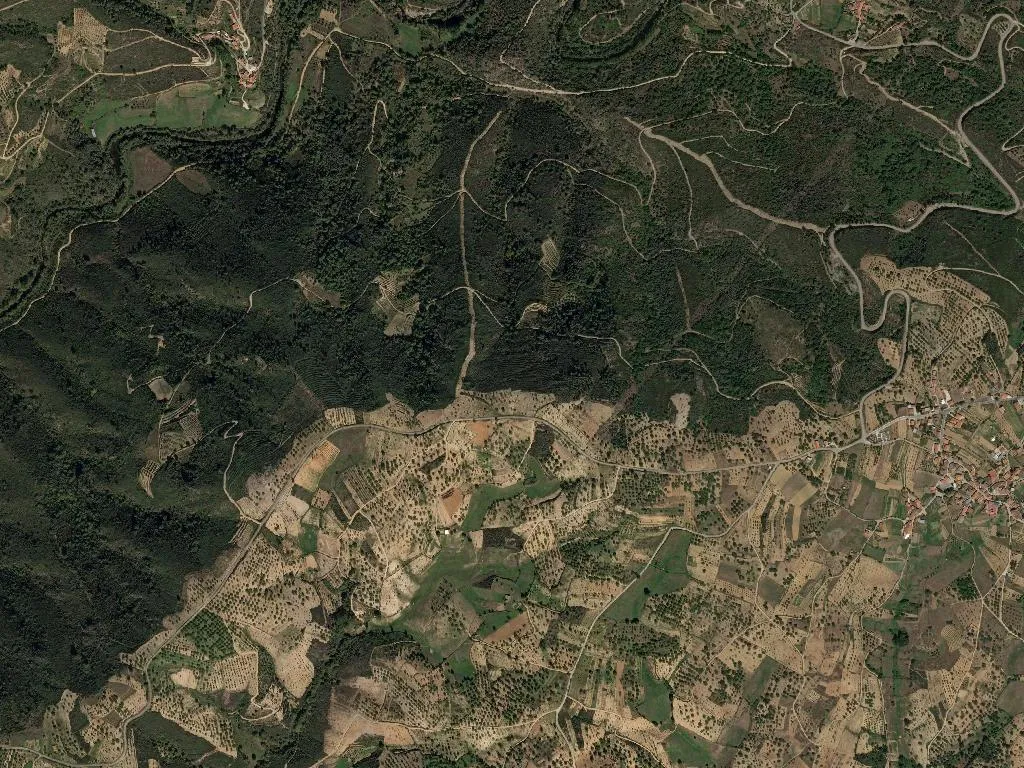
The bell in the tower of Nossa Senhora da Assunção strikes three times at seven sharp. No one oversleeps: October means chestnuts to shake from the trees and hams to inspect in the smoke-blackened lofts. One hundred and thirty-four people live here at 771 m, scattered across 18.4 km² of heather and granite. The name is medieval paperwork, not wishful branding—Vilar de Peregrinos appears in a 1220 royal charter as an official halt on the eastern branch of the Camino de Santiago.
The only bridge that matters
The single-lane Romanesque arch over the Sabor is still the village’s lifeline. When winter swells the river, detour signs send drivers 40 km south to the nearest safe crossing. Yellow arrows of the Caminho Nascente are daubed straight onto the stone; at the far end the path ducks left into Rua de Baixo because the original right-of-way now crosses a fenced estate whose owner charges pilgrims €5 for the privilege.
A church without a coach park
The priest unlocks the church at eight for Sunday mass, then locks it again. The key stays with the sacristan in the blue house opposite—knock on the shutter and wait. Inside, the oak high altar still smells of 1734 beeswax, and the polychrome Virgin was paid for not by passing walkers but by 10 moios of wheat harvested locally in 1623.
Chestnuts or the A10
October is decision month: €3/kg for DOP-certified Marvão chestnuts or €1,500 a month picking fruit in France. Those who stay set alarms for five, pocket a folding pruning hook and head for the soutos. The trees are wind-bent dwarfs; the wolf that took Carla’s dog last year left prints in the stream mud but no one has seen it.
Ham that waits for wind
Vinhais ham needs three things: Atlantic northerlies, altitude above 700 m and time. João hangs his 40 legs in November, takes them down in July. The annual household budget depends on how well the attic rafters breathe. His chorizo is shoulder-cut pork interlaced with belly fat, not jowl as the recipe books claim, and the only liquid used is mountain-spring water that has never seen chlorine.
15 August reckoning
The Feast of the Assumption doubles as the village spreadsheet. The procession steps off at ten; by one the fire brigade tarp is up in the square for posta à moda antiga—thick beef slice stewed with potatoes and turnip tops, €12 with wine from the Bragança co-op. There are only two guest rooms in the parish, both owned by London electricians who fly back for two weeks every August. When the bell rings again at ten the smell of burning oak drifts from every chimney; electricity is too dear and mains gas stops 20 km away. Lights go out one by one. Tomorrow the chestnuts will still be on the trees and the ham will still be waiting for wind.