Full article about Belmonte: granite whispers of crypto-Jews & Brazil’s finder
Wander castle shadows, Ladino alleys and hidden menorahs in the Beira sky-village
Hide article Read full article
Belmonte: where the stone remembers everything
The church bell strikes once. The note ricochets off the castle parapet, slips down a lane barely shoulder-wide and dissolves among the terracotta roofs that tilt over the Cova da Beira valley. At 543 m the morning air carries the metallic snap of altitude; you breathe it in like chilled white wine. Footsteps echo on granite setts – hollow, deliberate – because no-one in Belmonte has ever hurried for a stranger. Population 1,772, give or take a cousin.
A window that faces two worlds
The Castelo de Belmonte squats on its outcrop like a piece of defensive punctuation. Its ashlar walls, the colour of weathered cardboard, have absorbed every siege, every abandonment, every subsidy-fuelled restoration. On the south flank a single Manueline window frets the stone into lace. Stand here and you look over the same ridgeline the Cabral family surveyed after Afonso V granted them these lands. The castle was their town house; somewhere in the village Pedro Álvares Cabral was born in 1467, the boy who would haul Portugal to Brazil in 1500. The modern interpretation centre will tell you the dates, but the castle’s upper chambers tell you the story: light slanting across dust, silence thick enough to bite, floorboards that creak in the accent of the fifteenth century.
The secret spoken in Ladino
Drop downhill, past the pelourinho and the moth-eaten manor houses, and you enter the judiaria. Door heights shrink, whitewash flakes like old sun-cream, and the alleys smell of wood-smoke and closed doors. During the Inquisition Belmonte’s crypto-Jews kept the Sabbath behind drawn curtains, passing prayers from mother to daughter in the Iberian variant of Hebrew known as Ladino. Nowhere else in Portugal did the chain survive intact. The synagogue Bet Eliahu, built in 1996, looks across Rua Direita at the parish church; the two façades are separated by twenty metres and four centuries of mutual suspicion. At Hanukkah the menorah throws a nervous gold shimmer onto the cobbles while the Beira night sharpens its frost.
A roofless Roman riddle
Three kilometres east, the Torre de Centum Cellas rises from a sheep-nibbled plateau with the abruptness of a film-cut. No roof, no context, just three storeys of precisely fitted granite blocks – the only building of its kind on the peninsula. Archaeologists still argue: customs post, private villa, temple to a forgotten god? A footpath leads here from the village, threading through gorse and heather that smells of rosemary after rain. The wind that combs across the Serra da Esperança carries a sound like distant conversation; it may only be the broom pods cracking open, but the tower has had 2,000 years to perfect its ventriloquism.
Goat, clay pot and the taste of amber
Belmonte’s kitchens are unconcerned with fashion. At O Cabrito they still slow-cook Chanfana de Cabrito da Beira IGP in unglazed clay: kid, garlic, bay, paprika and a whole bottle of rough local red, simmered until the meat submits and the sauce turns the colour of old violin varnish. The dish arrives under a tea-towel lid; bread is obligatory, cutlery optional. Around it sit cured sheep’s-milk cheese, dogfish soup sharpened with coriander, and charcuterie that tastes of smokehouses tuned by centuries of trial and error. Olive oil – pick Beira Baixa DOP or Beira Alta DOP – pools on the plate like liquid topaz. Finish with Cova da Beira cherries or peaches in season, their skins tight with mountain acidity, and a cinnamon-dusted arroz doce that makes you forgive every bland hotel pudding you’ve ever pushed aside.
Evening on the ridge
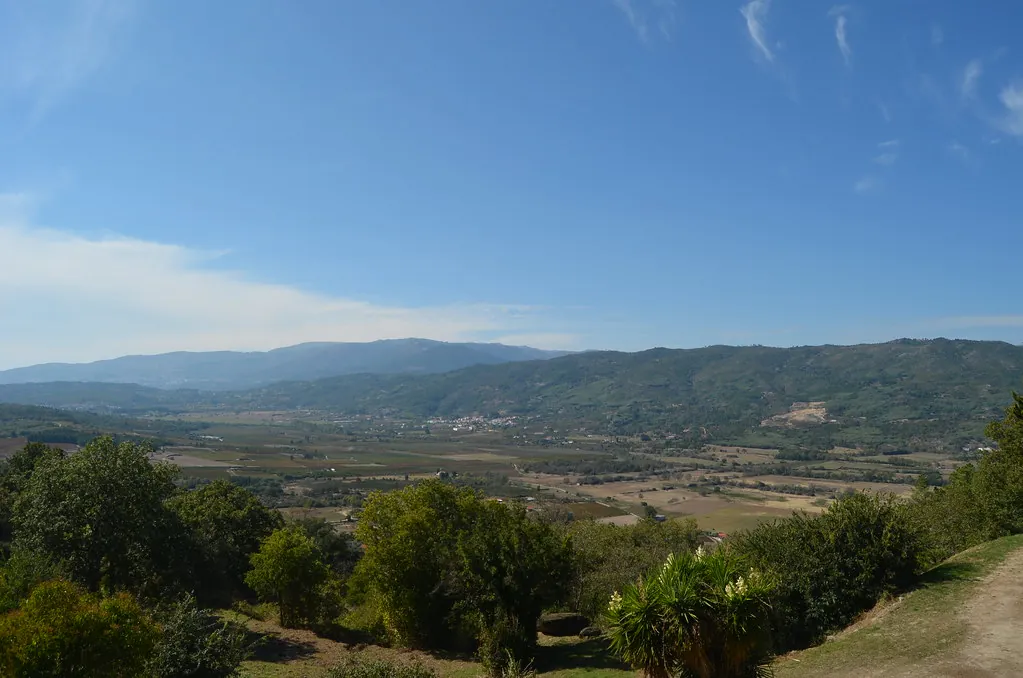
The Romaria de Nossa Senhora da Esperança hauls half the village up the Serra da Esperança every May, but you can make the climb any evening when the sun drags long shadows across the valley. From the crest the Cova da Beira spreads out – a cultivated trough stitched with olive and cherry, the Serra da Estrela closing the horizon like a broken wall. Belmonte sits within the Geopark Estrela; sign-posted trails – the Rota de Pedro Álvares Cabral among them – braid together granite, oak and the chill glide of the River Zêzere. The Portuguese interior Camino passes through here too, and the village’s 43 guest beds mean you can linger long enough for the place to recognise you.
Stay overnight. The N18 is a decent road, but Belmonte measures distance in conversations, not kilometres. At 22.00 the last café shutters up; you’ll hear the clatter of pans being washed at O Cabrito, then only Telmo’s dog and the church clock that strikes the hours like someone anxious to go to bed. Five thousand years ago someone raised the anta of Caria on a neighbouring plateau, presumably for the same reason visitors stop today: the night here is so complete you can hear your own pulse – and, if you listen past it, the faint, obstinate whisper of the Zêzere turning stones over in the dark valley, a conversation that never ends.