Full article about Cantar-Galo: Dawn above the clouds at 916 m
Shepherd bells, granite ridges and thyme-scented air in Covilhã’s hidden hamlet
Hide article Read full article
Dawn at 916 metres
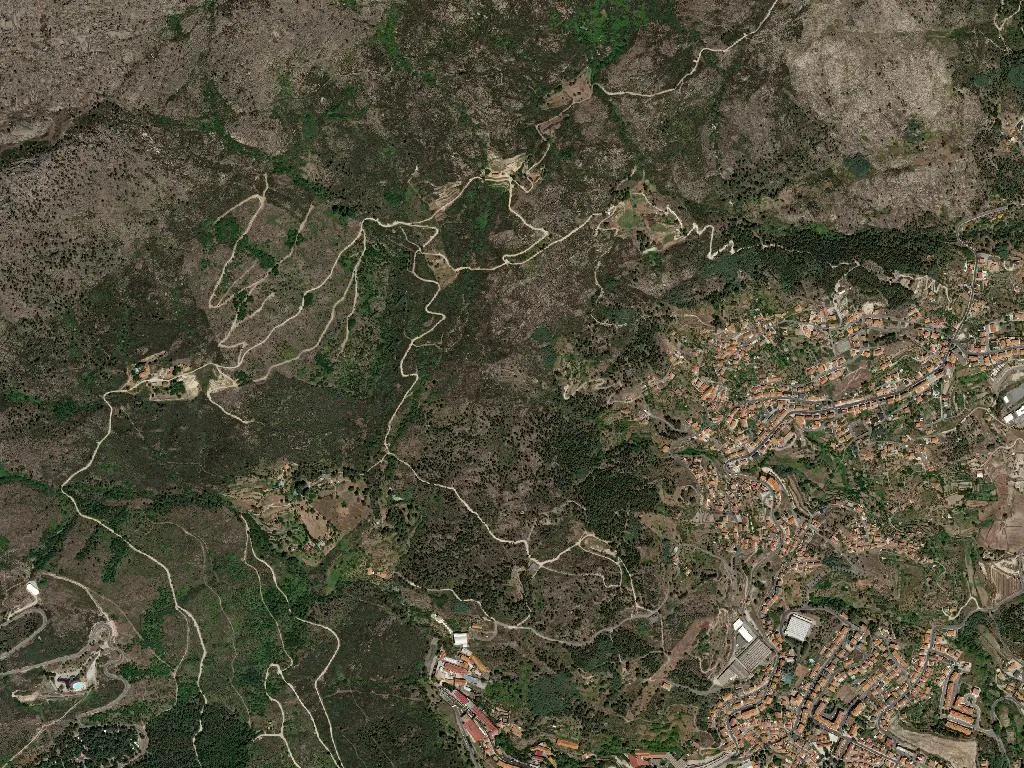
The morning light slips in diagonally through the gaps in the wooden shutters. Outside, church bells mark time at a cadence few places still observe—unhurried, unanxious, simply present. Cantar-Galo sits at 916 m on the southern flank of the Serra da Estrela, where the air has a different density and silence settles like a wool blanket.
Legend claims the hamlet’s name came from galeiros, the migrant mine-workers who crossed these ridges and sang to keep the mountain loneliness at bay. Today the only songs are birdsong and, occasionally, Sr António humming on his way to the vineyard with two tin cans swinging from the yoke across his shoulders.
The parish lies inside both the Serra da Estrela Natural Park and the UNESCO-estrela Geopark. Translation: granite everywhere—the kind that eats through shoe leather in a fortnight—and views that reimburse every calf-burning climb. When snow still clings to the summits while the valley below has already turned May-green, you feel two calendars running at once.
Following the inland Camino
The Portuguese Interior Way of St James passes through the village—no scallop-shell crowds here, just solitary walkers arriving short of breath to ask, “How much further?” The honest answer is always “depends”: on legs, on wind, on will.
Beside the trail, schist walls buckle like elderly knees yet refuse to fall. My grandfather swears they’re just like us—joints loosen, but we stay upright.
Mountain plate
The food is what it is. The queijo da Serra isn’t window dressing; it’s on the counter because it was ladled into moulds this week. Requeijão is eaten with bread still too hot to hold—if the loaf is cold, you’ve arrived too late.
The lamb grazed the steep paddock you can see from the terrace, where grass is sparse but tastes of wild thyme. And the cherries… when their moment comes, it’s as if nearby Fundão has temporarily relocated here. You buy them by the crate, eat them by the fistful, and your fingers stain the same purple as a winemaker’s.
The weight of years
Of the 1,606 residents, 587 are over 65. That isn’t statistics; it’s the queue outside the bakery at seven sharp. Yet 111 children still keep the primary school open—for now.
Sometimes I think the village is turning into the ancient olive groves: lower yield, deeper flavour. Granite staircases are climbed slowly, yes, but every window frames a face curious to see who is passing—an algorithm no city has replicated.
Late afternoon sunlight catches the stone façades like a forgotten burner left on high; cold then drifts down the slope the way an unannounced guest arrives. Doors shut early, true, yet inside there’s a fire, local wine, and a story—because here stories are like bread: baked daily and never the same twice.