Full article about Coutada: Schist Terraces & Wood-Smoke above Covilhã
Clinging to a Beira valley wall, this 361-soul village trades olives for pine air and Sunday kid.
Hide article Read full article
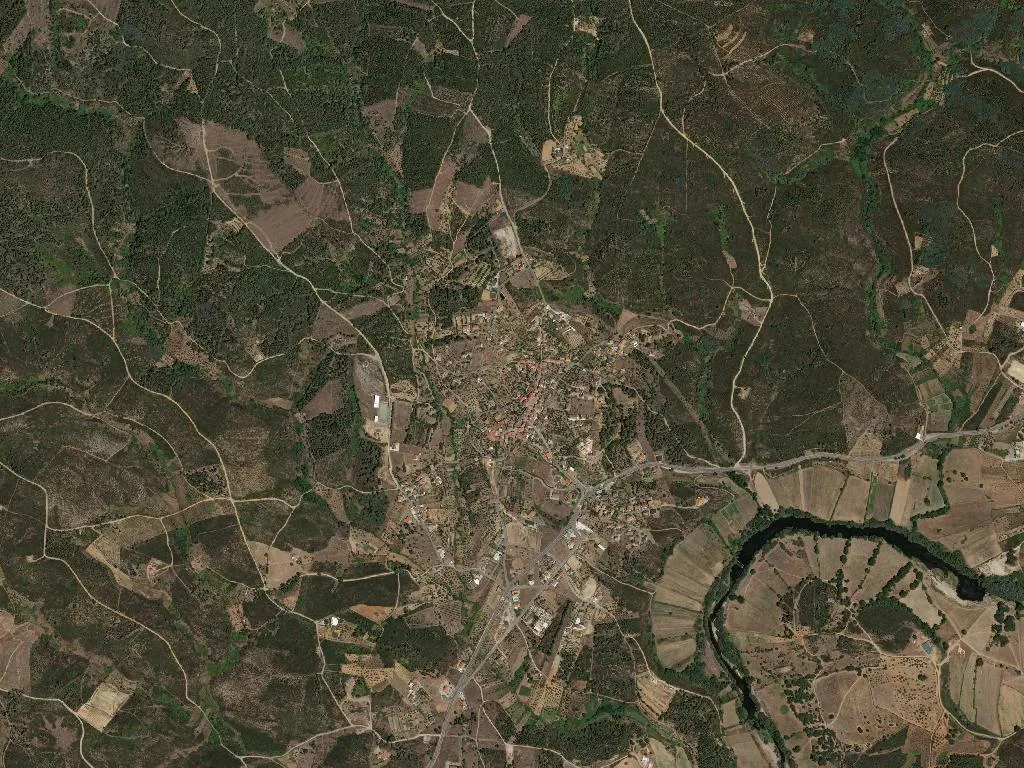
The tarmac drops between olive and the odd cherry tree—fewer now, but still enough to trace the road. Just before the bridge the bend tightens and Coutada reveals itself below, clamped to the valley wall as if it forgot to leave. Terraces of schist houses pile on top of one another; you park at the top and walk down. At 444 m the air is not yet mountain, but it no longer smells of city—wood smoke drifts up, and, in season, the green-acid tang of olives being crushed.
The parish register claims 361 inhabitants. On a Monday morning the reality is lower; at weekends the number swells when offspring drive in from Covilhã or Lisbon. Administratively we belong to Covilhã, yet Serra da Estrela is only a ridge away—climb the lane to Paul and the dull-green of pine soon elbows out the silver-grey of olive. Cherries are still grown, but not as when harvest meant school was cancelled and half the village was in the orchards. Today whoever owns a plot sells to the first passing van or lets the fruit fall; come June, Spanish lorries take the surplus away.
What you eat (and drink)
There is no restaurant in Coutada. There is Café Marques, open for Sunday breakfast and, if you order ahead, roast kid at festival time. Everything else is domestic: Serra cheese someone carried down from the Torre summit; requeijão still stirred by Dona Alice in a clay pan; Beira Baixa olive oil that Zé Manel decants into five-litre flagons. Wine arrives via the butcher or a cousin’s harvest—rough reds that never pretend, whites that turn if you dawdle. Cured meats travel west from Guarda: black-pork chouriço, rashers buried in coarse salt—everything the mountain provides when the pig is killed.
A waypoint, not a destination
Coutada sits on the Via Lusitana pilgrim trail, yet walkers are rare. When they appear they refill bottles at the spring and ask, “How far to Covilhã?” We answer eight kilometres, then watch them calculate: eight uphill. They rest five more minutes on the concrete bench under the eucalyptus. The church stays unlocked, but there is no souvenir stall or stamp, only the visitors’ book in which someone wrote, “Thank you for existing”—and that is enough.
After dark the lights switch on one by one and silence becomes almost absolute. It is not serenity; it is absence. Yet that is why you hear the river below, Fontão’s dog barking at the moon, Adelino’s tractor coughing at six. Coutada offers no itinerary. It is a place to halt, pull a warm cherry from the tree and realise time moves no faster than ripening fruit.